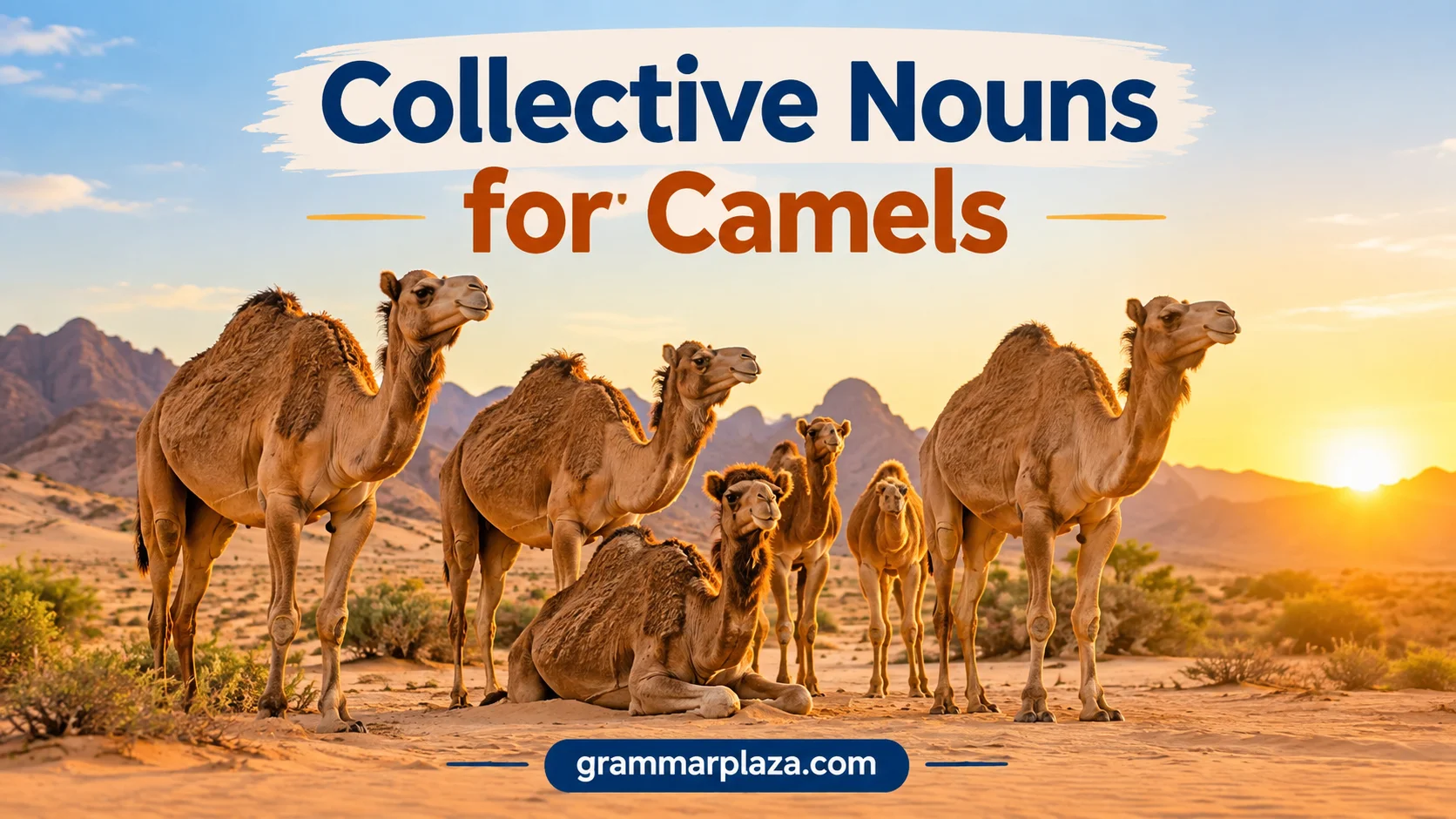
Collective Nouns for Camels help us understand the special words used to describe groups of camels. These social animals often travel in herds and are well adapted to harsh desert environments. A group of camels is commonly called a herd, while train is another term used for camels traveling together. Learning these terms makes English more precise and helps you describe animal groups naturally.
Camels are remarkable herbivores known for their endurance, strength, and ability to survive with little water. Their long legs help them cross sandy terrain, while their tough mouths allow them to eat thorny plants and other vegetation. They are also valuable pack animals, carrying heavy loads across difficult landscapes. Exploring their habitat, diet, behavior, and group names makes animal vocabulary both practical and fascinating.
What Are Collective Nouns and Why Do We Use Them?
A collective noun is a word used to describe a group of people, animals, or things as a single unit. Instead of saying “a group of camels,” English gives us more descriptive and often more poetic alternatives like “a herd of camels” or “a caravan of camels.”
Collective nouns exist for almost every animal species, and many of them tell us something meaningful about that animal’s behavior, history, or relationship with humans. In the case of camels, the collective nouns often reflect their long history as pack animals used for travel and trade across deserts. Understanding these terms doesn’t just improve vocabulary — it deepens our appreciation for how animals behave in groups and how language evolves to capture the natural world.
Below is a simple table summarizing the most common collective nouns used for camels, along with a simple example for each.
| Collective Noun | Simple Example |
| Herd | A herd of camels walked across the sand dunes. |
| Flock | A flock of camels gathered near the watering hole. |
| Caravan | A caravan of camels moved slowly through the desert. |
| Train | A train of camels carried supplies to the village. |
| Obstinacy | An obstinacy of camels stood still and refused to budge. |
Collective Nouns for Camels: Detailed Examples
Now let’s look at each collective noun in more detail, with 10 simple example sentences for each so you can see how they’re naturally used in everyday language.
Herd of Camels
“Herd” is the most commonly used collective noun for camels, just as it is for many other large mammals like cattle and elephants.
Examples:
- A herd of camels grazed peacefully near the oasis.
- The herd of camels moved together as the sun began to set.
- Farmers guided the herd of camels toward fresh grazing land.
- A large herd of camels gathered around the only water source for miles.
- Tourists watched the herd of camels cross the golden dunes.
- The herd of camels stayed close together during the sandstorm.
- Every morning, the herd of camels was led out to graze.
- The herder counted each camel in the herd before nightfall.
- A young calf stayed close to its mother within the herd of camels.
- The herd of camels rested in the shade during the hottest part of the day.
Flock of Camels
Although “flock” is more often associated with birds and sheep, it is also occasionally used to describe a group of camels.
Examples:
- A flock of camels wandered near the desert village.
- The flock of camels was guided by an experienced herder.
- Locals gathered to watch the flock of camels return home.
- The flock of camels moved quietly across the plain.
- A flock of camels rested beside the dry riverbed.
- The flock of camels grew larger after the spring births.
- Children ran alongside the flock of camels as it passed.
- The flock of camels was well cared for by the nomadic family.
- A flock of camels gathered under the few trees for shade.
- The flock of camels traveled slowly toward the market town.
Caravan of Camels
“Caravan” is one of the most iconic collective nouns for camels, historically linked to trade routes like the Silk Road, where camels carried goods across vast deserts.
Examples:
- A caravan of camels traveled across the Sahara Desert.
- Merchants once relied on a caravan of camels to transport silk and spices.
- The caravan of camels stopped to rest at an oasis.
- Ancient traders formed a caravan of camels to cross dangerous terrain.
- The caravan of camels carried heavy loads of goods and supplies.
- A long caravan of camels stretched across the horizon.
- The caravan of camels was guided by experienced desert travelers.
- Historical records describe caravans of camels crossing entire continents.
- The caravan of camels moved at night to avoid the extreme heat.
- Tourists today can still witness a caravan of camels moving through desert landscapes.
Train of Camels
A “train” of camels refers to camels tied together in a line, typically for the purpose of traveling or transporting goods.
Examples:
- A train of camels moved in a single line across the dunes.
- The train of camels was tied together with sturdy ropes.
- Traders formed a train of camels to carry goods efficiently.
- The train of camels followed a narrow desert path.
- A long train of camels made its way toward the trading post.
- The guide walked beside the train of camels to keep them steady.
- Each camel in the train carried a portion of the load.
- The train of camels moved slowly but steadily through the heat.
- Villagers watched the train of camels arrive with fresh supplies.
- The train of camels finally reached its destination after days of travel.
Obstinacy of Camels
This lesser-known but delightful collective noun reflects the camel’s famously stubborn reputation.
Examples:
- An obstinacy of camels refused to move despite the herder’s efforts.
- The obstinacy of camels stood firmly in place for hours.
- Even with gentle coaxing, the obstinacy of camels wouldn’t budge.
- The obstinacy of camels seemed unbothered by the rising heat.
- Travelers laughed at the obstinacy of camels blocking the path.
- The obstinacy of camels tested the patience of every handler.
- No amount of pulling could move the obstinacy of camels.
- The obstinacy of camels eventually gave in after a long rest.
- Locals joked about the obstinacy of camels during market day.
- The obstinacy of camels became a familiar sight near the village well.
Read More: Collective Nouns for Guinea Pigs
Interesting Facts About Camels
Camels are remarkable creatures with biological features that allow them to thrive in some of the most extreme environments on the planet. One of the most impressive aspects of camels is their longevity — camels can live between 40 and 50 years, making them one of the longer-living large mammals, especially considering the harsh desert climates they endure throughout their lives. Their physiology is equally astonishing. Contrary to popular belief, a camel’s hump does not store water but rather fat, which the animal can convert into energy and moisture when food is scarce. Camels also have thick eyelashes and the ability to close their nostrils, protecting their eyes and respiratory system from blowing sand during desert storms. Their broad, tough footpads allow them to walk comfortably across hot sand without sinking, a feature that has earned them the nickname “ships of the desert.” When it comes to diet, camels are highly adaptable herbivores, feeding on thorny plants, dry grasses, and shrubs that most other animals would avoid. They can also go for long periods — sometimes weeks — without drinking water, and when they finally do find a water source, they can consume an extraordinary amount in a very short time, rapidly rehydrating their bodies. These combined traits make camels one of nature’s most efficient survivors.
FAQs :
1. What is a group of camels called?
A group of camels is commonly called a herd. This term is widely used for camels living or traveling together.
2. What is the collective noun for camels?
The most common collective noun for camels is herd. Another term sometimes used is train, particularly for camels traveling together in a line.
3. Is “train” a collective noun for camels?
Yes, train can be used as a collective noun for a group of camels, especially when they are traveling together, often carrying people or goods.
4. Can a group of camels be called a herd?
Yes. Herd is a natural and widely understood term for a group of camels, particularly when they live, graze, or move together.
5. How many camels are usually in a herd?
The size of a camel herd can vary depending on the environment and purpose. Some herds may contain only a few animals, while others can include dozens of camels.
6. Why do camels travel in groups?
Camels are social animals, so traveling in groups can provide companionship and help them move safely through challenging environments. Herds may also make it easier to find food and water.
7. What do camels eat?
Camels are herbivores that eat grasses, leaves, seeds, shrubs, and other vegetation. Their tough mouths allow them to consume plants that many other animals cannot easily eat.
8. Where do camels live?
Camels are well adapted to arid and desert environments. They are found in regions of North Africa, the Middle East, and parts of Asia, as well as other areas where they have been introduced.
9. Why are camels called pack animals?
Camels are called pack animals because they can carry heavy loads over long distances. Their strength and endurance make them especially useful for transportation in dry and rugged regions.
10. What is the difference between a herd and a train of camels?
A herd generally describes camels living or moving together, while a train often refers to camels traveling together in a line, particularly when carrying loads or accompanying travelers.
Conclusion :
Learning the collective nouns for camels adds useful vocabulary to your English and helps you describe these fascinating animals accurately. Herd is the most common term, while train can describe camels traveling together. Understanding these expressions alongside camel behavior, habitat, diet, and role as pack animals makes your knowledge of animal vocabulary richer and more practical.














1 thought on “Collective Nouns for Camels”