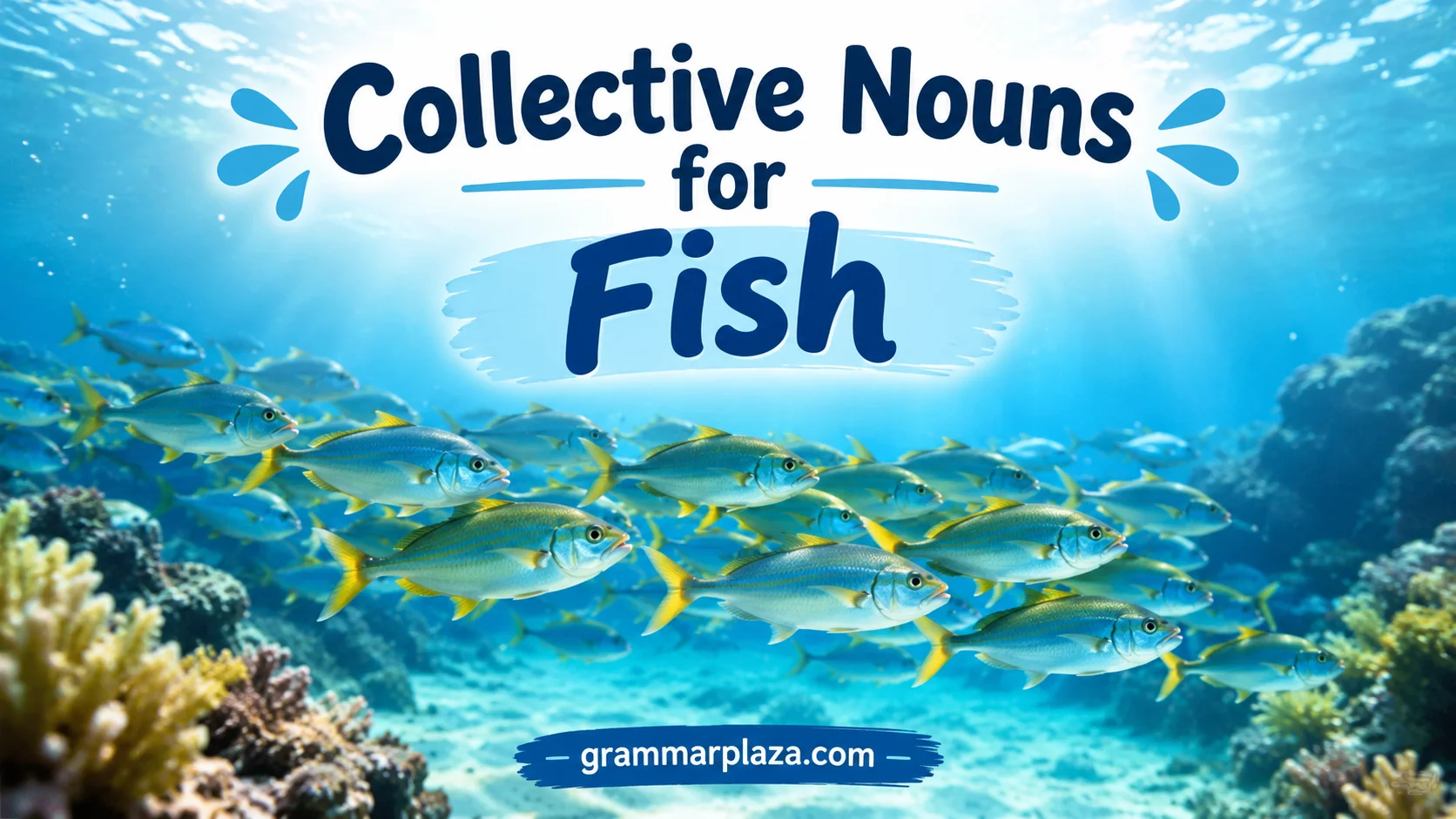
Explains collective nouns for fish, including school and shoal, and explores interesting names for sharks, stingrays, crabs, and turtles.
Collective nouns are special words that describe a group of people, animals, or things as a single unit. For fish, the common term is a school of fish, while a shoal of fish is another widely used expression. Some academics argue that school is incorrect in certain contexts and prefer shoal, although both terms appear in the English language and descriptive language. These specific terms, also known as group nouns or collective expressions, make descriptions more colorful, descriptive, and meaningful. Fascinating creatures, fish live, move, and survive in groups. Collective nouns for fish help us describe their social behavior, movement patterns, and natural habits when they are swimming together in oceans, rivers, or aquariums.
Different fish species and other sea animals have their own collective term, making a short list of names especially interesting. A group of sharks is called a shiver of sharks, while a group of rainbow fish may be called a party of rainbow fish. Other witty terms include a shoal of bass, a fever of stingrays, a cast of crabs, and a bale of turtles. These examples represent various marine animals, aquatic animals, and forms of aquatic life, including freshwater fish and creatures found in sea life, marine life, and ocean wildlife. When stingrays swim near a boat, crabs move along the shores, or turtles appear in the waters, the right terminology can make wildlife descriptions more vivid. Such animal groups also show how plural nouns and collective terminology add variety to writing about animal behavior.
Learning these words can improve English vocabulary and help people understand and appreciate the organized ways aquatic creatures interact with each other. For example, fishing mates who want to impress others with their knowledge while trying to catch fish can use these expressions in everyday conversation. A writer might describe fish that swim together, crabs that have played along a shore, or turtles that have appeared in shallow waters during fishing. These terms make sentences more precise. A simple table of common collective nouns can help readers compare various fish, different fish groups, and other forms of aquatic life. Choosing the correct expressions helps us describe life in the water clearly and accurately.
| Collective Noun Type | Simple Example |
| School | A school of fish moved through the clear water. |
| Shoal | A shoal of fish gathered near the coral reef. |
| Swarm | A swarm of tiny fish surrounded the boat. |
| Catch | A catch of fish was brought back by fishermen. |
| Run | A run of salmon traveled upstream. |
Collective Nouns for Fish with Examples
1. A School of Fish
A “school” is the most common collective noun for fish. It describes a group of fish swimming together in the same direction. Fish often form schools for protection, finding food, and traveling efficiently.
Example
- A school of fish swam gracefully near the ocean surface.
- The diver watched a school of fish moving around the coral reef.
- A school of fish quickly changed direction when a predator appeared.
- The children saw a school of fish during their aquarium visit.
- A school of fish passed beneath the boat in the blue water.
- The photographer captured a beautiful school of fish underwater.
- A school of fish searched for food among the sea plants.
- The ocean was filled with a colorful school of fish.
- A school of fish moved together like a single creature.
- The scientist studied how a school of fish communicated.
2. A Shoal of Fish
A “shoal” refers to a group of fish that stay together in the same area. Unlike a school, fish in a shoal may not always swim in a coordinated pattern.
Example
- A shoal of fish rested near the rocky shore.
- The fisherman noticed a shoal of fish in shallow water.
- A shoal of fish gathered around the underwater plants.
- The coral reef was home to a large shoal of fish.
- A shoal of fish moved slowly through the warm ocean water.
- The children enjoyed watching a shoal of fish in the aquarium.
- A shoal of fish provided shelter for smaller sea creatures.
- The diver discovered a colorful shoal of fish near the reef.
- A shoal of fish stayed close to the safety of the rocks.
- The ocean current carried a shoal of fish toward the bay.
3. A Swarm of Fish
A “swarm” is sometimes used for a large number of small fish moving together. It creates the image of many fish gathered closely in one place.
Example
- A swarm of fish surrounded the underwater cave.
- The diver saw a swarm of tiny fish near the coral.
- A swarm of fish moved quickly through the shallow water.
- The ocean looked alive with a swarm of colorful fish.
- A swarm of fish escaped when a larger fish approached.
- The researchers observed a swarm of fish near the coastline.
- A swarm of fish created beautiful patterns underwater.
- The boat passed above a swarm of fish in the sea.
- A swarm of fish gathered around a source of food.
- The photographer recorded a swarm of fish swimming together.
4. A Catch of Fish
A “catch” refers to a group of fish caught by fishermen. It is commonly used when talking about fishing activities and the amount of fish collected.
Example
- The fishermen returned with a large catch of fish.
- The catch of fish was sold at the local market.
- The captain was proud of his successful catch of fish.
- The village celebrated after a good catch of fish.
- The fishermen counted their catch of fish carefully.
- A small catch of fish was enough for the family dinner.
- The boat carried a fresh catch of fish to the shore.
- The fishermen shared their catch of fish with the community.
- The market received a daily catch of fish from the harbor.
- The team worked together to bring in a large catch of fish.
5. A Run of Fish
A “run” is used for fish that travel together during migration, especially species like salmon that return to rivers to lay eggs.
Example
- A run of salmon traveled upstream during migration.
- The researchers tracked a run of fish moving toward the river.
- A run of fish arrived during the breeding season.
- The fishermen waited for the annual run of salmon.
- A run of fish crossed the river after a long journey.
- The wildlife experts studied the behavior of a run of fish.
- A run of fish returned to their birthplace to reproduce.
- The river became crowded during the yearly run of fish.
- A run of fish showed the amazing migration skills of aquatic animals.
- The conservation team protected the run of fish during their journey.
Interesting Facts About Fish
Fish are among the oldest living creatures on Earth, with some species existing for hundreds of millions of years. Certain fish can live for an exceptionally long time, such as some rockfish that may survive for more than 100 years. The Greenland shark, although not a typical bony fish, is one of the longest-living marine animals and can live for several centuries.
Fish have unique physical features that help them survive underwater. Most fish breathe through gills, which allow them to take oxygen from water. Many fish have streamlined bodies that help them swim efficiently, while some species can change colors to hide from predators or communicate with others. Some fish also have special abilities, such as producing electricity or sensing movements through their surroundings.
Fish have a wide variety of diets depending on their species. Some fish eat plants and algae, while others feed on insects, smaller fish, or tiny organisms called plankton. Their feeding habits help maintain balance in aquatic ecosystems. From tiny reef fish to giant ocean species, fish play an important role in maintaining healthy water environments around the world.
Frequently Asked Questions About Collective Nouns for Fish
1. What is the most common collective noun for fish?
The most common collective noun for fish is “school.” It describes a group of fish swimming together in an organized way.
2. What is the difference between a school and a shoal of fish?
A school of fish usually swims together in a coordinated pattern, while a shoal refers to fish that gather together but may not move in a synchronized way.
3. Can “swarm” be used for fish?
Yes, “swarm” can describe a large group of small fish moving closely together, although it is less common than “school” or “shoal.”
4. Why do fish swim in groups?
Fish swim in groups for protection from predators, easier searching for food, and more efficient movement through water.
5. Are collective nouns for fish used in everyday English?
Yes, terms like “school of fish” and “catch of fish” are commonly used in conversations, books, and wildlife descriptions.
Conclusion
Understanding collective nouns for fish helps us describe these amazing creatures more accurately and appreciate their social behaviors. Words like “school,” “shoal,” “swarm,” “catch,” and “run” show how fish interact, travel, and survive in different environments.
Beyond language, learning about fish reveals their incredible biological traits, from their unique breathing systems to their long lifespans and diverse diets. Collective nouns connect the beauty of the English language with the fascinating world of wildlife, helping us better understand and admire the creatures that live beneath the water.