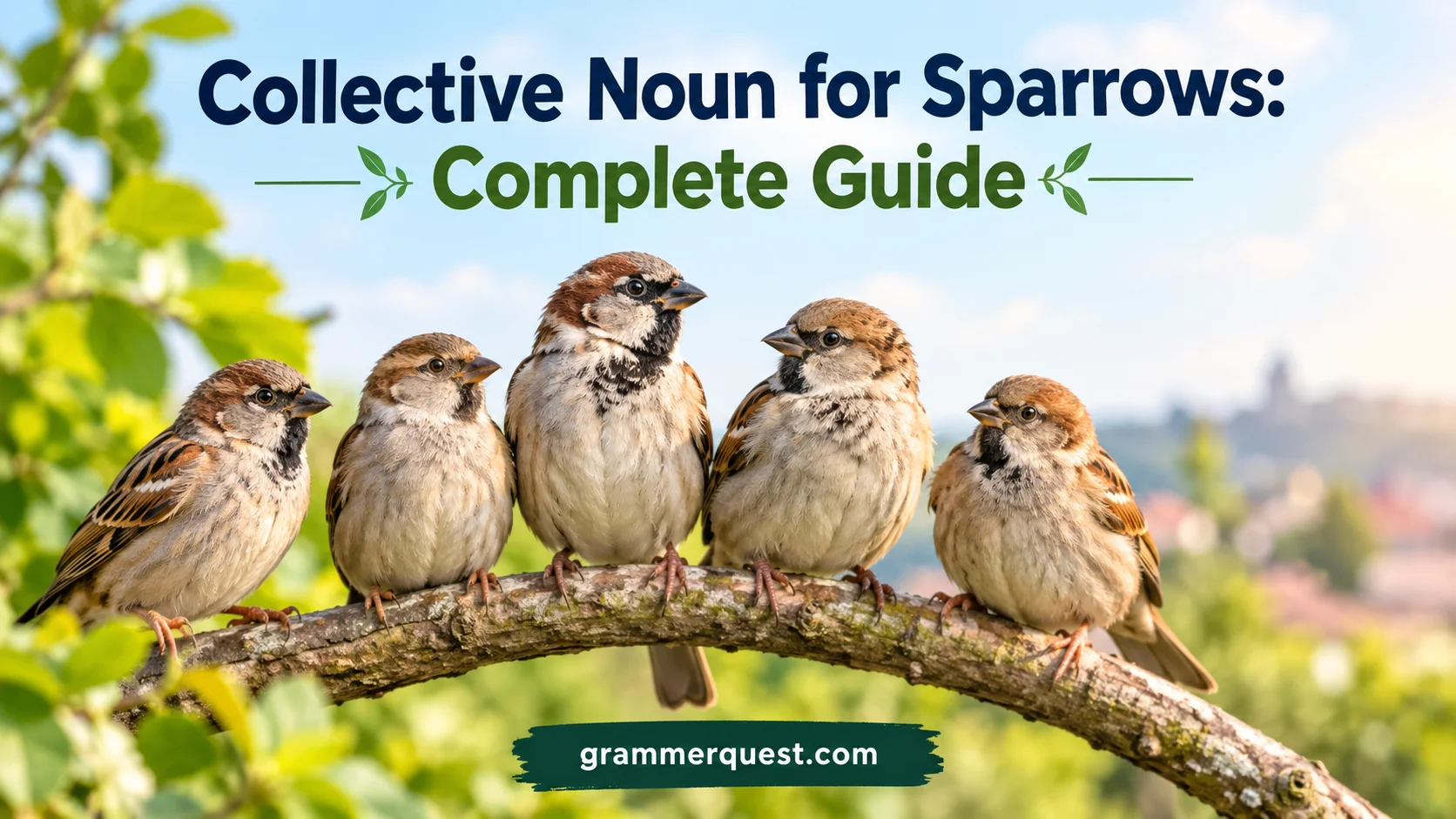
The collective-noun-for-sparrows is a useful English term for describing a group of sparrows clearly in writing and speaking with greater confidence. When I look at the animal kingdom, one of the remarkable things about the English language is its variety of collective nouns. For English learners, these nouns provide specific names for groups of birds, helping make writing and speaking more natural. A collective noun describes a group, and host is the commonly recognized term for sparrows. This formal word can describe a large number of sparrows or birds gathered in one place. From my experience with English vocabulary, learning these collective terms helps language learners describe birds correctly, rather than choosing the wrong word and making unnatural, unclear sentences.
Sparrows forage and fly in flocks, particularly during migration when abundant food sources are available. Their foraging, flying, and movement make host a fitting term for a group of sparrows. When birds gathered around a food source, their large number of birds could be easy to notice. These social birds display active behavior and constant communication, often becoming noisy birds near a hedge. Quarrel is another term sometimes connected with a group of sparrows, reflecting their noisy and social behavior as little birds. This tradition contributes to the variety of bird terminology, where familiar, well known, and not so well known expressions can appear in a comprehensive list of collective nouns for birds.
For learners, this concept makes collective grouping an interesting part of English. A list of bird groups can contain collective nouns for birds, collective terms, and expressions linked with behavior, bird movement, and bird traditions. Some terms are known, while others are uncommon or less familiar. Learning these names, groups, and examples supports vocabulary building, writing skills, and speaking skills, giving learners greater confidence. Students studying the animal kingdom, preparing an article, or exploring 50+ terms can see how language connects groups of birds with their habits and history.
Collective Nouns for Sparrows: Types and Simple Examples
The following table gives a quick overview of useful collective nouns associated with sparrows.
| Collective Noun | Simple Example |
| Host | A host of sparrows gathered near the tree. |
| Flock | A flock of sparrows flew over the garden. |
| Quarrel | A quarrel of sparrows chirped noisily near the feeder. |
| Tribe | A tribe of sparrows rested in the bushes. |
| Ubiquity | An ubiquity of sparrows filled the village with song. |
Host is one of the traditional terms associated with sparrows and suggests a large gathering. Flock is the clearest and most familiar term for everyday English. Other expressions, such as quarrel, tribe, and ubiquity, appear in traditional lists of bird collective nouns and can add a literary or descriptive touch.
Host, Flock, and Quarrel of Sparrows
Host of Sparrows
A host of sparrows describes a large gathering of sparrows. The word “host” gives the impression of many birds assembled together and is especially useful in descriptive or literary writing.
Examples of “Host of Sparrows”
- A host of sparrows gathered near the old tree.
- We saw a host of sparrows in the garden.
- A host of sparrows flew across the blue sky.
- The host of sparrows searched for seeds.
- A host of sparrows rested on the roof.
- The farmer noticed a host of sparrows near the field.
- A host of sparrows rose from the grass.
- The host of sparrows returned before sunset.
- A host of sparrows gathered around the feeder.
- We watched a host of sparrows move between the trees.
Flock of Sparrows
A flock of sparrows is one of the simplest and most natural ways to describe several sparrows together. Sparrows frequently feed and move in groups, making “flock” especially suitable for everyday descriptions.
Examples of “Flock of Sparrows”
- A flock of sparrows flew over the garden.
- We watched a flock of sparrows in the trees.
- A flock of sparrows gathered near the feeder.
- The flock of sparrows searched for food.
- A large flock of sparrows crossed the field.
- The flock of sparrows rested on the fence.
- A flock of sparrows suddenly flew into the air.
- The children watched a flock of sparrows outside.
- A flock of sparrows landed near the bushes.
- The flock of sparrows returned to the garden.
Quarrel of Sparrows
A quarrel of sparrows is a colorful traditional expression. It is particularly fitting when several sparrows are noisy, competing over food, or squabbling with one another. Traditional sources list “quarrel” among collective nouns for sparrows.
Examples of “Quarrel of Sparrows”
- A quarrel of sparrows chirped near the feeder.
- We heard a quarrel of sparrows in the bushes.
- A quarrel of sparrows gathered around the seeds.
- The quarrel of sparrows became very noisy.
- A quarrel of sparrows moved between the branches.
- We watched a quarrel of sparrows near the garden.
- The quarrel of sparrows scattered when the cat appeared.
- A quarrel of sparrows competed for crumbs.
- The children heard a quarrel of sparrows outside.
- A quarrel of sparrows filled the tree with sound.
Tribe and Ubiquity of Sparrows
Tribe of Sparrows
A tribe of sparrows is another traditional collective expression. The word “tribe” can suggest a close-knit community and works particularly well in descriptive writing about social groups of birds. Traditional collective-noun lists include “tribe” for sparrows.
Examples of “Tribe of Sparrows”
- A tribe of sparrows gathered in the garden.
- We saw a tribe of sparrows near the trees.
- A tribe of sparrows flew across the field.
- The tribe of sparrows searched for seeds.
- A tribe of sparrows rested on the branches.
- The farmer watched a tribe of sparrows near the crops.
- A tribe of sparrows gathered before sunset.
- The tribe of sparrows moved toward the feeder.
- A tribe of sparrows flew away together.
- We noticed a tribe of sparrows near the old building.
Ubiquity of Sparrows
An ubiquity of sparrows is a less familiar and more unusual traditional expression. “Ubiquity” means being present in many places, so the expression can create an interesting image of sparrows appearing everywhere. It is best suited to creative, literary, or educational writing rather than ordinary conversation. Traditional sources list “ubiquity” among sparrow collective nouns.
Examples of “Ubiquity of Sparrows”
- An ubiquity of sparrows filled the village.
- We noticed an ubiquity of sparrows around the town.
- An ubiquity of sparrows gathered near the market.
- The ubiquity of sparrows made the garden lively.
- An ubiquity of sparrows appeared around the buildings.
- We watched an ubiquity of sparrows searching for food.
- An ubiquity of sparrows could be seen at sunrise.
- The village was surrounded by an ubiquity of sparrows.
- An ubiquity of sparrows moved between the rooftops.
- The ubiquity of sparrows made their presence impossible to miss.
Interesting Facts About Sparrows
Sparrows are small but remarkably adaptable birds. The House Sparrow (Passer domesticus) is strongly associated with people and buildings and has successfully established populations across much of the world. Its average lifespan is often around three years in the wild, although individual birds can live much longer; a ringed House Sparrow has been recorded at more than 15 years old.
Their physiology also reflects their active lifestyle. House Sparrows are small birds with compact bodies, short wings, and strong, chunky bills suited to cracking seeds. Their typical body weight is around 27 grams, while adults have wing lengths of roughly 77 millimetres on average. Males and females also differ in appearance, with males developing distinctive dark markings.
Sparrows are flexible feeders. House Sparrows eat mostly seeds and grains, but they also consume insects, especially during the breeding season when insects are important for growing young. In towns and cities, they readily take advantage of discarded human food and bird feeders.
Another fascinating feature is their social behavior. House Sparrows often feed in groups, nest relatively close to one another, and communicate through a variety of calls and displays. They even have social dominance patterns within flocks, with physical characteristics such as the amount of black on a male’s throat associated with status.
Sparrows also have an unusual way of keeping their feathers clean: they frequently take dust baths, throwing dust over their bodies in a motion similar to bathing in water. This behavior is another example of how such a familiar little bird has surprisingly interesting biological traits.
Conclusion
The collective-noun-for-sparrows is an interesting part of English vocabulary. Host is a recognized collective term for a group of sparrows, while quarrel can also be used to describe them. Learning these terms helps English learners improve their writing, speaking, and understanding of bird-related vocabulary.
FAQs
1. What is the collective noun for sparrows?
The most recognized collective noun for sparrows is host. It refers to a group of sparrows gathered together.
2. Can “quarrel” be used for a group of sparrows?
Yes, quarrel is another term sometimes used for a group of sparrows. It relates to their lively and noisy communication.
3. Why are collective nouns used for sparrows?
Collective nouns provide specific words for describing groups of birds. They make sentences more precise, natural, and interesting.
4. Do sparrows usually live in groups?
Sparrows are social birds and may gather in groups, especially when foraging, feeding, migrating, or searching for suitable food sources.
5. What are the main collective nouns for sparrows?
Host is the best-known term, while quarrel is another expression associated with a group of sparrows.