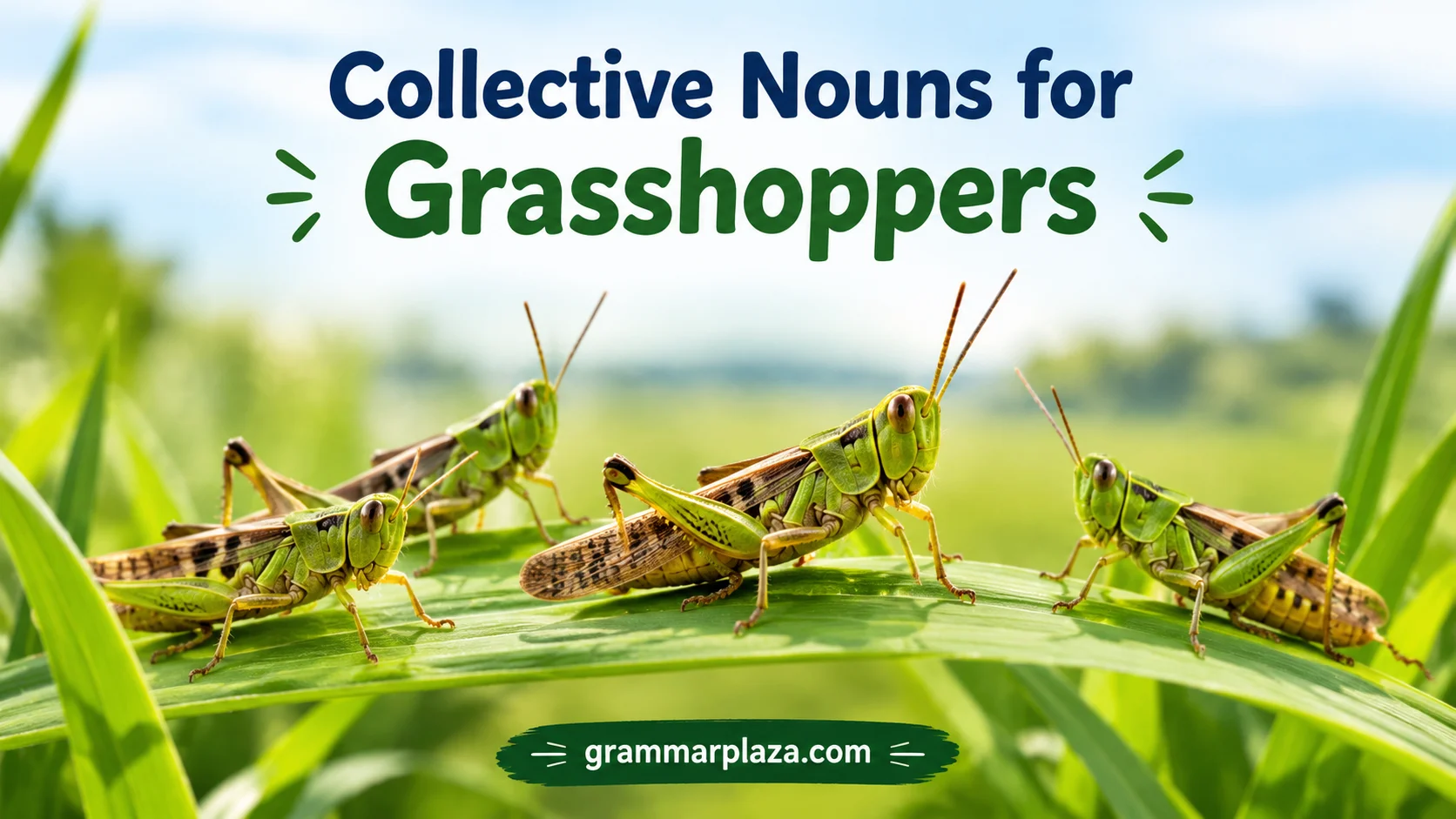
Collective Nouns for Grasshoppers help describe lively insects in groups, using familiar terms that make English writing clearer and more precise. These special words describe groups of people, animals, or things as one unit. In everyday English use, swarm, cloud, plague, and horde can describe many insects gathered together or moving together. The best choice depends on the situation and the intended meaning. These common terms make writing more vivid, accurate, and easy to understand, offering writers, students, and speakers a creative way to describe groups of animals. From my experience with educational writing, using familiar words alongside unusual expressions helps readers understand new vocabulary.
Grasshoppers are fascinating insects recognized for their powerful jumping ability and strong legs. They gather in fields, grassland, gardens, crops, and other open spaces, sometimes appearing in large numbers during migration or feeding. Their behavior, movement patterns, natural habits, and feeding behavior help explain why terms such as swarm and cloud can describe insect groups. Different collective nouns also appear in storytelling, observation, and discussions of wildlife. Learning these terms improves vocabulary and helps readers understand animal behavior, insect movement, and insect movement patterns.
Some collective nouns for animals are unusual words connected with old traditions, medieval lists, and hunting terms. These special group names, including flock, herd, and pack, are familiar examples, but they are not all specific collective nouns for grasshoppers. Reference lists can be especially useful when describing animals, although not every term is widely used today. For precise, natural English vocabulary, readers should distinguish established expressions from colorful terms that may be traditional or descriptive. This approach makes descriptive language clearer and helps explain collective terminology without suggesting that every expression is an equally common name for a group of grasshoppers.
Common Collective Nouns for Grasshoppers
The most common collective nouns used for grasshoppers include cloud, cluster, swarm, plague, and locust swarm. Some terms describe ordinary groups, while others are connected with large gatherings of grasshoppers that can affect crops and ecosystems.
| Collective Noun Type | Simple Example |
| Cloud | A cloud of grasshoppers moved across the field. |
| Cluster | A cluster of grasshoppers rested on a plant. |
| Swarm | A swarm of grasshoppers flew over the grassland. |
| Plague | A plague of grasshoppers damaged the crops. |
| Locust swarm | A locust swarm covered the sky during migration. |
Collective Nouns for Grasshoppers with Examples
1. A Cloud of Grasshoppers
A cloud is one of the most commonly used collective nouns for grasshoppers. It describes a large group flying together, often creating the appearance of a moving cloud in the sky.
Examples
- A cloud of grasshoppers flew above the green field.
- The farmers watched a cloud of grasshoppers moving toward their crops.
- A cloud of grasshoppers covered the sky during the summer season.
- The children saw a cloud of grasshoppers near the village.
- A cloud of grasshoppers jumped across the open land.
- The wind carried a cloud of grasshoppers over the hills.
- A cloud of grasshoppers settled on the tall grass.
- The farmer noticed a cloud of grasshoppers approaching his farm.
- A cloud of grasshoppers moved together in search of food.
- The sky became dark when a cloud of grasshoppers passed overhead.
2. A Cluster of Grasshoppers
A cluster refers to a smaller group of grasshoppers gathered together in one place. They may gather on plants, rocks, or grass while resting or feeding.
Examples
- A cluster of grasshoppers sat on a green leaf.
- The child discovered a cluster of grasshoppers near the garden.
- A cluster of grasshoppers rested under the sunlight.
- The grass was filled with a cluster of grasshoppers.
- A cluster of grasshoppers moved from one plant to another.
- The scientist studied a cluster of grasshoppers in the field.
- A cluster of grasshoppers gathered near the water source.
- The farmer noticed a cluster of grasshoppers eating plants.
- A cluster of grasshoppers disappeared into the tall grass.
- The garden became home to a cluster of grasshoppers.
3. A Swarm of Grasshoppers
A swarm describes a large number of grasshoppers moving together. This term is often used when grasshoppers travel, especially during migration.
Examples
- A swarm of grasshoppers crossed the countryside.
- The villagers saw a swarm of grasshoppers flying nearby.
- A swarm of grasshoppers moved quickly across the farmland.
- The swarm of grasshoppers covered many plants.
- A swarm of grasshoppers traveled in search of fresh food.
- The farmers protected their crops from a swarm of grasshoppers.
- A swarm of grasshoppers filled the air above the fields.
- The researchers observed a swarm of grasshoppers during migration.
- A swarm of grasshoppers landed on the grassland.
- The large swarm of grasshoppers attracted attention from locals.
4. A Plague of Grasshoppers
A plague is used when a very large group of grasshoppers causes damage, especially to crops. It is commonly associated with destructive grasshopper outbreaks.
Examples
- A plague of grasshoppers destroyed many crops.
- Farmers struggled when a plague of grasshoppers arrived.
- The village prepared for a possible plague of grasshoppers.
- A plague of grasshoppers damaged the fields quickly.
- The farmers used special methods to control the plague of grasshoppers.
- A plague of grasshoppers affected food production in the area.
- The news reported a plague of grasshoppers near farmland.
- A plague of grasshoppers consumed many green plants.
- The community worked together after the plague of grasshoppers appeared.
- A plague of grasshoppers can create challenges for farmers.
5. A Locust Swarm of Grasshoppers
A locust swarm refers to a huge group of locusts, which are a type of grasshopper that can change behavior and form massive groups. This term is used when grasshoppers gather in enormous numbers.
Examples
- A locust swarm covered the fields during migration.
- The farmers watched a locust swarm moving across the land.
- A locust swarm searched for plants to eat.
- The sky became dark because of a locust swarm.
- A locust swarm traveled long distances for food.
- The scientists studied how a locust swarm forms.
- A locust swarm affected crops in many areas.
- The village prepared when a locust swarm approached.
- A locust swarm showed the powerful movement of insects.
- The farmers monitored the movement of a locust swarm carefully.
Interesting Facts About Grasshoppers
Grasshoppers are among the most successful insects on Earth and can be found in grasslands, forests, deserts, and agricultural areas. Their lifespan is usually around several months, although some species may survive longer depending on environmental conditions. Grasshoppers have powerful hind legs that allow them to jump many times their body length, helping them escape predators and move quickly through their habitats. They breathe through a network of tiny tubes called tracheae, which deliver oxygen directly to their bodies. Grasshoppers mainly eat plants, including grasses, leaves, and crops, making them important parts of many ecosystems. While most grasshoppers live alone, some species, such as locusts, can gather into enormous groups and travel together when conditions are suitable.
Frequently Asked Questions (FAQs)
1. What is the collective noun for grasshoppers?
The common collective nouns for grasshoppers include cloud, cluster, swarm, plague, and locust swarm.
2. What is the most common collective noun used for grasshoppers?
A cloud of grasshoppers is one of the most commonly used terms, especially when many grasshoppers are flying together.
3. Why are grasshopper groups called a swarm?
Grasshoppers are called a swarm when they gather and move together in large numbers, especially during migration.
4. Are all groups of grasshoppers harmful?
No, small groups of grasshoppers are usually harmless. Large groups, especially locust swarms, can damage crops.
5. How do collective nouns help us understand grasshoppers?
Collective nouns describe how grasshoppers gather and move, helping us better understand their behavior and role in nature.
Conclusion
Understanding collective nouns for grasshoppers adds creativity and accuracy to the English language while helping us appreciate these remarkable insects. Words like cloud, cluster, swarm, plague, and locust swarm describe different ways grasshoppers gather and move. Beyond language, learning about grasshoppers reveals their unique abilities, survival skills, feeding habits, and importance in ecosystems. By exploring both their names and natural behaviors, we gain a deeper appreciation for the fascinating world of insects.