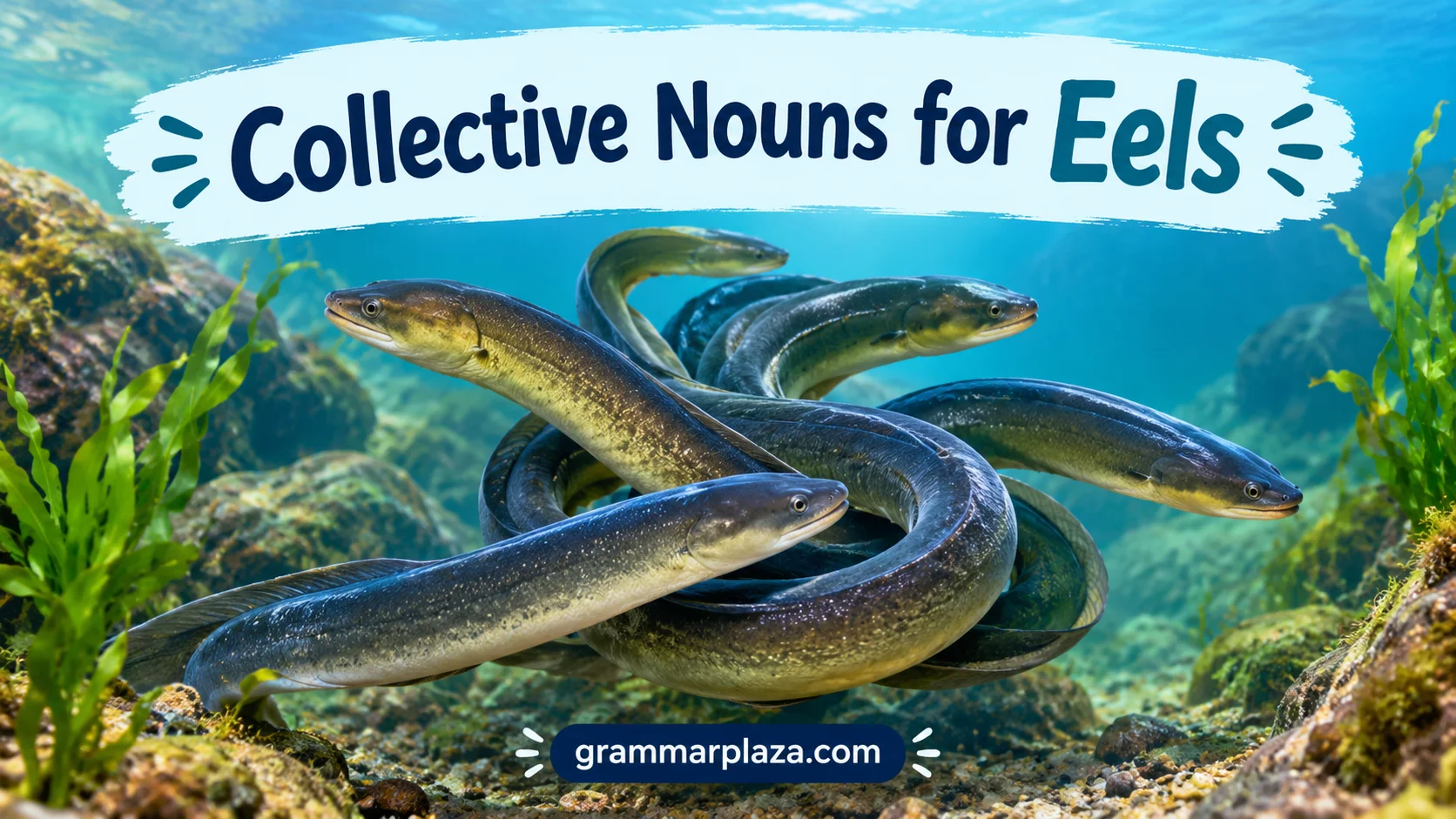
Collective Nouns for Eels help readers describe groups of these fascinating aquatic animals with clear, simple English.
Eels are fascinating aquatic animals known for their long bodies, snake-like bodies, and mysterious lifestyles. Although many people recognize eels because of their unusual appearance, they may not know how to describe groups of eels using special collective nouns. These terms make the English language more colorful and help writers describe animal groups accurately. Collective nouns are words used to describe a collection of people, animals, or objects as a single unit. Instead of writing many eels, a specific collective noun can add interest, precision, and variety to your writing.
Some animal group names are widely recognized, while others are less common and depend on context. These expressions contribute to more descriptive language and deepen our understanding of animal terminology. This guide to common collective nouns for eels introduces simple examples and interesting facts about these remarkable fish. It connects English vocabulary and group descriptions with collective terms, eel behavior, and different fish species. From my experience working with animal vocabulary, the clearest approach is to explain how a term is used instead of claiming that every animal has a universally accepted group name. This approach helps readers explore aquatic life while using English naturally.
Collective Nouns for Eels
The table below introduces the most commonly used collective nouns for eels.
| Collective Noun | Used For | Simple Example |
| Bed | A group of eels resting together | A bed of eels rested on the riverbed. |
| Swarm | A large moving group of eels | A swarm of eels swam through the water. |
| School | A group of eels swimming together | A school of eels crossed the lagoon. |
| Congregation | A gathering of eels | A congregation of eels gathered near the rocks. |
| Cluster | A closely packed group of eels | A cluster of eels hid beneath the logs. |
Bed of Eels
A bed of eels usually refers to a group of eels lying together on the bottom of a river, lake, or ocean. Since many eel species spend time hiding in mud, sand, or rocky crevices, this collective noun suits their resting behavior.
Example
- A bed of eels rested quietly beneath the rocks.
- We spotted a bed of eels near the riverbank.
- The diver carefully observed a bed of eels.
- A bed of eels hid beneath the sandy floor.
- Fishermen avoided disturbing the bed of eels.
- The bed of eels remained still all afternoon.
- Scientists studied a bed of eels in the lagoon.
- A bed of eels blended into the muddy bottom.
- The children learned about a bed of eels during class.
- A bed of eels disappeared as the tide changed.
Swarm of Eels
A swarm of eels describes a large number of eels moving together, especially during migration or feeding. This term emphasizes their active movement.
Example
- A swarm of eels moved through the river.
- We watched a swarm of eels swim downstream.
- A swarm of eels gathered near the shore.
- The fisherman noticed a swarm of eels after sunset.
- A swarm of eels disappeared into deeper water.
- The camera captured a swarm of eels in motion.
- A swarm of eels searched for food together.
- Divers admired a swarm of eels underwater.
- A swarm of eels crossed the shallow channel.
- The swarm of eels quickly vanished into the sea.
School of Eels
Although “school” is more commonly used for fish, it can also describe eels swimming together, particularly young eels.
Example
- A school of eels swam beside the reef.
- We observed a school of eels in the estuary.
- A school of eels followed the ocean current.
- The school of eels moved gracefully.
- A school of eels entered the freshwater stream.
- The guide pointed to a school of eels.
- A school of eels avoided the larger fish.
- Scientists tracked a school of eels during migration.
- A school of eels passed beneath the boat.
- The school of eels disappeared into deeper water.
Congregation of Eels
A congregation of eels refers to a gathering of eels in one place, often during migration, feeding, or sheltering.
Example
- A congregation of eels gathered near the rocks.
- We found a congregation of eels under the bridge.
- A congregation of eels stayed close together.
- The diver photographed a congregation of eels.
- A congregation of eels rested beneath seaweed.
- The river contained a congregation of eels.
- Researchers monitored a congregation of eels.
- A congregation of eels slowly entered the cave.
- The congregation of eels scattered when disturbed.
- Everyone admired the congregation of eels.
Cluster of Eels
A cluster of eels refers to several eels packed closely together, usually while hiding or resting.
Example
- A cluster of eels hid beneath the logs.
- We noticed a cluster of eels near the shore.
- The cluster of eels stayed hidden in the mud.
- A cluster of eels rested under the rocks.
- Scientists found a cluster of eels in the cave.
- The cluster of eels remained motionless.
- A cluster of eels avoided the bright sunlight.
- The fisherman discovered a cluster of eels.
- A cluster of eels slowly emerged at night.
- The cluster of eels disappeared into the sand.
Interesting Facts About Eels
Eels are among the most mysterious fish in the world. Many species have surprisingly long lifespans, with some freshwater eels living for 20 to 50 years under favorable conditions. Their lengthy lives allow them to complete incredible migrations between freshwater rivers and the open ocean.
One of the most remarkable features of eels is their elongated, flexible body covered with a smooth layer of mucus. This slippery coating helps protect their skin and allows them to move easily through narrow spaces, mud, and underwater crevices. Unlike many fish, eels can even survive for short periods out of water if their skin remains moist, as they are capable of absorbing some oxygen through their skin.
Eels are carnivorous and have a varied diet depending on their species and habitat. They commonly feed on insects, worms, shrimp, crabs, mollusks, small fish, frogs, and other aquatic animals. Most eels hunt at night, using their excellent sense of smell to locate prey in dark or murky waters.
Perhaps the most amazing fact about eels is their migration. Species such as the European eel and American eel travel thousands of miles to the Sargasso Sea to spawn. After hatching, their young begin an extraordinary journey back toward rivers and coastal waters, completing one of nature’s most impressive migrations.
Why Learn Collective Nouns for Eels?
Learning collective nouns for eels makes your vocabulary richer and improves your understanding of descriptive English. These terms are useful in writing, storytelling, education, and wildlife discussions. They also encourage people to appreciate the unique behaviors and habitats of these remarkable fish while making communication more engaging.
Frequently Asked Questions (FAQs)
1. What is the most common collective noun for eels?
The most common collective nouns are bed of eels, school of eels, swarm of eels, congregation of eels, and cluster of eels.
2. Why is a group of eels called a bed?
The term bed reflects the habit of many eels resting together on riverbeds, ocean floors, or muddy bottoms.
3. Do eels always live in groups?
No. Many eels spend much of their lives alone, but they may gather during migration, feeding, or in suitable hiding places.
4. How long can eels live?
Depending on the species, eels can live anywhere from 10 to over 50 years, with some freshwater species reaching exceptional ages.
5. What do eels eat?
Eels mainly eat insects, worms, crustaceans, mollusks, frogs, and small fish. Most species hunt during the night.
Conclusion
Collective nouns bring life and variety to the English language, making descriptions of animals more vivid and memorable. Terms such as bed, swarm, school, congregation, and cluster help describe groups of eels in different situations while enriching both spoken and written communication. Beyond their unique group names, eels are extraordinary creatures known for their long lifespans, flexible bodies, remarkable migrations, and diverse diets. Understanding both their collective nouns and their biology deepens our appreciation for these mysterious fish and the fascinating natural world they inhabit.