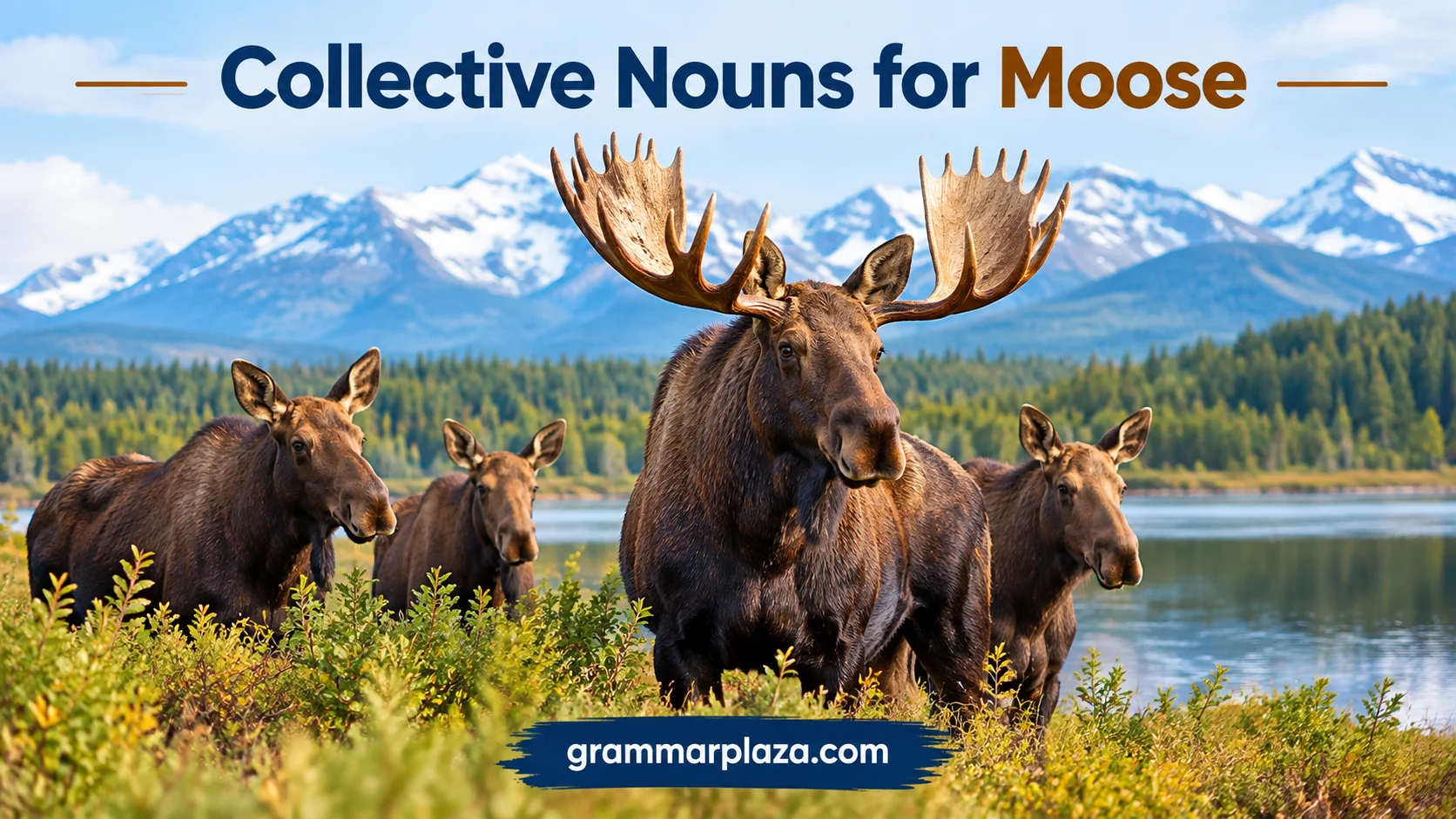
Collective Nouns for Moose help you describe a group of these large animals with the right and most commonly used terms. If you see several moose together, you may wonder whether to call them a herd, gang, or simply a group. Learning these special collective nouns can make your English vocabulary more interesting while helping you describe animals naturally and accurately. These terms also show how language gives groups of animals unique and memorable names.
Collective nouns are words used to describe groups of people, animals, or things as a single unit. Many animal group names have interesting connections to history, hunting traditions, poetry, and imagination. Some are familiar, such as a pride of lions or an army of ants, while others are unusual and less widely known. Exploring the collective nouns associated with moose gives you a simple way to expand your animal vocabulary and discover fascinating examples of English usage.
What Are Collective Nouns?
A collective noun is a word that refers to a group of people, animals, or things as one unit. Instead of saying “a group of moose,” English sometimes uses a special collective noun to describe them.
Collective nouns make writing and speaking more interesting while providing a richer understanding of language. They are commonly used in books, wildlife documentaries, and educational materials.
For example:
- A herd of moose
- A gang of moose
- A team of moose
Although herd is the most common and widely accepted term, several other collective nouns are occasionally used.
Collective Nouns for Moose
| Collective Noun | Type | Simple Example |
| Herd | Most common | A herd of moose crossed the river. |
| Gang | Less common | A gang of moose stood near the trees. |
| Team | Informal | A team of moose walked through the forest. |
| Group | General term | A group of moose rested in the meadow. |
| Gathering | Descriptive | A gathering of moose drank from the lake. |
Herd of Moose
A herd is the most widely accepted and commonly used collective noun for moose. Although moose are generally solitary animals, they sometimes gather in small groups during winter or around food sources.
Examples
- A herd of moose crossed the snowy field.
- We spotted a herd of moose near the lake.
- The herd of moose moved quietly through the forest.
- A herd of moose searched for food together.
- The herd rested beside the river.
- Rangers observed a herd of moose at sunrise.
- A herd of moose wandered across the valley.
- The herd disappeared into the woods.
- We photographed a herd of moose from a distance.
- A herd of moose enjoyed the cool morning.
Gang of Moose
The word gang is an uncommon but recognized collective noun for moose. It is mainly used in creative writing or informal conversations.
Examples
- A gang of moose stood beside the pond.
- We watched a gang of moose eating leaves.
- The gang of moose slowly crossed the trail.
- A gang of moose rested under the tall trees.
- The gang wandered through the forest.
- A gang of moose surprised the hikers.
- We saw a gang of moose near the marsh.
- The gang moved together across the meadow.
- A gang of moose explored the open field.
- The gang disappeared behind the hills.
Team of Moose
A team of moose is an informal expression that is occasionally used to describe several moose together. It is not as common as herd, but it appears in some educational and creative contexts.
Examples
- A team of moose walked through the forest.
- We noticed a team of moose near the river.
- The team of moose searched for fresh plants.
- A team of moose stood quietly in the snow.
- Rangers observed a team of moose at dawn.
- The team crossed the shallow stream.
- A team of moose rested among the trees.
- The team moved slowly across the valley.
- We photographed a team of moose from afar.
- A team of moose disappeared into the woods.
Group and Gathering of Moose
Sometimes people simply use general descriptive words like group or gathering when talking about multiple moose. These terms are easy to understand and perfectly acceptable in everyday English.
Examples
- A group of moose stood near the lake.
- We found a group of moose in the forest.
- The group moved slowly together.
- A group of moose searched for food.
- The group crossed the road carefully.
- We admired the group from a safe distance.
- The group rested beside the stream.
- A group of moose wandered into the valley.
- The group remained calm all afternoon.
- A group of moose disappeared behind the trees.
Read This: Collective Nouns for Unicorns
Interesting Facts About Moose
Moose are remarkable animals known for their enormous size and unique adaptations. They are the largest members of the deer family and can live 15 to 25 years in the wild under favorable conditions. Male moose, called bulls, grow massive antlers every year that can span more than six feet across before being shed during winter and regrown the following year. Their long legs help them travel through deep snow, wetlands, and rough forest terrain with ease. Moose are also excellent swimmers and can dive underwater to feed on aquatic plants. As herbivores, their diet mainly consists of leaves, twigs, bark, shrubs, grasses, and water vegetation, changing with the seasons. Despite their enormous size, moose are usually solitary and peaceful animals, gathering mainly during breeding season or where food is plentiful.
Faqs :
1. What is the collective noun for moose?
The most common collective nouns for moose are herd, gang, and group. A herd of moose is a natural and widely understood way to describe several moose together.
2. What do you call a group of moose?
A group of moose can be called a herd of moose. You may also hear gang of moose or simply group of moose in general usage.
3. Is “herd of moose” correct?
Yes, herd of moose is correct. The word herd is commonly used for groups of large animals, including moose.
4. Is “gang of moose” a collective noun?
Yes, gang can be used as a collective noun for moose. However, herd is the more familiar term for everyday descriptions.
5. What is the plural of moose?
The plural of moose is also moose. You say “one moose” and “five moose,” not “five mooses.”
6. Can I say “a group of moose”?
Yes. A group of moose is grammatically correct and easy to understand. It is a general expression rather than a particularly distinctive animal collective noun.
7. Why are animal collective nouns interesting?
Animal collective nouns are interesting because many have developed through history, hunting traditions, poetry, and creative language. Some names are simple, while others are surprisingly unusual.
8. How do you use “herd of moose” in a sentence?
You can say, “We saw a herd of moose near the forest.” Here, herd identifies the moose as a group.
9. Are collective nouns for moose officially fixed?
Not always. English has several collective terms that vary by source and context. Herd is a straightforward and widely recognized choice, while other terms may be less common.
10. What are some other unusual animal collective nouns?
English has many memorable examples, including a pride of lions, an army of ants, a school of fish, and an orchestra of crickets. These names add variety to animal vocabulary.
Conclusion :
Knowing the collective nouns for moose makes it easier to describe these impressive animals naturally. Herd, gang, and group can all refer to several moose together, with herd being the most familiar choice. Learning these terms also gives you a glimpse into the fascinating history and creativity of the English language.














1 thought on “Collective Nouns for Moose”