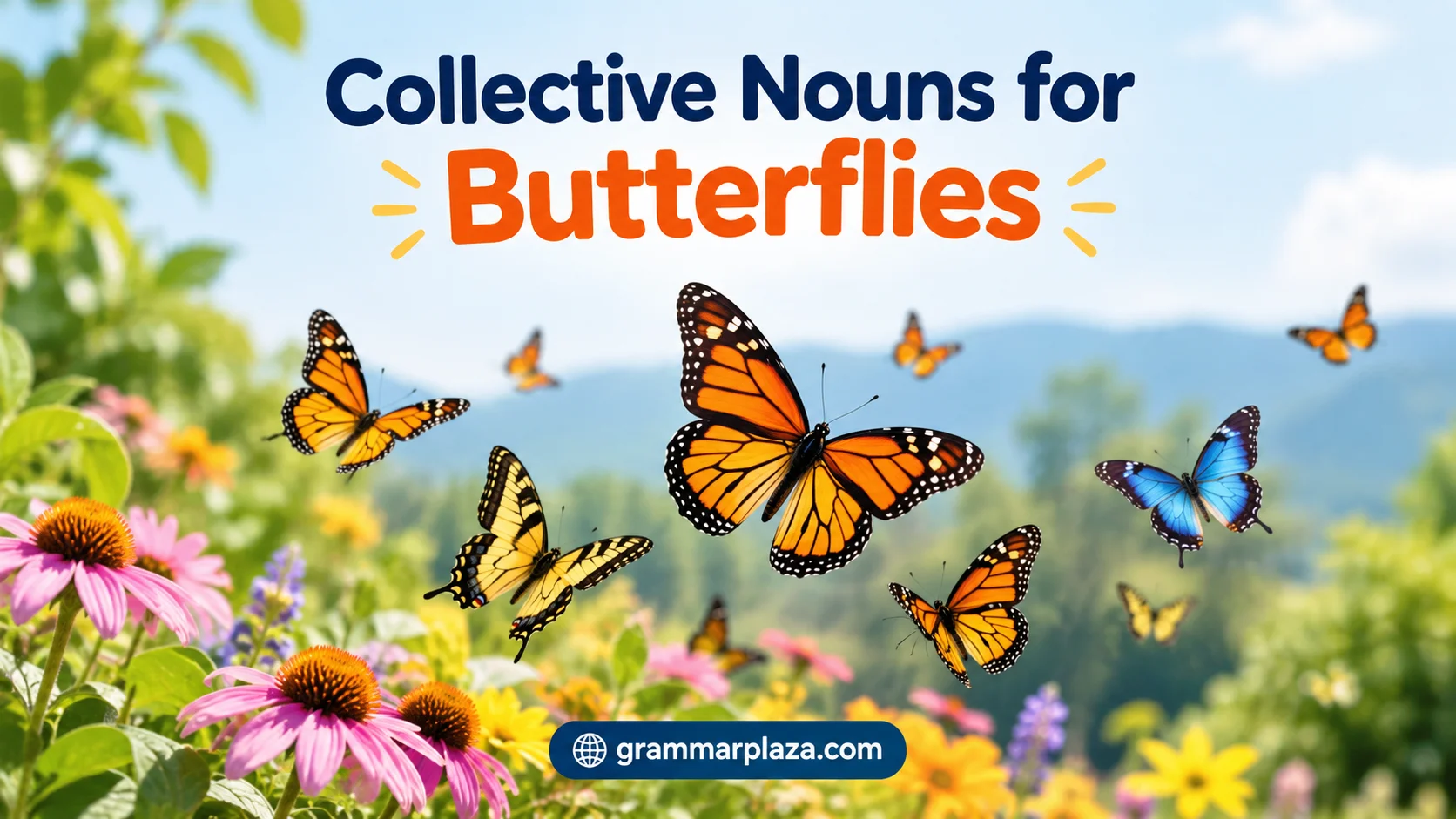
When you learn about Collective Nouns for Butterflies, you’ll discover several interesting terms for a group of butterflies, including kaleidoscope, swarm, and rabble. Butterflies are usually solitary, but some species gather during feeding, resting, or migration. The term kaleidoscope is especially memorable because it reflects the beautiful colors, patterns, and graceful movement of butterflies when they gather together.
There are nearly butterfly species worldwide, with about species found in the United States. Although many butterflies live and migrate alone, monarch butterflies may gather along a migration route. The word kaleidoscope also relates to the colorful, changing patterns created by a traditional optical instrument invented by David Brewster, making it a fitting and vivid term for a colorful butterfly gathering.
What Are Collective Nouns?
Collective nouns are special words used to describe a collection of individuals acting as one group. They make language more expressive and are especially common when referring to animals and birds.
For butterflies, collective nouns often reflect their colorful appearance, gentle movements, and graceful behavior. Whether butterflies are resting on flowers or flying through a garden, these terms paint a vivid picture.
The table below introduces some of the most commonly used collective nouns for butterflies.
| Collective Noun | Simple Example |
| Kaleidoscope | A kaleidoscope of butterflies landed on the flowers. |
| Flutter | A flutter of butterflies danced through the garden. |
| Swarm | A swarm of butterflies crossed the meadow. |
| Rabble | A rabble of butterflies rested near the bushes. |
| Flight | A flight of butterflies floated across the field. |
A Kaleidoscope of Butterflies
A kaleidoscope is the most famous and widely accepted collective noun for butterflies. It perfectly reflects the brilliant mix of colors created when many butterflies gather together.
Examples
- A kaleidoscope of butterflies covered the blooming flowers.
- We admired a kaleidoscope of butterflies in the butterfly garden.
- The children watched a kaleidoscope of butterflies fly together.
- A kaleidoscope of butterflies rested on the green leaves.
- Tourists photographed a kaleidoscope of butterflies.
- A kaleidoscope of butterflies brightened the forest.
- The colorful kaleidoscope of butterflies amazed everyone.
- We followed a kaleidoscope of butterflies along the trail.
- A kaleidoscope of butterflies gathered near the pond.
- The park became beautiful with a kaleidoscope of butterflies.
A Flutter of Butterflies
The word flutter describes the light and delicate movement of butterfly wings. It is a poetic and commonly used collective noun.
Examples
- A flutter of butterflies flew over the flowers.
- We spotted a flutter of butterflies in the garden.
- A flutter of butterflies danced in the warm breeze.
- The flutter of butterflies rested on the wildflowers.
- Children chased a flutter of butterflies across the field.
- A flutter of butterflies surrounded the blooming plants.
- The photographer captured a flutter of butterflies.
- A flutter of butterflies appeared after the rain.
- We admired the flutter of butterflies from a distance.
- A flutter of butterflies filled the meadow with color.
A Swarm of Butterflies
Although swarm is more commonly associated with bees or insects, it may also describe a large gathering of butterflies moving together.
Examples
- A swarm of butterflies crossed the open field.
- We noticed a swarm of butterflies near the river.
- A swarm of butterflies landed on the flowers.
- The farmer watched a swarm of butterflies pass by.
- A swarm of butterflies gathered in the sunny meadow.
- The garden attracted a swarm of butterflies.
- We walked through a swarm of butterflies.
- A swarm of butterflies rested on the bushes.
- The colorful swarm of butterflies amazed visitors.
- A swarm of butterflies floated above the grass.
A Rabble of Butterflies
The collective noun rabble is rare but occasionally used in literature for butterflies. It adds a creative touch when describing an active or scattered group.
Examples
- A rabble of butterflies rested on the flowers.
- We saw a rabble of butterflies near the forest.
- A rabble of butterflies moved gently in the wind.
- The garden welcomed a rabble of butterflies.
- A rabble of butterflies gathered around the blooming plants.
- We photographed a rabble of butterflies together.
- A rabble of butterflies decorated the meadow.
- The children enjoyed watching a rabble of butterflies.
- A rabble of butterflies flew across the park.
- A rabble of butterflies disappeared into the trees.
A Flight of Butterflies
The term flight emphasizes butterflies moving gracefully through the air together.
Examples
- A flight of butterflies floated above the flowers.
- We admired a flight of butterflies in the park.
- A flight of butterflies crossed the meadow.
- The morning sun illuminated a flight of butterflies.
- A flight of butterflies landed on colorful blossoms.
- The hikers spotted a flight of butterflies nearby.
- A flight of butterflies moved gently through the forest.
- We watched a flight of butterflies from the hill.
- A flight of butterflies circled the garden.
- A flight of butterflies disappeared into the trees.
Read More: Collective Nouns for Balloons
Interesting Facts About Butterflies
Butterflies are extraordinary insects with fascinating biological features. Their lifespan varies greatly depending on the species. While many butterflies live for only two to four weeks as adults, some species, such as the monarch butterfly, can survive for several months, especially during migration. One of their most unique physiological features is their four delicate wings, which are covered with thousands of tiny overlapping scales that create their beautiful colors and patterns. Butterflies also possess a long, tube-like mouthpart called a proboscis, which they use like a straw to drink nectar from flowers. Their diet mainly consists of nectar, providing them with energy for flight, although some species also feed on tree sap, rotting fruit, pollen, or mineral-rich moisture from mud puddles. Butterflies undergo a remarkable process known as complete metamorphosis, transforming from egg to caterpillar, then chrysalis, and finally into a winged adult. Besides adding beauty to nature, they play an essential role as pollinators, helping many flowering plants reproduce.
Why Learn Collective Nouns for Butterflies?
Understanding collective nouns offers several benefits.
- It improves English vocabulary.
- It makes writing more descriptive.
- It enhances storytelling.
- It helps students learn animal-related terminology.
- It deepens appreciation for wildlife and nature.
FAQs :
1. What is the collective noun for butterflies?
The most commonly known collective noun for butterflies is kaleidoscope. Other terms, such as swarm and rabble, may also be used to describe a group of butterflies.
2. Why is a group of butterflies called a kaleidoscope?
A group of butterflies can be called a kaleidoscope because their colorful wings and movements can create a beautiful, changing display, similar to the patterns seen in a kaleidoscope.
3. Can I use “swarm” for a group of butterflies?
Yes, swarm can describe a group of butterflies, particularly when many butterflies are flying together. However, kaleidoscope is the more distinctive and memorable collective term.
4. What does “rabble” mean for butterflies?
Rabble is another collective term sometimes associated with butterflies. It refers to a disorderly or loosely gathered group and is less common in everyday English than kaleidoscope.
5. Do butterflies usually live in groups?
Many butterflies are solitary and spend much of their lives alone. However, some species gather in particular places for feeding, resting, reproduction, or migration.
6. Do monarch butterflies gather together?
Yes. Monarch butterflies can gather in large numbers, especially during their seasonal migration. These gatherings are particularly noticeable at their overwintering locations.
7. How many butterfly species are there?
There are nearly 20,000 known butterfly species around the world. They live in many different habitats and display a wide variety of colors, sizes, and wing patterns.
8. What is the most popular collective noun for butterflies?
Kaleidoscope is one of the most recognized collective nouns for butterflies. It is popular because it beautifully describes the colorful appearance of butterflies moving together.
9. Can I use “kaleidoscope” in a sentence?
Yes. For example: “A kaleidoscope of butterflies flew across the garden.” The phrase creates a vivid picture of several butterflies moving together.
10. What is the difference between a kaleidoscope and a swarm of butterflies?
A kaleidoscope emphasizes the colorful and beautiful appearance of butterflies gathered together, while swarm focuses more on a large group moving or flying together.
Conclusion :
A group of butterflies can be described with several collective nouns, including kaleidoscope, swarm, and rabble. Among these, kaleidoscope stands out because it captures the colorful wings, graceful movement, and changing patterns of butterflies. Although many butterflies are solitary, certain species, especially monarchs, gather during important periods such as migration. Knowing these collective nouns can make your writing more descriptive and help you use colorful language when talking about these fascinating insects.













1 thought on “Collective Nouns for Butterflies”