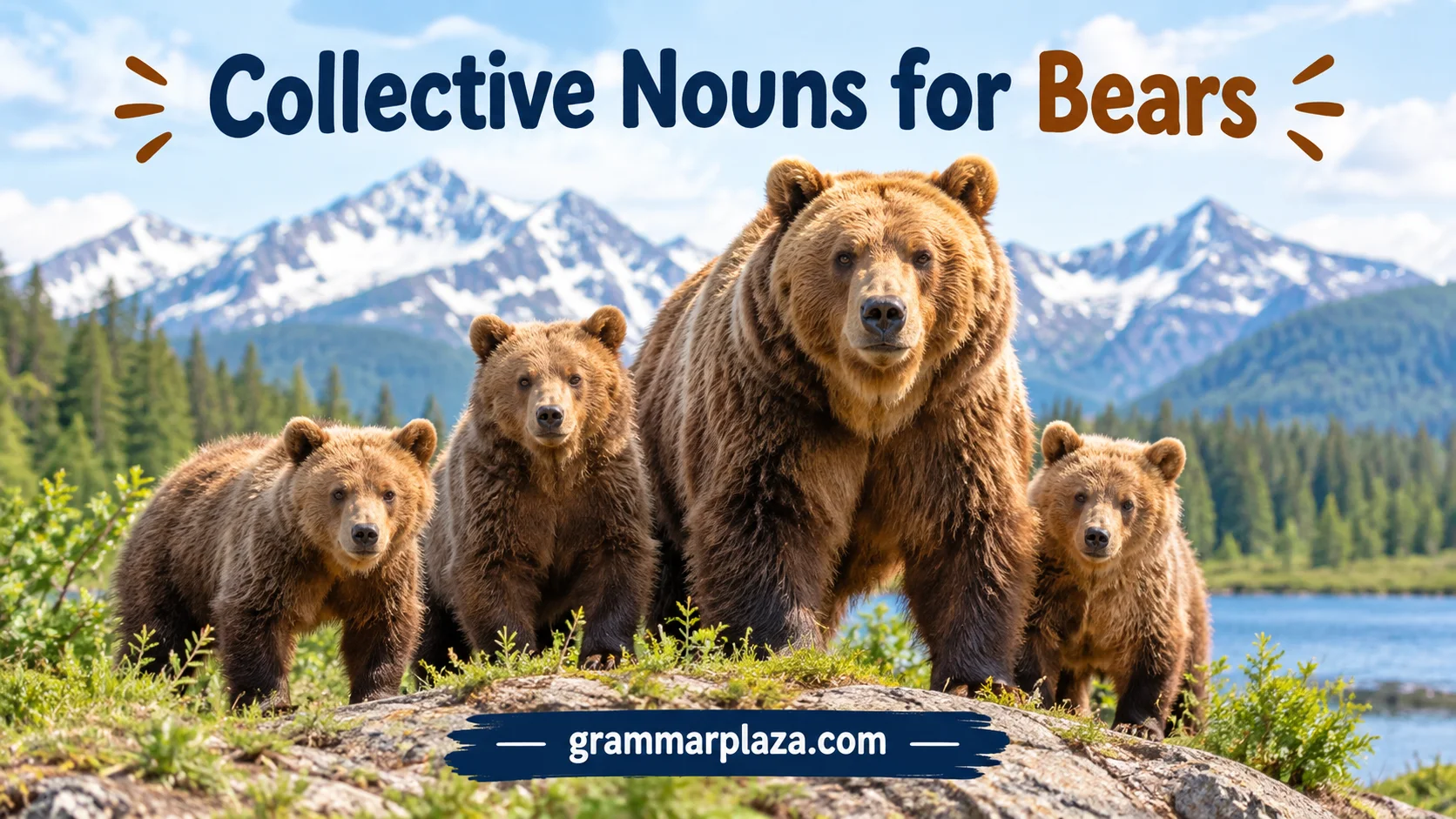
Collective Nouns for Bears offer an interesting look at how English uses special words to describe groups of animals. A group of bears can be called a sleuth or sloth, depending on the traditional term being used. These expressions add variety to everyday English and make animal descriptions more vivid. Learning these collective nouns can help students, writers, and language learners improve their vocabulary while discovering unusual terms connected with bears and their behavior.
Many animal group names have roots in medieval English, when lists of supposed hunting terms became popular. Some expressions were genuinely used, while others appear to have been fanciful or rarely used. Over time, a few became familiar parts of standard English, whereas others remained obscure. Terms such as sleuth of bears are especially interesting because they connect language with traditional ideas about animal behavior. Exploring these unusual animal collective nouns makes English vocabulary more engaging and memorable.
Collective Nouns for Bears
Below is a simple table showing the most commonly used collective nouns for bears.
| Collective Noun | Type | Simple Example |
| Sloth | Most common collective noun | A sloth of bears crossed the forest. |
| Sleuth | Traditional collective noun | A sleuth of bears searched for food. |
| Family | Related bears | A family of bears rested near the river. |
| Pack | Informal usage | A pack of bears wandered through the valley. |
| Group | General term | A group of bears gathered near the lake. |
Sloth of Bears
A sloth of bears is the most widely recognized collective noun for a group of bears. The word “sloth” refers to their seemingly slow and relaxed movements, although bears can run surprisingly fast when necessary.
Examples
- A sloth of bears walked through the forest.
- We spotted a sloth of bears near the river.
- The sloth of bears searched for berries.
- A sloth of bears rested beneath the tall trees.
- Rangers observed a sloth of bears from a safe distance.
- The sloth of bears crossed the open meadow.
- A sloth of bears gathered around the salmon stream.
- The photographer captured a sloth of bears in the wild.
- A sloth of bears disappeared into the woods.
- Children learned about a sloth of bears in science class.
Sleuth of Bears
A sleuth of bears is another traditional collective noun. The term suggests bears investigating or searching for food with their powerful sense of smell.
Examples
- A sleuth of bears explored the forest.
- The sleuth of bears searched for honey.
- We watched a sleuth of bears from afar.
- A sleuth of bears wandered through the valley.
- Rangers tracked a sleuth of bears.
- The sleuth of bears gathered near the stream.
- A sleuth of bears looked for berries.
- Tourists admired the sleuth of bears safely.
- The sleuth of bears climbed the hillside.
- Everyone was excited to see a sleuth of bears.
Family of Bears
The phrase family of bears is commonly used when referring to a mother bear and her cubs. While it is not a traditional collective noun, it is accurate and frequently used.
Examples
- A family of bears crossed the road.
- We saw a family of bears near the forest.
- The family of bears stayed close together.
- A family of bears drank from the river.
- Rangers protected the family of bears.
- The family of bears rested in the shade.
- A family of bears climbed the rocky hill.
- The family of bears searched for food.
- Visitors admired the family of bears.
- The family of bears returned to their den.
Pack of Bears
Although pack is more commonly associated with wolves, it is occasionally used informally to describe several bears together.
Examples
- A pack of bears moved across the meadow.
- We noticed a pack of bears near the lake.
- The pack of bears looked for fish.
- A pack of bears wandered through the woods.
- The pack of bears climbed the hillside.
- A pack of bears rested after feeding.
- Rangers monitored the pack of bears carefully.
- The pack of bears scattered into the forest.
- A pack of bears crossed the river.
- Everyone watched the pack of bears quietly.
Group of Bears
The phrase group of bears is the simplest and most universally accepted way to describe several bears together. It is appropriate in everyday speech and writing.
Examples
- A group of bears gathered near the river.
- We saw a group of bears eating berries.
- The group of bears walked through the forest.
- A group of bears rested under the trees.
- Rangers observed the group of bears safely.
- The group of bears searched for food.
- A group of bears climbed the mountain.
- The group of bears crossed the stream.
- Children enjoyed seeing the group of bears.
- The group of bears disappeared into the forest.
Read More: Collective Nouns for Tigers
Interesting Facts About Bears
Bears are among the most fascinating mammals on Earth, known for their intelligence, adaptability, and impressive physical abilities. Depending on the species, bears can live between 20 and 35 years in the wild, while those in protected environments may live even longer. One of their most remarkable physiological features is their ability to hibernate. During hibernation, a bear’s heart rate slows dramatically, allowing it to survive for months without eating, drinking, or producing waste. Bears also possess an extraordinary sense of smell that is many times stronger than that of humans, enabling them to detect food from miles away. Despite their large size, many bears are excellent climbers and strong swimmers. Their diet varies by species and habitat; most bears are omnivores, eating berries, nuts, roots, insects, fish, honey, and small mammals, while polar bears rely mainly on seals, and giant pandas feed almost exclusively on bamboo. These unique traits have helped bears survive in forests, mountains, tundras, and Arctic regions across the world.
FAQs :
1. What is a group of bears called?
A group of bears can be called a sleuth or a sloth. These are traditional collective nouns used to describe bears as a group.
2. What is the most common collective noun for bears?
Sleuth is one of the best-known collective nouns for bears. However, in everyday English, people may simply say a group of bears.
3. Why are bears called a sleuth?
The term sleuth is a traditional expression associated with a group of bears. It is an unusual animal collective noun that has become well known through lists of traditional English terms.
4. Can I use “sloth” for a group of bears?
Yes. Sloth is another traditional collective noun for bears. However, it is relatively uncommon in everyday conversation compared with the simple phrase group of bears.
5. Are collective nouns for bears commonly used?
Some traditional terms, including sleuth and sloth, are recognized in English, but they are not frequently used in ordinary conversation. Most people simply say a group of bears.
Conclusion :
Learning the collective nouns for bears is a fun way to expand your English vocabulary. Terms such as sleuth and sloth have interesting traditional backgrounds and can make your writing more colorful. Although these expressions are uncommon in everyday speech, understanding them gives you a better appreciation of the richness and history of the English language.














1 thought on “Collective Nouns for Bears”