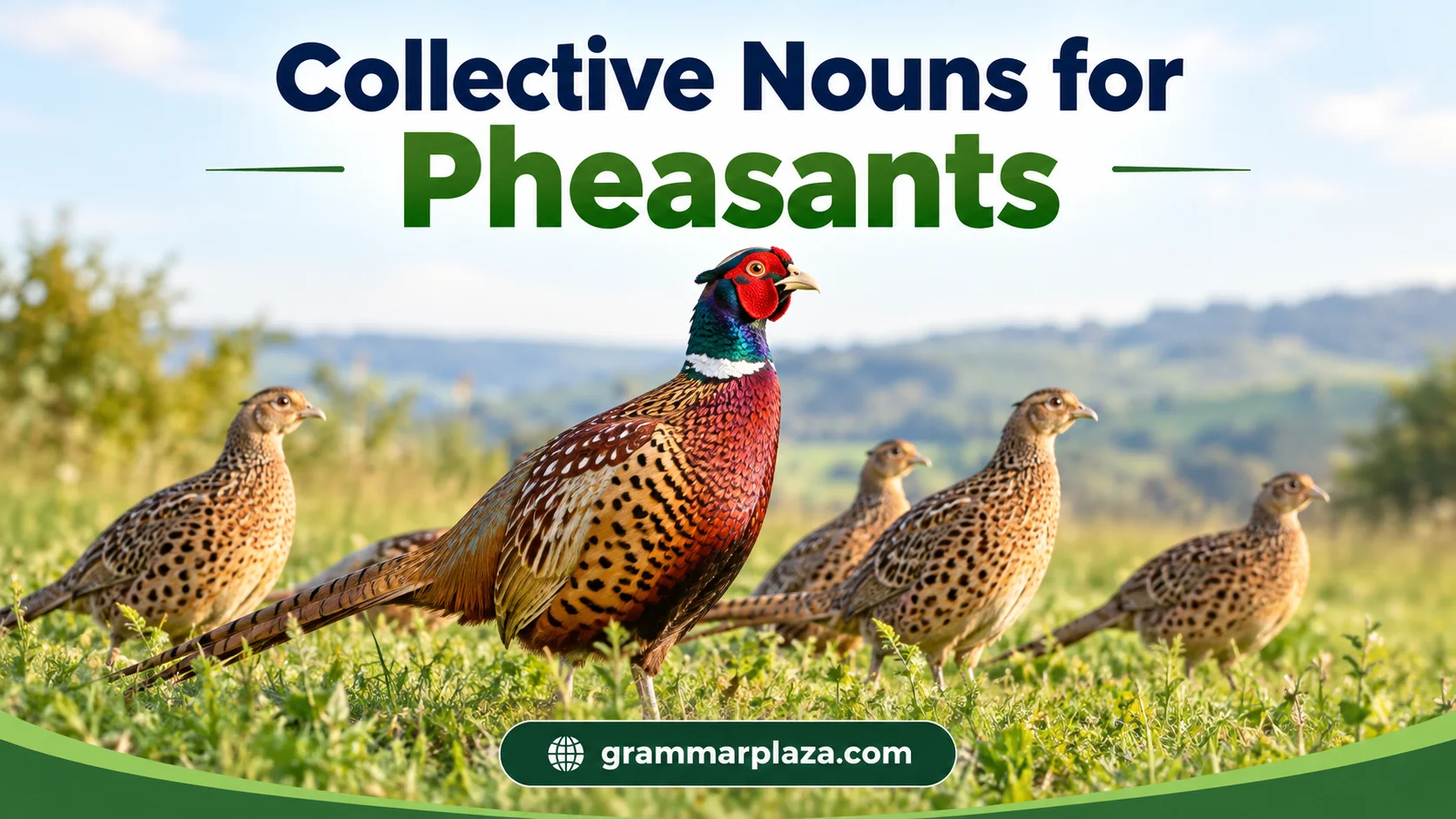
Collective Nouns for Pheasants help you describe these game birds when they appear in a group. In standard English vocabulary, a flock is a simple and familiar term, while older medieval terms can add a more colorful touch. Words such as brace, covey, and brood have appeared in discussions of bird groups, although their use can depend on context. For English learners, choosing a clear and commonly understood term is often more useful than using an obscure expression.
Pheasants are often seen in open country, where their behavior and movement make group descriptions interesting. Historical collective nouns came from medieval lists, hunting traditions, and technical hunting terms, giving bird vocabulary a rich origin. Some terms became widely known, while others remained arcane terms found mainly in literature. When writing or speaking, I prefer using a flock of birds or group of pheasants when clarity matters, especially because a proper term should communicate the meaning without leaving the reader unclear.
| Collective Noun | Type | Simple Example |
| Bouquet | Group of pheasants | A bouquet of pheasants crossed the field. |
| Covey | Small group of pheasants | A covey of pheasants hid in the grass. |
| Nest | Family or nesting group | A nest of pheasants rested nearby. |
| Nye | Flock of pheasants | A nye of pheasants gathered at sunrise. |
Bouquet of Pheasants
The term bouquet is one of the most beautiful collective nouns for pheasants. It is inspired by the colorful plumage of these birds, especially the vibrant males, whose bright feathers resemble a bouquet of flowers.
Examples
- A bouquet of pheasants wandered across the meadow.
- We watched a bouquet of pheasants feeding together.
- The hunter spotted a bouquet of pheasants near the trees.
- A bouquet of pheasants disappeared into the tall grass.
- The colorful bouquet of pheasants attracted photographers.
- Children admired a bouquet of pheasants in the wildlife park.
- A bouquet of pheasants searched for seeds after sunrise.
- We quietly observed a bouquet of pheasants from a distance.
- The bouquet of pheasants scattered when startled.
- A bouquet of pheasants brightened the countryside with their feathers.
Covey
A covey is the most widely recognized collective noun for pheasants. It usually refers to a small group of ground-dwelling birds that stay together for protection and feeding.
Examples
- A covey of pheasants crossed the country road.
- The farmer noticed a covey of pheasants in his field.
- A covey of pheasants searched for insects.
- We photographed a covey of pheasants near the bushes.
- The covey of pheasants remained close together.
- A covey of pheasants quickly flew into the woods.
- The dog carefully approached a covey of pheasants.
- A covey of pheasants rested under the shrubs.
- Early in the morning, a covey of pheasants appeared.
- The covey of pheasants disappeared after hearing loud noises.
Nest of Pheasants
Although nest usually refers to the structure where birds lay eggs, it can also describe a family or nesting group of pheasants in certain contexts.
Examples
- A nest of pheasants stayed hidden among the plants.
- We discovered a nest of pheasants in the tall grass.
- The nest of pheasants remained quiet all afternoon.
- Rangers protected a nest of pheasants from predators.
- A nest of pheasants sheltered young chicks.
- The nest of pheasants was well concealed.
- Visitors admired a nest of pheasants from a safe distance.
- A nest of pheasants rested beside the hedgerow.
- The nest of pheasants blended perfectly into the surroundings.
- We carefully avoided disturbing the nest of pheasants.
Nye of Pheasants
The word nye is a rare and traditional collective noun used for a flock of pheasants. Although it is less common today, it remains an interesting historical term.
Examples
- A nye of pheasants gathered near the woodland.
- We watched a nye of pheasants feeding together.
- A nye of pheasants crossed the open field.
- The nye of pheasants flew away together.
- A nye of pheasants searched for berries.
- The guide pointed toward a nye of pheasants.
- A nye of pheasants rested near the stream.
- The sunrise revealed a nye of pheasants.
- A nye of pheasants scattered into the bushes.
- We admired a nye of pheasants from the observation tower.
Read This: Collective Nouns for Butterflies
Interesting Facts About Pheasants
Pheasants are fascinating birds known for both their beauty and adaptability. In the wild, many pheasants live for one to three years, although those that avoid predators and harsh conditions may survive up to seven years or more. In protected environments, some pheasants have been known to live for 10 to 18 years, depending on the species and quality of care. Male pheasants are especially famous for their dazzling feathers, long tails, and colorful facial markings, while females have brown, camouflaged plumage that helps protect them during nesting. These birds possess strong leg muscles that allow them to run at impressive speeds, and although they can fly, they usually prefer short bursts of flight followed by running. Pheasants are omnivores, feeding on seeds, grains, berries, leaves, insects, worms, and other small invertebrates. This varied diet helps them thrive in woodlands, grasslands, and agricultural landscapes across many parts of the world.
FAQs :
1. What is the collective noun for pheasants?
The most common collective noun for pheasants is flock. You can say a flock of pheasants when describing several pheasants together.
2. Can I say “a group of pheasants”?
Yes. A group of pheasants is clear, natural, and easy to understand. It is a good choice when you want to avoid uncommon or historical terms.
3. Is “flock” a standard term for pheasants?
Yes, flock is a familiar collective noun for many birds, including pheasants. It works well in everyday English and general writing.
4. What does “brood” mean for pheasants?
Brood can describe a group of young birds, especially birds cared for by a mother. Its meaning is more specific than simply saying flock of pheasants.
5. Are “brace” and “covey” collective nouns for pheasants?
Brace and covey appear in historical and hunting vocabulary connected with birds and game birds. However, their use can vary, so flock is usually clearer for modern readers.
6. Why are there unusual collective nouns for pheasants?
Many unusual bird-group terms have an origin in medieval hunting traditions. Hunters created colorful vocabulary to describe different animals and birds.
7. What is a simple way to describe pheasants in a group?
The simplest choices are a flock of pheasants and a group of pheasants. Both expressions communicate the meaning clearly.
8. Are medieval collective nouns still commonly used?
Most medieval terms are not common in everyday English today. Some survive in books, historical writing, or discussions of traditional hunting terms.
9. Why should English learners use “flock of pheasants”?
Flock of pheasants is easy to understand and fits normal English vocabulary. It helps English learners communicate clearly without relying on an arcane term.
10. Can I use “flock of birds” for pheasants?
Yes. Since pheasants are game birds, flock of birds can be used as a general description. However, flock of pheasants is more specific and precise.
Conclusion :
Understanding collective nouns for pheasants can make your vocabulary more interesting and precise. Flock is a simple and familiar choice, while terms such as brace, covey, and brood may appear in historical or specialized contexts. These expressions show how English vocabulary developed through medieval traditions, hunting culture, and everyday speech. When clarity is important, a flock of pheasants or a group of pheasants is usually the easiest choice for modern readers.










1 thought on “Collective Nouns for Pheasants”