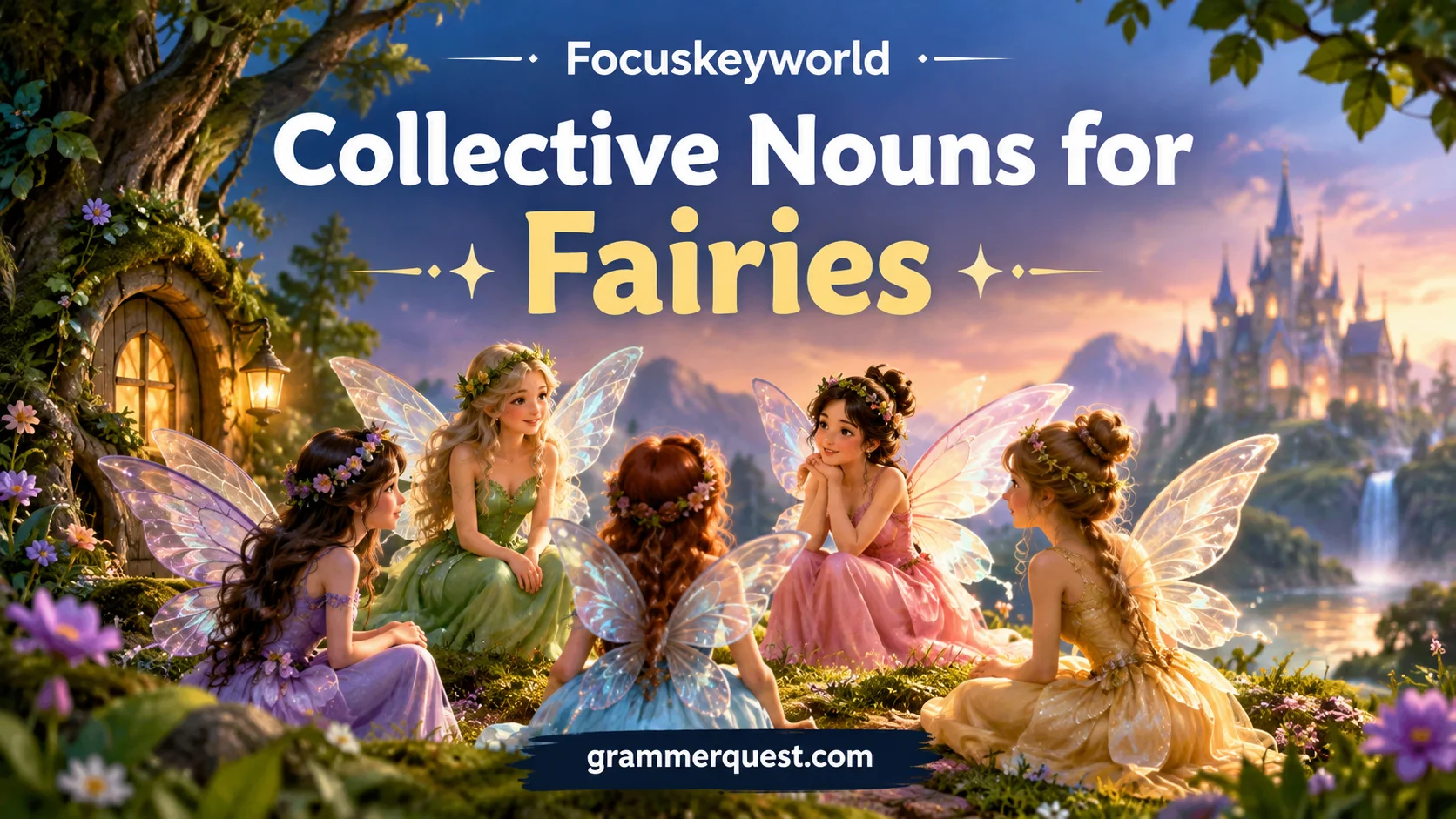
Collective Nouns for Fairies help writers describe several fairies appearing together in stories, folklore, and fantasy literature, making scenes more vivid and imaginative. Fairies are imaginary creatures, so English has no single, universally accepted term for them. Writers can select different group expressions based on the scene, feeling, and style they want. In English vocabulary, the right phrase can make a description more colourful, imaginative, and natural.
A troop of fairies can show movement and a lively group, while a circle of fairies may express friendship, shared activity, or a magical gathering. A flight of fairies suits tiny beings with unusual powers moving through the air. These choices improve storytelling by creating a stronger picture of a magical scene and helping the reader imagine an imaginative picture.
A gathering of fairies can describe fairies meeting for a celebration, while a host of fairies can represent a large magical gathering. In creative writing and fantasy writing, the right phrase can turn a simple sentence into a vivid expression. A writer can use a vivid scene, feel, and atmosphere to make descriptions more engaging.
The table below highlights some of the most popular collective nouns used for fairies.
| Collective Noun | Type | Simple Example |
| A Host of Fairies | Large gathering | A host of fairies danced in the moonlight. |
| A Troop of Fairies | Organized group | A troop of fairies protected the forest. |
| A Charm of Fairies | Magical gathering | A charm of fairies surrounded the flowers. |
| A Swarm of Fairies | Fast-moving group | A swarm of fairies flew across the meadow. |
| A Ring of Fairies | Circle of fairies | A ring of fairies celebrated beneath the old oak tree. |
Host of Fairies
A host refers to a large gathering of fairies. It is commonly used in fantasy literature to describe many fairies appearing together in one magical place.
Examples
- A host of fairies filled the forest with glowing lights.
- We watched a host of fairies dance around the pond.
- The children imagined a host of fairies hiding in the garden.
- A host of fairies welcomed the travelers.
- At sunset, a host of fairies appeared among the flowers.
- The old tree became home to a host of fairies.
- A host of fairies sang cheerful songs all night.
- Everyone admired the host of fairies at the festival.
- A host of fairies gathered around the sparkling stream.
- The story described a host of fairies protecting the enchanted woods.
Troop of Fairies
A troop describes a group of fairies working together, often with a shared purpose such as protecting nature or helping magical creatures.
Examples
- A troop of fairies guarded the magical bridge.
- The troop of fairies flew over the meadow.
- We spotted a troop of fairies near the waterfall.
- A troop of fairies cared for the woodland flowers.
- The troop of fairies greeted every forest animal.
- A troop of fairies gathered around the ancient tree.
- Children imagined a troop of fairies living nearby.
- A troop of fairies carried glowing lanterns.
- The troop of fairies celebrated the arrival of spring.
- Every troop of fairies had a wise leader.
Charm of Fairies
A charm is one of the most beautiful collective nouns for fairies because it reflects their magical and enchanting qualities.
Examples
- A charm of fairies rested on the flower petals.
- We admired a charm of fairies in the moonlight.
- A charm of fairies filled the air with laughter.
- The artist painted a charm of fairies dancing together.
- A charm of fairies glowed beneath the stars.
- A charm of fairies visited the enchanted forest.
- The garden seemed alive with a charm of fairies.
- A charm of fairies sprinkled magical dust everywhere.
- We imagined a charm of fairies protecting the flowers.
- The fairy queen led a charm of fairies through the woods.
Swarm of Fairies
A swarm describes many fairies moving quickly through the air, much like a swarm of insects.
Examples
- A swarm of fairies flew over the lake.
- We saw a swarm of fairies sparkle in the sky.
- A swarm of fairies rushed toward the flowers.
- The story mentioned a swarm of fairies helping the queen.
- A swarm of fairies disappeared into the forest.
- The children followed a swarm of fairies along the path.
- A swarm of fairies circled the old castle.
- Bright lights surrounded the swarm of fairies.
- A swarm of fairies danced in the evening breeze.
- Everyone watched the swarm of fairies with amazement.
Ring of Fairies
A ring describes fairies gathered in a circle, often dancing or celebrating. This term is inspired by the folklore of fairy rings.
Examples
- A ring of fairies danced around the mushrooms.
- We discovered a ring of fairies beneath the oak tree.
- A ring of fairies welcomed the fairy queen.
- The ring of fairies glowed under the full moon.
- Children imagined a ring of fairies in the garden.
- A ring of fairies celebrated the arrival of spring.
- The story described a ring of fairies singing together.
- We admired the ring of fairies from a distance.
- A ring of fairies formed near the waterfall.
- Every ring of fairies looked magical.
Interesting Facts About Fairies
Although fairies are mythical beings rather than real wildlife, they have fascinating characteristics in folklore and fantasy traditions. Stories often describe fairies as having exceptionally long lifespans, with some legends claiming they can live for hundreds or even thousands of years without showing signs of aging. They are usually portrayed as tiny humanoid creatures with delicate wings that allow graceful flight, glowing skin, pointed ears, and magical abilities that vary from one culture to another. Their diets also differ across legends. Many tales suggest fairies enjoy flower nectar, dew drops, berries, honey, herbs, sweet fruits, and magical feasts prepared in enchanted forests. In many traditions, fairies are considered guardians of nature, protecting plants, animals, rivers, and ancient trees while rewarding kindness and respecting the natural world.
Why Learn Collective Nouns for Fairies?
Learning collective nouns for fairies makes reading and writing more imaginative. These unique terms:
- Add creativity to stories.
- Improve English vocabulary.
- Make fantasy writing more descriptive.
- Help readers understand literary expressions.
- Bring magical scenes to life.
Conclusion
Collective Nouns for Fairies add variety and imagination to English descriptions. Since there is no single universally accepted collective noun, writers can choose expressions such as troop of fairies, circle of fairies, flight of fairies, gathering of fairies, or host of fairies according to the scene. These phrases make stories and fantasy writing more vivid and enjoyable.
FAQs
1. What is a collective noun for fairies?
A collective noun for fairies is a phrase used to describe a group of fairies. Examples include troop of fairies, circle of fairies, and flight of fairies.
2. Is there one official collective noun for fairies?
No. There is no single, universally accepted collective noun for fairies. Different expressions can be used depending on the context and the writer’s style.
3. What is a troop of fairies?
A troop of fairies is an imaginative expression for a group of fairies. It can suggest a lively group that is moving or acting together.
4. What is a flight of fairies?
A flight of fairies is a creative expression that works well when fairies are imagined flying or moving through the air.
5. Can I use different collective nouns for fairies in creative writing?
Yes. Writers can use different expressions, such as gathering of fairies, host of fairies, or circle of fairies, to create different feelings and magical scenes.