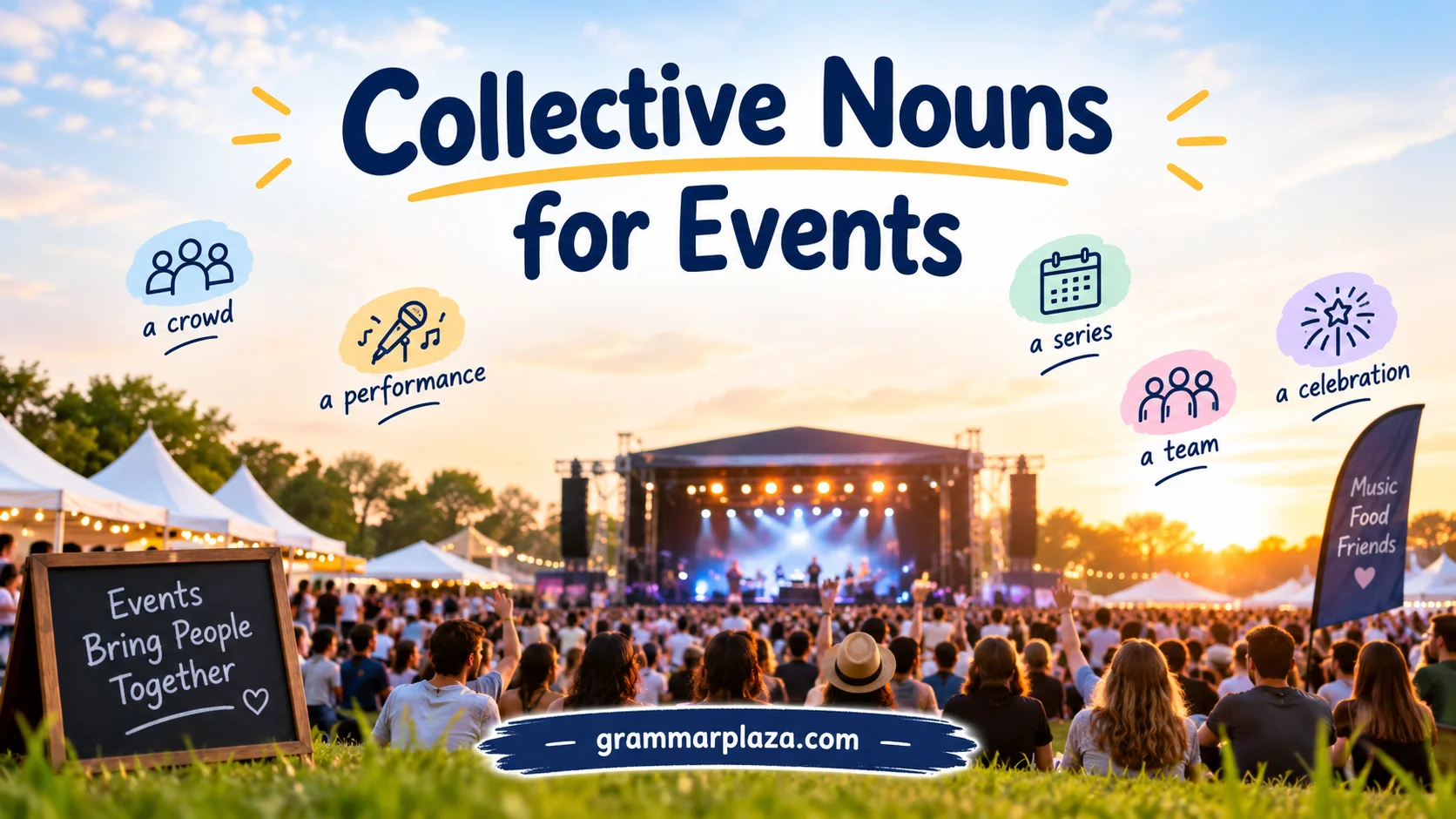
Collective Nouns for Events help describe groups of occasions and activities in clear, simple English, making event writing more meaningful and organized.
Collective nouns are special words that describe groups of people, animals, objects, or things as one unit. For events, they help us discuss festivals, meetings, ceremonies, competitions, performances, public celebrations, social gatherings, cultural traditions, special occasions, and community events. Learning suitable collective nouns improves vocabulary, writing skills, speaking, and the ability to choose words according to context, meaning, and purpose. Understanding definitions, examples, historical meanings, cultural meanings, and humorous meanings also helps learners recognize how language changes with different situations. In my experience with editing, selecting accurate words makes better sentences and clearer event descriptions while improving group descriptions, event terminology, and event organization.
Regular learning and practice support language learning, vocabulary development, English vocabulary, and broader language skills. Studying linguistic expressions and organized activities builds a deeper appreciation of the English language and helps people communicate naturally. Collective nouns strengthen grammar, sentence construction, word usage, collective expressions, collective terms, nouns, grammar concepts, semantic relationships, contextual meanings, and descriptive language. They also encourage creative writing, effective communication, meaningful communication, and communication skills in everyday conversations. Events matter in human society because they bring people together, create shared experiences, preserve traditions, and celebrate important moments. Using suitable words to describe individuals, items, total individuals, or multiple items helps readers understand the nature and purpose of occasions and communicate ideas clearly.
Common Collective Nouns for Events
The English language does not have many fixed collective nouns only for events, but several words are commonly used to describe groups or collections of events. These words help explain the type, arrangement, or relationship between different occasions.
| Collective Noun Type | Simple Example |
| Series | A series of events |
| Schedule | A schedule of events |
| Program | A program of events |
| Calendar | A calendar of events |
| Lineup | A lineup of events |
| Festival | A festival of events |
| Collection | A collection of events |
| Round | A round of events |
| Sequence | A sequence of events |
| Cycle | A cycle of events |
Collective Nouns for Events with Examples
1. Series of Events
A series of events refers to several connected events that happen one after another. These events usually share a common purpose or theme.
Examples:
- The school organized a series of events for Science Week.
- The festival included a series of events throughout the month.
- The city hosted a series of events to celebrate its anniversary.
- The museum arranged a series of events about ancient history.
- The company planned a series of events for its customers.
- The sports club held a series of events during the summer.
- The charity created a series of events to collect donations.
- The university announced a series of events for new students.
- The organizers prepared a series of events for the celebration.
- The community enjoyed a series of events during the holiday season.
2. Schedule of Events
A schedule of events describes a planned list of events arranged according to time and order.
Examples:
- The conference shared a schedule of events with all guests.
- The wedding planner created a schedule of events for the ceremony.
- The school provided a schedule of events for sports day.
- The festival website displayed the schedule of events.
- The organizer updated the schedule of events before the program started.
- The guests received a schedule of events at the entrance.
- The event manager prepared a detailed schedule of events.
- The tournament followed a strict schedule of events.
- The club printed a schedule of events for members.
- The audience checked the schedule of events before arriving.
3. Program of Events
A program of events refers to a planned collection of activities included in a special occasion.
Examples:
- The school prepared a program of events for graduation day.
- The festival had an exciting program of events for visitors.
- The ceremony followed a formal program of events.
- The organizers created a program of events for the celebration.
- The community enjoyed the program of events during the fair.
- The conference announced its program of events online.
- The cultural center offered a rich program of events.
- The guests received the program of events before the show.
- The charity prepared a program of events for fundraising.
- The town arranged a program of events for the festival.
4. Calendar of Events
A calendar of events is a collection of upcoming events arranged by dates.
Examples:
- The city published a calendar of events for the year.
- The website contains a calendar of events for visitors.
- The university shared its calendar of events online.
- The community center created a calendar of events.
- The club updated its calendar of events every month.
- The tourism office released a calendar of events.
- The school prepared a calendar of events for students.
- The organization keeps a calendar of events for members.
- The festival’s calendar of events included many activities.
- The newspaper printed a calendar of events for readers.
5. Lineup of Events
A lineup of events refers to a planned arrangement of different events, usually in order.
Examples:
- The festival announced an impressive lineup of events.
- The concert featured a great lineup of events.
- The organizers prepared a complete lineup of events.
- The sports day had an exciting lineup of events.
- The community enjoyed the weekend’s lineup of events.
- The museum revealed its new lineup of events.
- The celebration included a colorful lineup of events.
- The company planned a professional lineup of events.
- The visitors looked forward to the lineup of events.
- The announcement showed the full lineup of events.
Interesting Facts About Events
Events have existed throughout human history and have played a major role in shaping cultures and communities. Ancient civilizations organized ceremonies, festivals, competitions, and gatherings to celebrate achievements, honor traditions, and strengthen social connections. Many modern events have evolved from these early practices and continue to bring people together.
Events have unique features depending on their purpose. Some events are designed for entertainment, while others focus on education, religion, sports, business, or cultural traditions. Large events often require careful planning, including organization of locations, schedules, participants, food, security, and communication.
Unlike living organisms, events do not have biological traits or dietary habits. However, they can be described as having a “life cycle.” An event is created, planned, launched, experienced, and eventually completed. The success of an event depends on resources, preparation, and the participation of people. Events continue to grow and change as societies develop new interests and technologies.
Frequently Asked Questions (FAQs)
1. What is a collective noun for events?
A collective noun for events is a word or phrase used to describe a group or collection of events, such as a series, schedule, or program.
2. What is the most common collective noun used for events?
“Series of events” is one of the most commonly used phrases because it describes several connected events happening together.
3. Can events have different collective nouns?
Yes, different collective nouns can be used depending on the meaning. For example, a calendar of events focuses on dates, while a program of events focuses on activities.
4. Why are collective nouns useful in English?
Collective nouns make communication shorter, clearer, and more descriptive by grouping several things under one term.
5. Are collective nouns only used for animals?
No, collective nouns are used for people, objects, activities, and events as well as animals.
Conclusion
Understanding collective nouns for events helps us use the English language more effectively and express ideas in a clearer way. Words such as series, schedule, program, calendar, and lineup allow us to describe different groups of events with accuracy and style. Events themselves hold great importance in human life because they connect communities, preserve traditions, and create memorable experiences. By learning these terms, we gain a better appreciation of both language and the social importance of gatherings and occasions.