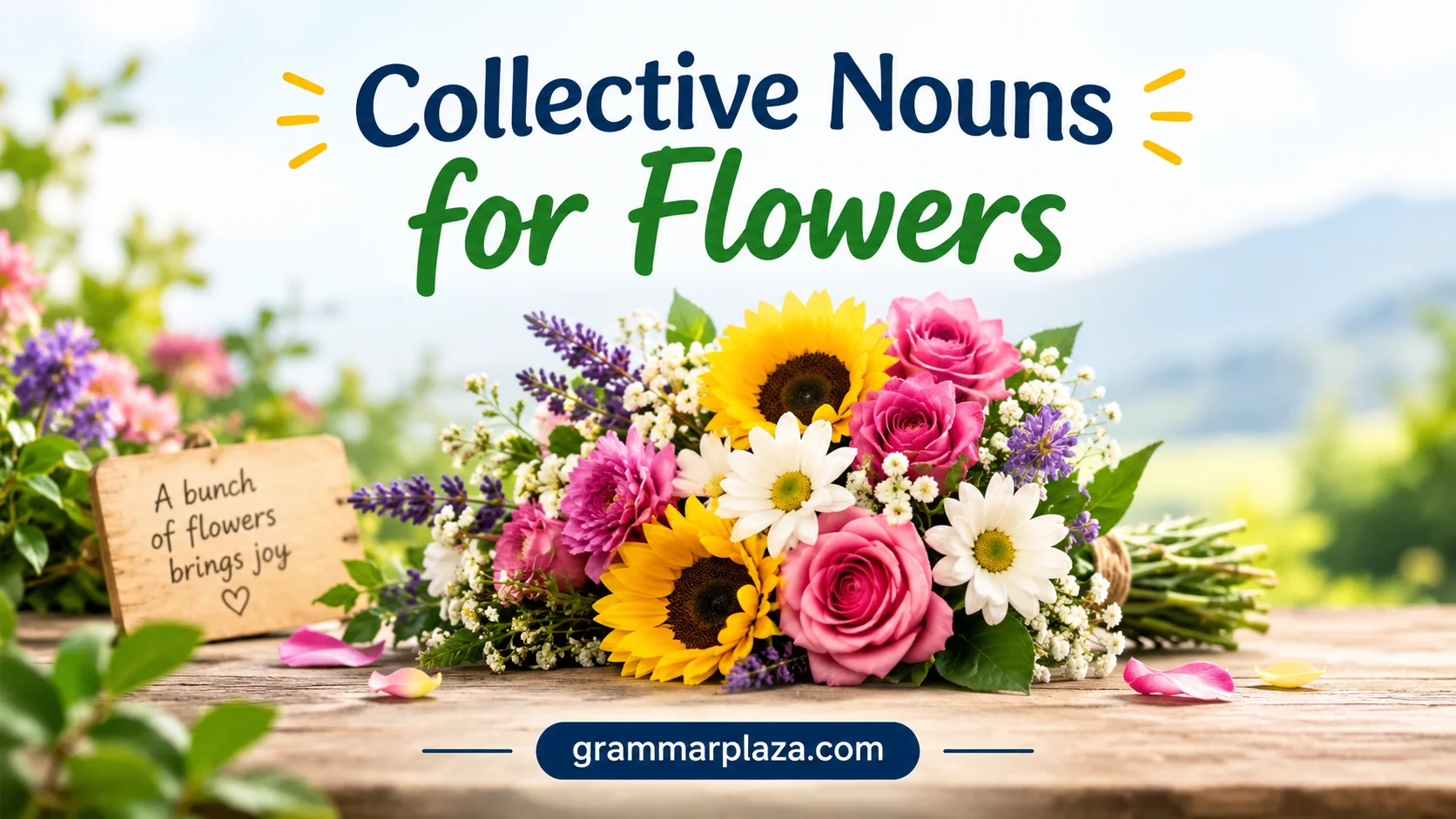
Collective Nouns for Flowers help describe groups of colorful blooms using simple, meaningful words that make English writing clearer and more engaging for readers.
Common examples include a bouquet, bunch, bed, and cluster of flowers. These terms describe a group of similar things as a single unit and help writers, students, and nature lovers explain how flowers grow naturally or are gathered together for decoration, gifts, and special occasions. Using these words in sentences improves grammar, expands vocabulary, and makes descriptions more interesting.
Flowers appear in collections and groupings throughout the natural world. A flower bed describes flowers growing together, while a bouquet is an arrangement gathered by people. Fields, meadows, forests, stands, copses, paddies, riparian zones, and cornucopias describe different plants, landscapes, growing environments, or abundant collections. Although these terms are not all standard collective nouns for flowers, they help writers describe their natural appearance, understand the beauty of nature, and express creativity in a descriptive manner.
Common Collective Nouns for Flowers
| Collective Noun Type | Simple Example |
| Bouquet | A bouquet of roses was placed on the table. |
| Cluster | A cluster of wildflowers grew near the river. |
| Bed | A bed of tulips decorated the garden. |
| Bunch | A bunch of flowers was given as a gift. |
| Garden | A garden of colorful flowers attracted visitors. |
| Field | A field of sunflowers covered the landscape. |
| Patch | A patch of daisies appeared in the meadow. |
1. Bouquet of Flowers
A bouquet is one of the most common collective nouns for flowers. It refers to a collection of flowers arranged together, usually for decoration, gifts, weddings, or special occasions.
Example
- She received a beautiful bouquet of flowers on her birthday.
- The bride carried a bouquet of white roses during the wedding.
- A colorful bouquet of flowers brightened the room.
- He bought a bouquet of lilies for his mother.
- The florist prepared a fresh bouquet for the customer.
- The bouquet of flowers smelled wonderful.
- A small bouquet was placed beside the window.
- The children made a bouquet from garden flowers.
- The artist painted a bouquet of spring flowers.
- The table was decorated with a lovely bouquet.
2. Cluster of Flowers
A cluster describes flowers that grow close together in a group. Many wildflowers naturally grow in clusters to create attractive displays.
Example
- A cluster of flowers grew beside the old tree.
- The garden had a cluster of colorful roses.
- Bees visited a cluster of flowers in the field.
- A cluster of small flowers covered the plant.
- The photographer captured a beautiful cluster of blossoms.
- A cluster of wildflowers appeared after the rain.
- The butterfly rested on a cluster of flowers.
- The forest floor had clusters of tiny flowers.
- A cluster of purple flowers decorated the pathway.
- The gardener planted a cluster of spring flowers.
3. Bed of Flowers
A bed of flowers refers to an area where many flowers are planted together, usually in gardens or parks.
Example
- The park had a beautiful bed of flowers.
- A bed of roses surrounded the fountain.
- The gardener created a colorful bed of tulips.
- Visitors admired the flower bed in the garden.
- A bed of daisies covered the corner of the yard.
- The school planted a bed of flowers near the entrance.
- A large bed of flowers made the park attractive.
- The gardener watered the flower bed every morning.
- The children enjoyed walking beside the flower bed.
- A bed of wildflowers attracted many insects.
4. Bunch of Flowers
A bunch is a simple and common word used for flowers gathered together, often when they are picked or arranged casually.
Example
- She carried a bunch of fresh flowers home.
- He gave his friend a bunch of roses.
- A bunch of flowers was placed in a vase.
- The child collected a bunch of colorful flowers.
- The shop displayed many bunches of flowers.
- A bunch of daisies looked beautiful on the table.
- The farmer picked a bunch of wildflowers.
- She decorated the room with a bunch of flowers.
- The teacher received a bunch of flowers from students.
- A bunch of flowers added beauty to the house.
5. Field of Flowers
A field of flowers describes a large area covered with many flowers growing together naturally or through farming.
Example
- A field of flowers stretched across the valley.
- The field of flowers looked amazing in spring.
- Tourists visited the field of flowers to take pictures.
- A field of sunflowers brightened the countryside.
- The children ran through a field of wildflowers.
- The field of flowers attracted butterflies and bees.
- Farmers protected the field of flowers from damage.
- The mountain had a beautiful field of flowers.
- A field of colorful flowers created a magical view.
- The field of flowers was full of natural beauty.
Interesting Facts About Flowers
Flowers are some of the most fascinating parts of the plant world. Many flowers can survive for different lengths of time depending on their species, environment, and care. Some cut flowers, such as orchids and chrysanthemums, can stay fresh for several weeks, while certain desert flowers have adapted to survive in harsh conditions for long periods.
Flowers have unique physiological features that help plants reproduce. Their bright colors, sweet scents, and nectar attract pollinators such as bees, butterflies, birds, and other insects. Some flowers can open and close depending on sunlight, temperature, or the time of day. Their petals, shapes, and patterns are specially designed to help with pollination.
Although flowers do not eat food like animals, plants use their leaves to create energy through photosynthesis. Flowers depend on sunlight, water, minerals, and carbon dioxide to grow. Some plants also have special relationships with insects and animals, providing nectar while receiving help with pollination.
Flowers have also played an important role in human culture for thousands of years. They are used for decoration, medicine, celebrations, perfumes, and even food. Some flowers, such as roses, lavender, and hibiscus, are valued for their beauty, fragrance, and practical uses.
Frequently Asked Questions About Collective Nouns for Flowers
1. What is the most common collective noun for flowers?
The most common collective noun for flowers is bouquet. It usually describes flowers arranged together as a gift or decoration.
2. Can we use “group” for flowers?
Yes, “group of flowers” is grammatically correct, but specific collective nouns like bouquet, cluster, or bed provide a more descriptive meaning.
3. What collective noun is used for flowers growing in a garden?
A bed of flowers is commonly used for flowers planted together in a garden area.
4. What is the collective noun for wildflowers?
Wildflowers are often described as a field, patch, or cluster depending on how they grow.
5. Why are collective nouns important in English?
Collective nouns make language more expressive and help people describe groups of things in a clear and creative way.
Conclusion
Understanding collective nouns for flowers helps us appreciate both the beauty of language and the wonders of nature. Words like bouquet, cluster, bed, bunch, and field allow us to describe flowers in a more vivid and meaningful way. While flowers do not have social behaviors like animals, their natural arrangements, relationships with pollinators, and unique biological features make them fascinating parts of our environment.
Learning these collective nouns not only improves English vocabulary but also encourages a deeper appreciation of flowers, their survival abilities, and their important role in ecosystems around the world.