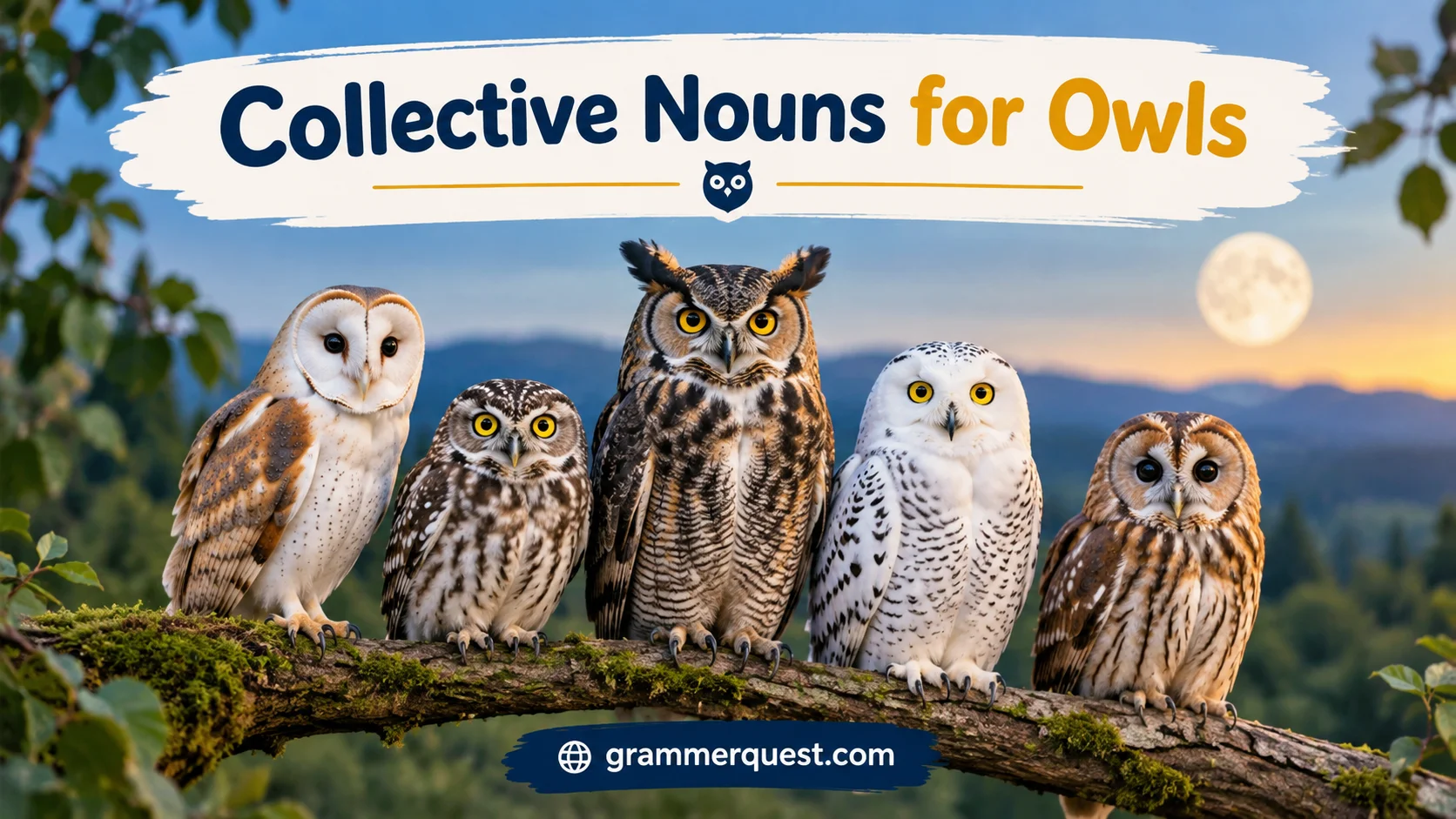
Collective Nouns for Owls help explain why these nocturnal birds are often named by terms such as parliament, wisdom, silence, and a stare today. An owl is a wise, old-looking creature of the night, often resting silently on branches, staring into the dark void and searching for prey. Since owls have nocturnal and solitary behaviors, they can be challenging to spot together. When you see one in the wild, it is usually alone and on its own, while seeing more than one is rare. This makes the group of owls an interesting subject, especially when asking what it is called and how these intelligent creatures function when they flock together. The most common collective noun is a parliament, but wisdom, congress, hooting, and stare are also used. A group in flight may be described as a silence because an owl’s quiet flight is extremely quiet, helping these birds become excellent hunters.
The history of collective nouns adds another layer to these names. Medieval sources contain lists of names for animals and birds, with many presented as technical hunting terms used by hunters. Some names had a fanciful origin, while their genuine use is supported by only sketchy evidence or may be non-existent. Scholars from the 19th century studied and reproduced medieval lists, although their accuracy could vary. Many expressions entered standard English vocabulary, but their use often stayed within a limited domain. Through imitation of older medieval terms, new terms of a similar nature were coined in recent times. Examples include a crash of rhinoceroses, a pod of whales, a pack of dogs, a clowder of cats, and a descension of woodpeckers. Plovers, starlings, and owls also have special expressions, although everyday spoken English and written English commonly favor flock over congregation, murmuration, or parliament.
The exact terms can vary by the part of the world or part of the country, so a complete list does not mean every expression is commonly used. In everyday English vocabulary, flock is familiar, while parliament remains the proper term most often connected with owls. From my experience with reading bird terminology, these expressions are best understood as traditional vocabulary rather than assuming that every name describes a regularly observed behavior. The explanation behind each term can make the subject easier to understand than simply memorizing names. This approach is especially useful when exploring relevant questions about owl groups and parliaments.
Common Collective Nouns for Owls
| Collective Noun | Used For | Simple Example |
| Parliament | A group of owls | A parliament of owls rested in the forest. |
| Stare | A group of owls | We spotted a stare of owls at dusk. |
| Wisdom | A group of owls | A wisdom of owls perched on the old oak tree. |
| Bazaar (rare) | A gathering of owls | A bazaar of owls gathered near the woodland. |
| Congress (rare) | A gathering of owls | A congress of owls watched quietly from above. |
Parliament of Owls
What Does “Parliament of Owls” Mean?
The most famous collective noun for owls is parliament. This term likely comes from the way owls appear wise and thoughtful. Their large eyes and calm expressions have long been associated with intelligence, making “parliament” a fitting name for a gathering of these birds.
Examples
- A parliament of owls perched on the tall pine trees.
- We saw a parliament of owls during our evening walk.
- The parliament of owls remained silent until sunset.
- A parliament of owls watched the forest from above.
- The guide pointed toward a parliament of owls near the river.
- A parliament of owls flew quietly across the valley.
- Children were excited to see a parliament of owls.
- The photographer captured a parliament of owls in one picture.
- A parliament of owls gathered before nightfall.
- Scientists observed a parliament of owls in the protected forest.
Stare of Owls
What Does “Stare of Owls” Mean?
The collective noun stare refers to the intense gaze of owls. Their large, forward-facing eyes make them appear as though they are constantly staring, giving rise to this descriptive term.
Examples
- A stare of owls sat quietly on the fence.
- We noticed a stare of owls in the woodland.
- A stare of owls watched every movement below.
- The stare of owls remained perfectly still.
- A stare of owls gathered near the cliffs.
- Tourists admired a stare of owls at the sanctuary.
- A stare of owls filled the old barn.
- The ranger found a stare of owls in the forest.
- A stare of owls flew silently into the night.
- Everyone was amazed by the stare of owls overhead.
Wisdom of Owls
What Does “Wisdom of Owls” Mean?
The phrase wisdom of owls comes from the long-standing belief that owls symbolize knowledge and intelligence. Although less common than “parliament,” it is still widely recognized in literature and storytelling.
Examples
- A wisdom of owls rested on the branches.
- We heard a wisdom of owls calling after sunset.
- The wisdom of owls looked across the valley.
- A wisdom of owls gathered in the ancient forest.
- The campers spotted a wisdom of owls nearby.
- A wisdom owl hunted quietly at night.
- A photographer followed the wisdom of owls.
- The wisdom of owls stayed hidden during the day.
- The guide described the wisdom of owls to visitors.
- We admired the wisdom of owls from a safe distance.
Bazaar of Owls
What Does “Bazaar of Owls” Mean?
Bazaar is a rare and creative collective noun for owls. It suggests a lively gathering, although it is much less common than “parliament.”
Examples
- A bazaar of owls gathered in the forest.
- We watched a bazaar of owls before dark.
- A bazaar of owls perched on old branches.
- The bazaar of owls remained calm and quiet.
- Rangers spotted a bazaar of owls in the reserve.
- A bazaar of owls flew across the hills.
- The children learned about a bazaar of owls.
- A bazaar of owls stayed near the woodland edge.
- We photographed a bazaar of owls at dusk.
- A bazaar of owls disappeared into the night.
Congress of Owls
What Does “Congress of Owls” Mean?
The term congress is another uncommon collective noun for owls. Like “parliament,” it suggests an organized gathering, reflecting the birds’ calm and dignified appearance.
Examples
- A congress of owls gathered on the hillside.
- We observed a congress of owls from afar.
- The congress of owls hunted after sunset.
- A congress of owls perched in silence.
- The guide pointed toward a congress of owls.
- A congress of owls rested near the lake.
- The congress of owls flew across the forest.
- We admired a congress of owls during the tour.
- A congress of owls stayed hidden among the trees.
- The photographer captured a congress of owls at dawn.
Interesting Facts About Owls
Longevity of Owls
Owls have impressive lifespans, especially larger species. In the wild, many owls live between 10 and 20 years, while some species can survive for more than 25 years under favorable conditions. In captivity, where food and veterinary care are readily available, certain owls have been known to live for over 30 years. Their longevity depends on factors such as habitat quality, food availability, and protection from predators.
Unique Physiological Features
Owls possess several remarkable physical adaptations that make them exceptional hunters. Their large forward-facing eyes provide outstanding binocular vision and excellent depth perception, particularly in low light. Since their eyes are fixed in their sockets, owls can rotate their heads up to 270 degrees to expand their field of view. Their specialized feathers allow for nearly silent flight, helping them approach prey without being detected. In addition, their asymmetrical ears enable them to locate prey with incredible accuracy using sound alone, even in complete darkness.
Dietary Habits
Owls are carnivorous birds with diets that vary depending on their species and habitat. Most owls feed on small mammals such as mice, voles, rats, and rabbits. They also eat birds, insects, frogs, reptiles, and fish when available. Rather than chewing their food, owls swallow prey whole or in large pieces. Later, they regurgitate compact pellets containing indigestible materials such as bones, fur, feathers, and insect shells. Studying these pellets helps scientists learn more about owl diets and local ecosystems.
Conclusion
Collective Nouns for Owls show how language connects the behavior, appearance, and traditions surrounding these fascinating birds. Terms such as parliament, wisdom, congress, hooting, stare, and silence are commonly associated with groups of owls. Among them, parliament is the most widely recognized collective noun.
Because owls are usually solitary and quiet hunters, these unusual group names add character to bird terminology. Whether you encounter these terms in traditional vocabulary, books, or modern writing, understanding their meanings can make descriptions of owls more interesting and memorable.
FAQs
1. What is a group of owls called?
A group of owls is commonly called a parliament. Other collective terms associated with owls include wisdom, congress, hooting, stare, and silence.
2. Why is a group of owls called a parliament?
The term parliament is traditionally associated with owls because of their appearance and the idea of wisdom connected with these birds. It is a well-known collective noun in English.
3. What is the most common collective noun for owls?
Parliament is the most commonly recognized collective noun for owls. It is especially common in bird-related writing, educational material, and general English usage.
4. Are owls usually found in groups?
Most owl species are generally solitary, particularly outside breeding or nesting situations. Their quiet and independent behavior is one reason collective nouns for owls are more memorable than descriptions of large groups.
5. What are some other collective nouns for owls?
Some terms associated with groups of owls include parliament, wisdom, congress, hooting, stare, and silence. Their usage can vary depending on the source, region, and context.