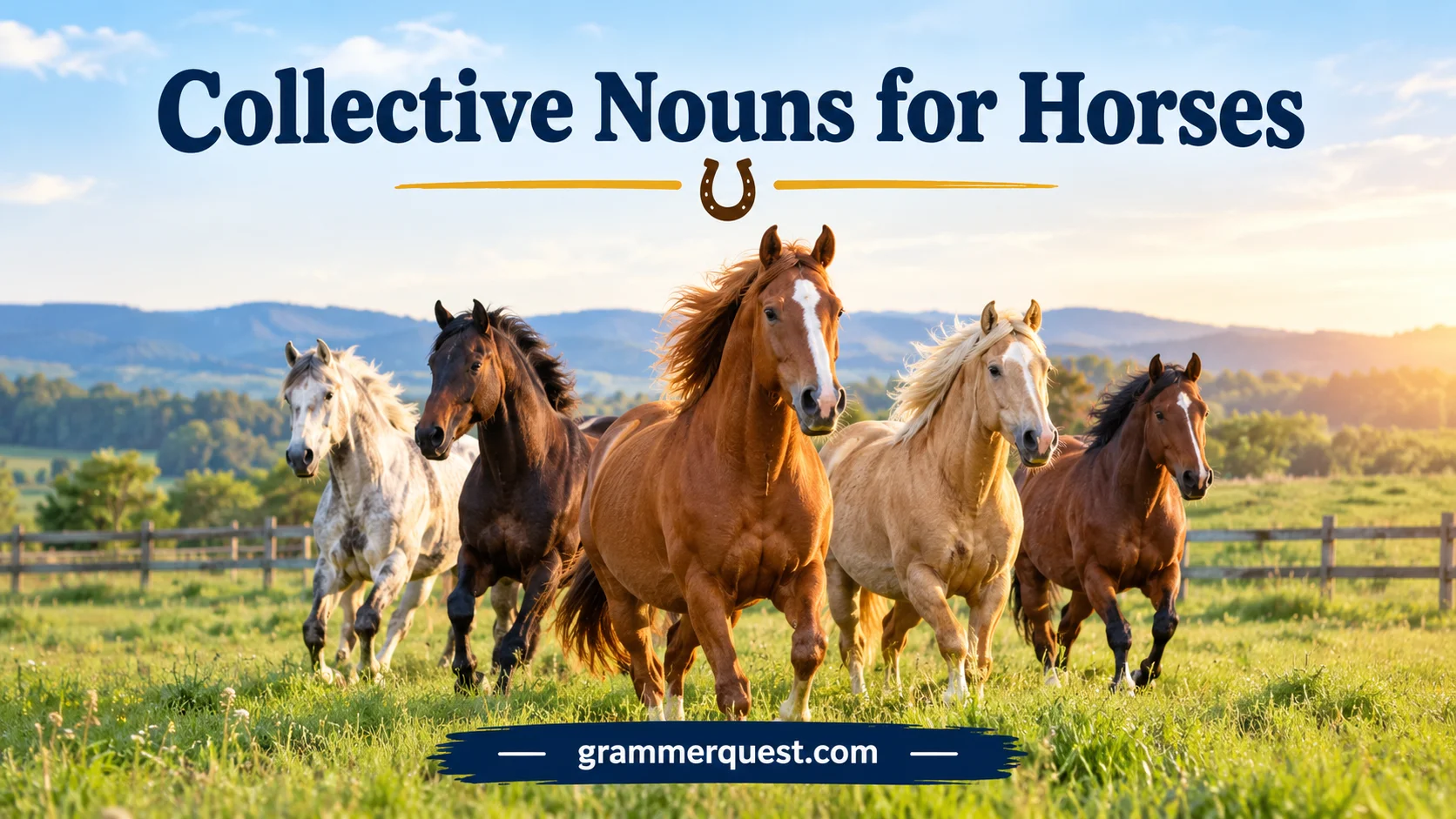
Collective Nouns for Horses help learners understand how words like herd describe horses together in everyday English and improve their animal vocabulary.
When learning English, readers often encounter horse-related words in novels, movies, and other forms of English reading. A herd is a group of horses that may be seen running together in a field. These word groups and horse phrases are useful for building vocabulary, improving writing skills, and understanding how animals behave in groups. They can also support essay writing, an English exam, academic writing, and written communication by helping learners choose suitable expressions during essay preparation.
Writers are sometimes unsure whether to treat a collective noun as singular or plural. The general rule is to use a singular verb when the sentence presents the group as one unit, such as “The herd is moving across the field.” In some varieties of English, a plural verb is also possible when the context focuses on the individuals within the group, as in “The herd are spreading out.” This difference relates to grammar, noun usage, grammatical number, and subject-verb agreement. Understanding these language rules, usage rules, and the grammatical context helps learners see how sentence structure affects sentence meaning. By examining sample sentences and sentence examples, learners can understand the difference between a collective noun as singular and a collective noun as plural, depending on meaning and dialect.
Common Collective Nouns for Horses
The collective noun used for horses can change depending on the situation. Some words describe horses living together, while others describe horses used for work, transportation, or competition.
| Collective Noun Type | Simple Example |
| Herd | A herd of horses was grazing in the field. |
| Team | A team of horses pulled the carriage. |
| String | A string of horses was prepared for the riders. |
| Stud | A stud of horses was kept for breeding. |
| Stable | A stable of horses was cared for by the workers. |
Collective Nouns for Horses with Example Sentences
1. Herd of Horses
A herd is the most common collective noun for horses. It refers to a group of horses living or moving together, especially in natural environments. Horses form herds for protection, companionship, and social interaction.
Examples
- A herd of horses was running across the open grassland.
- The farmer watched a herd of horses grazing peacefully.
- A herd of horses moved together toward the water source.
- The wild herd of horses traveled many miles in search of food.
- A herd of horses gathered near the fence in the evening.
- The photographer captured a beautiful herd of horses in the valley.
- A herd of horses showed strong social bonds while moving together.
- The children enjoyed watching a herd of horses in the field.
- A herd of horses rested under the shade of trees.
- The wildlife team studied a herd of horses in their natural habitat.
2. Team of Horses
A team of horses describes horses that work together to complete a task. This term is commonly used for horses pulling carriages, wagons, or performing in competitions.
Examples
- A team of horses pulled the heavy carriage.
- The farmer trained a team of horses for farm work.
- A team of horses carried supplies across the countryside.
- The coach prepared a team of horses for the competition.
- A team of horses moved the wagon smoothly along the road.
- The visitors admired a team of horses during the parade.
- A team of horses helped people travel long distances in the past.
- The driver guided a team of horses through the village.
- A strong team of horses completed the difficult journey.
- The team of horses worked together with perfect coordination.
3. String of Horses
A string of horses usually refers to a group of horses owned or managed by one person, especially horses used for riding. It is often associated with ranches, stables, and traveling riders.
Examples
- The cowboy managed a string of horses on the ranch.
- A string of horses was ready for the mountain journey.
- The guide selected a string of horses for the tourists.
- A string of horses waited near the stable entrance.
- The ranch owner cared for a valuable string of horses.
- A string of horses followed the rider along the trail.
- The traveler rented a string of horses for the adventure.
- A string of horses was trained for different riding styles.
- The ranch displayed its finest string of horses.
- A string of horses helped explorers travel through difficult areas.
4. Stud of Horses
A stud refers to a group of male breeding horses or a place where horses are bred. This term is often used in horse breeding and farming.
Examples
- The breeder owned a stud of horses with excellent qualities.
- A stud of horses was carefully selected for breeding.
- The farm became famous for its healthy stud of horses.
- The owner maintained a stud of horses for future generations.
- A stud of horses was kept in a special breeding area.
- The expert examined the stud of horses before choosing a champion.
- The farm’s stud of horses produced strong young horses.
- The breeder proudly showed visitors the stud of horses.
- A stud of horses helped improve the quality of the breed.
- The successful ranch managed a large stud of horses.
5. Stable of Horses
A stable can describe a group of horses kept in the same stable area. It is commonly used when talking about horses cared for by humans.
Examples
- A stable of horses was kept clean and comfortable.
- The trainer cared for a stable of horses every morning.
- A stable of horses was prepared for the upcoming race.
- The children visited a stable of horses during their trip.
- A stable of horses received fresh food and water daily.
- The workers cleaned the stable where the horses lived.
- A stable of horses included many different breeds.
- The owner maintained a healthy stable of horses.
- A stable of horses rested after a long journey.
- The veterinarian checked the stable of horses regularly.
Interesting Facts About Horses
Horses are fascinating animals with a long history of living alongside humans. They have been domesticated for thousands of years and have played important roles in transportation, farming, sports, and culture. Horses can live for around 25 to 30 years, and some well-cared-for horses may live even longer. Their powerful legs contain a unique structure that allows them to stand and rest while using very little energy. Horses also have excellent hearing and can move their ears in different directions to detect sounds around them. Their large eyes provide a wide field of vision, helping them notice possible dangers. Horses are herbivores, meaning they mainly eat grass, hay, and other plant materials. They have a special digestive system designed for eating small amounts of food throughout the day, making regular access to forage important for their health.
Conclusion
Collective Nouns for Horses help us describe a group of horses clearly and naturally. The word herd is the most common term for a group of horses. Understanding collective nouns also helps learners use singular and plural verbs correctly, improve their English grammar, and write better sentences. With regular practice, you can use these terms confidently in everyday conversations, school assignments, and English exams.
FAQs
1. What is the collective noun for horses?
Herd is the most common collective noun for horses. For example, A herd of horses is grazing in the field.
2. Can I use “herd” in a sentence?
Yes, you can use herd to describe horses together. For example, The herd of horses ran across the open field.
3. Is “herd” singular or plural?
Herd is a singular collective noun when the group is treated as one unit. The verb choice can vary when the sentence focuses on individual horses, especially in British English.
4. What is the difference between a herd and a horse?
A horse refers to one animal, while a herd refers to a group of horses living or moving together.
5. Why should we learn collective nouns for horses?
Learning collective nouns for horses improves vocabulary, strengthens grammar skills, and helps you write clearer sentences in schoolwork, stories, and English exams.