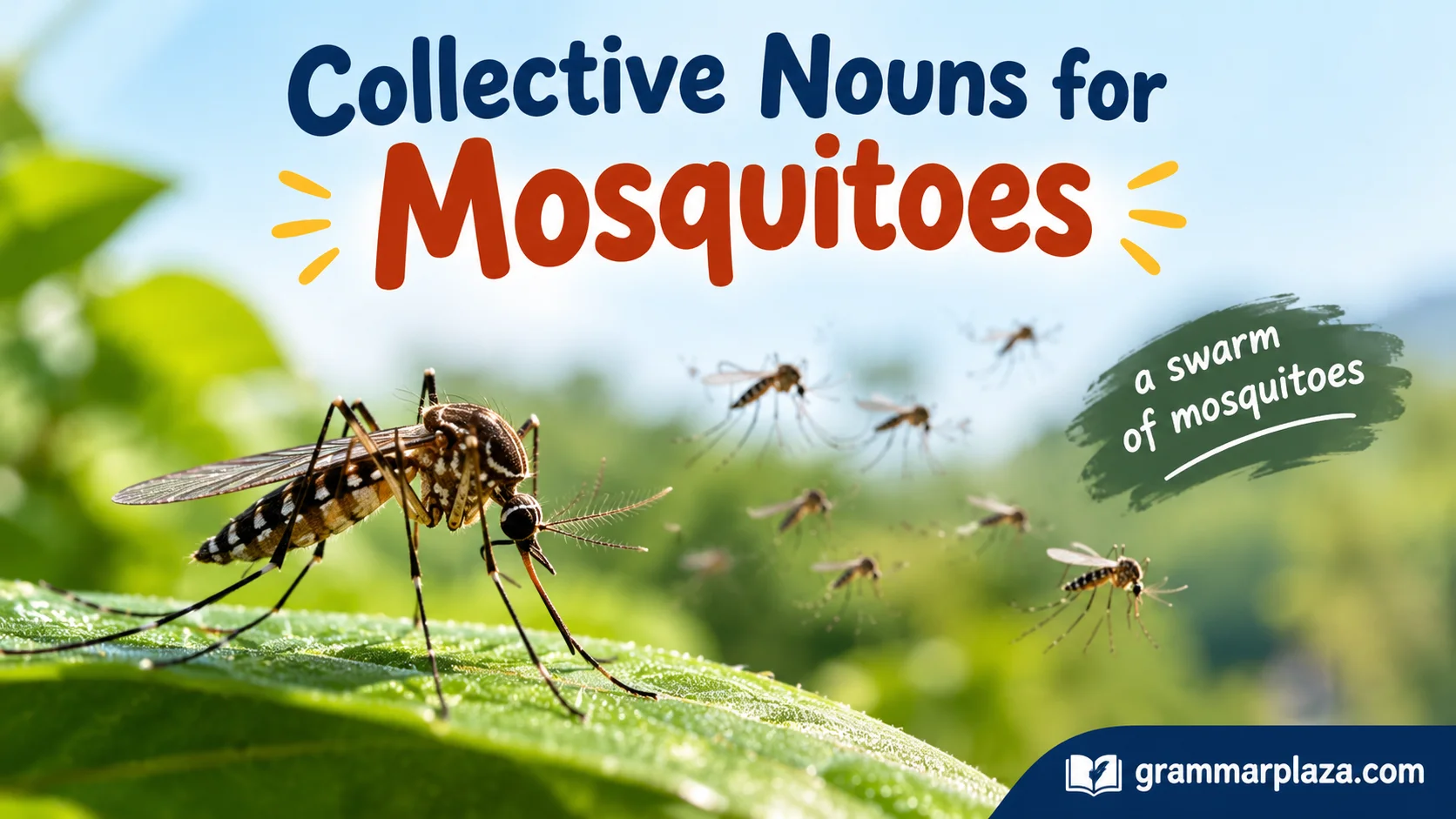
Collective Nouns for Mosquitoes explain how words like swarm, cloud, and horde describe these tiny insects in simple, clear English.
Collective nouns describe groups of people, animals, or things as a single unit. A swarm is a common term for mosquitoes flying together, while cloud and horde are creative, descriptive terms for a large gathering. These special words make sentences easier to understand and help people choose precise language when writing or speaking about insects. Learning these expressions improves vocabulary and makes everyday language more natural and interesting.
When mosquitoes gather, fly, or move together, these expressions help describe their behavior in different settings, including water sources, gardens, and warm environments. Although there is no universally accepted collective noun for every group of insects, swarm, cloud, and horde are useful terms for discussing mosquito behavior and characteristics. Related vocabulary includes singular forms, plural forms, and immature stages. The singular form is mosquito, while the plural form is mosquitoes. Choosing the right expression depends on the context: swarm emphasizes mosquitoes flying in groups, while cloud creates a picture of many insects gathered in the air. These descriptive words help writers explain different types of insect groups, appreciate their characteristics, and make writing more engaging for readers.
Collective Nouns for Mosquitoes: A Quick Overview
| Collective Noun Type | Simple Example |
| Swarm | A swarm of mosquitoes flew near the pond. |
| Cloud | A cloud of mosquitoes gathered above the water. |
| Horde | A horde of mosquitoes appeared after the rain. |
| Plague | A plague of mosquitoes affected the village. |
| Bunch | A bunch of mosquitoes hovered near the plants. |
Common Collective Nouns Used for Mosquitoes
1. Swarm of Mosquitoes
A swarm of mosquitoes is one of the most commonly used expressions. It describes a large number of mosquitoes flying together, usually in a moving group. Mosquito swarms often appear near breeding areas, such as ponds, wetlands, and areas with standing water.
Example
- A swarm of mosquitoes flew around the lake during the evening.
- The campers noticed a swarm of mosquitoes near their tents.
- A swarm of mosquitoes gathered after the heavy rainfall.
- The farmer saw a swarm of mosquitoes above the field.
- A swarm of mosquitoes moved across the garden.
- The children avoided the area because of a swarm of mosquitoes.
- A swarm of mosquitoes appeared near the old pond.
- The scientist studied a swarm of mosquitoes in the laboratory.
- A swarm of mosquitoes surrounded the animals near the river.
- The warm weather attracted a swarm of mosquitoes.
2. Cloud of Mosquitoes
A cloud of mosquitoes describes a large group that appears like a floating cloud because of the number of insects flying together. This term is often used when mosquitoes are seen moving in the air.
Example
- A cloud of mosquitoes covered the area near the wetland.
- The hikers walked away from a cloud of mosquitoes.
- A cloud of mosquitoes formed above the grass.
- The sunset revealed a cloud of mosquitoes flying together.
- A cloud of mosquitoes appeared after the storm.
- The villagers used protection against a cloud of mosquitoes.
- A cloud of mosquitoes hovered near the riverbank.
- The researcher observed a cloud of mosquitoes outdoors.
- A cloud of mosquitoes moved slowly through the air.
- The garden became home to a cloud of mosquitoes.
3. Horde of Mosquitoes
A horde of mosquitoes refers to a very large and overwhelming group. It is often used when mosquitoes gather in great numbers and become difficult to avoid.
Example
- A horde of mosquitoes surrounded the travelers.
- The forest contained a horde of mosquitoes near the water.
- A horde of mosquitoes appeared during the humid season.
- The villagers protected themselves from a horde of mosquitoes.
- A horde of mosquitoes gathered around the pond.
- The explorers faced a horde of mosquitoes in the jungle.
- A horde of mosquitoes made outdoor activities difficult.
- The warm climate encouraged a horde of mosquitoes.
- A horde of mosquitoes filled the garden area.
- The researchers counted a horde of mosquitoes in the region.
4. Plague of Mosquitoes
A plague of mosquitoes is used when mosquitoes become extremely numerous and create a serious problem. This term is commonly associated with outbreaks where mosquito populations increase rapidly.
Example
- A plague of mosquitoes spread after the flooding.
- The town prepared for a plague of mosquitoes during summer.
- A plague of mosquitoes affected people living near wetlands.
- The health workers controlled the plague of mosquitoes.
- A plague of mosquitoes appeared after several rainy days.
- The villagers suffered from a plague of mosquitoes.
- A plague of mosquitoes caused concern among residents.
- The government worked to prevent a plague of mosquitoes.
- A plague of mosquitoes increased the need for insect protection.
- The scientists studied the causes of a plague of mosquitoes.
5. Bunch of Mosquitoes
A bunch of mosquitoes is a simple and informal way to describe a small group of mosquitoes gathered together.
Example
- A bunch of mosquitoes flew around the flowers.
- I noticed a bunch of mosquitoes near the window.
- A bunch of mosquitoes gathered beside the water container.
- The child moved away from a bunch of mosquitoes.
- A bunch of mosquitoes hovered over the plants.
- The gardener removed standing water where a bunch of mosquitoes appeared.
- A bunch of mosquitoes rested on the wall.
- The scientist collected a bunch of mosquitoes for research.
- A bunch of mosquitoes gathered in the shaded area.
- The birds caught a bunch of mosquitoes near the trees.
Interesting Facts About Mosquitoes
Mosquitoes are among the oldest insects on Earth and have existed for millions of years. Their lifespan varies depending on species and environmental conditions. Male mosquitoes usually live for about a week, while female mosquitoes can survive for several weeks or even longer in favorable conditions.
Mosquitoes have unique physical features that help them survive. They have specialized mouthparts called a proboscis, which allows females to pierce skin and obtain blood. Their sensitive antennae help them detect movement, body heat, and carbon dioxide released by animals and humans.
Although mosquitoes are famous for biting, not all mosquitoes feed on blood. Male mosquitoes usually survive by feeding on plant nectar, while female mosquitoes mainly drink nectar as well. Female mosquitoes require nutrients from blood meals to develop their eggs. These insects play a role in ecosystems because they serve as food for birds, fish, frogs, and other animals. However, some mosquito species can spread diseases, making their population control important.
Frequently Asked Questions About Collective Nouns for Mosquitoes
1. What is the most common collective noun for mosquitoes?
The most common collective noun for mosquitoes is swarm. It describes a group of mosquitoes flying together in the air.
2. Can we use the word “cloud” for a group of mosquitoes?
Yes, a cloud of mosquitoes is a descriptive term used when a large number of mosquitoes appear together and look like a moving cloud.
3. Are collective nouns for mosquitoes officially recognized?
Some collective nouns, such as “swarm,” are commonly used, while others are informal or descriptive. English often allows creative group names for animals.
4. Why do mosquitoes gather in groups?
Mosquitoes gather in groups for mating, finding suitable environments, and locating sources of food and water.
5. Do all mosquitoes bite humans?
No, only female mosquitoes of certain species bite humans because they need blood nutrients to produce eggs. Male mosquitoes mainly feed on plant nectar.
Conclusion
Understanding collective nouns for mosquitoes adds richness to the English language and gives us a more interesting way to describe these tiny insects. Words like swarm, cloud, horde, plague, and bunch help us imagine how mosquitoes gather and move in nature.
Beyond language, learning about mosquitoes reveals their fascinating biological features, survival abilities, and important role in ecosystems. Although they are often considered pests, mosquitoes are complex creatures with unique behaviors that contribute to the natural world. Exploring both their collective nouns and biological traits helps us appreciate the diversity and wonder of wildlife.