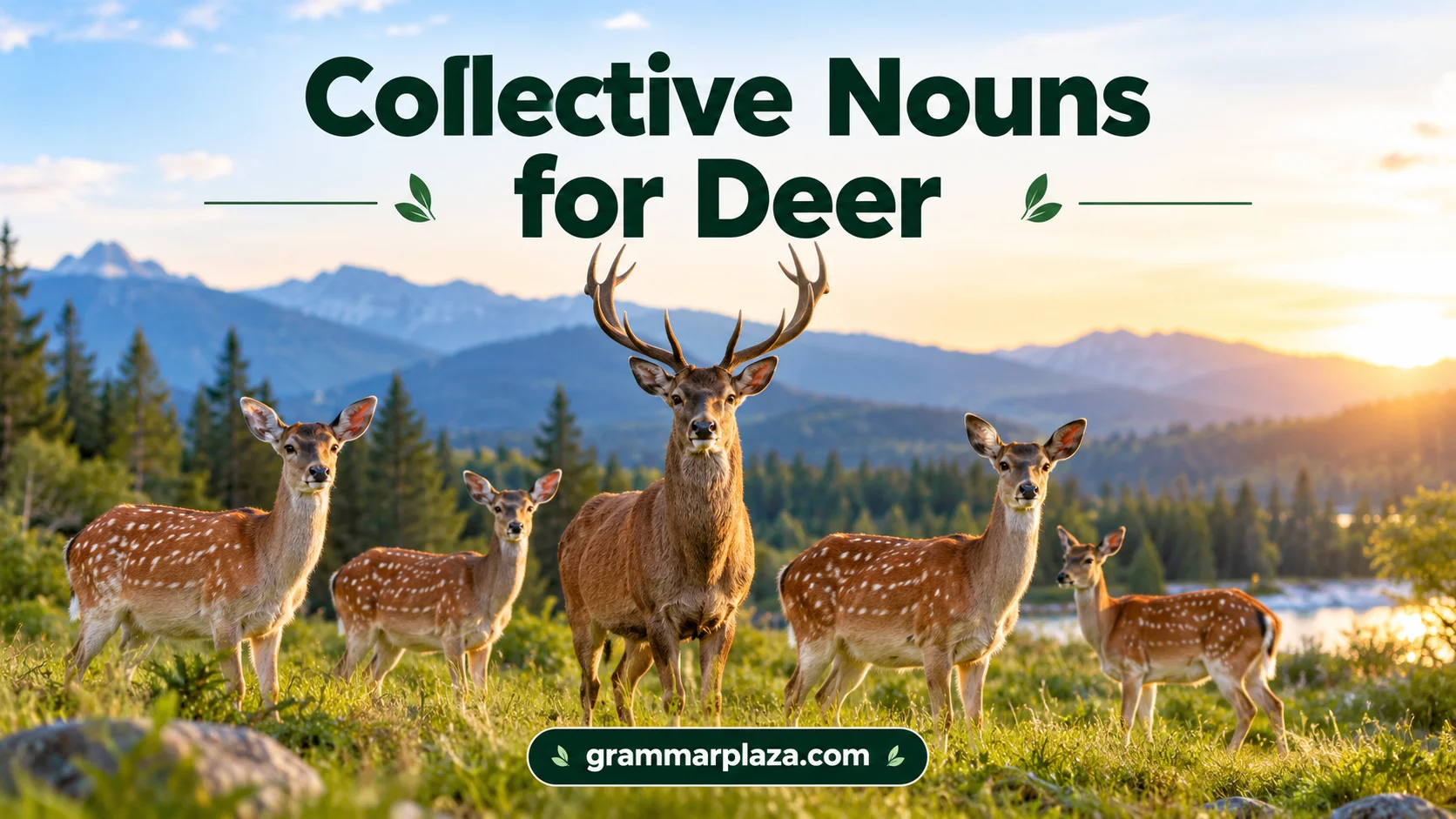
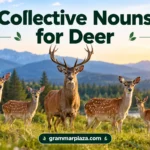
Collective Nouns for Deer help us understand the special words used to describe a group of these graceful animals. The most common term is herd, which is widely used in everyday English, wildlife writing, and biological contexts. When several deer graze together in a meadow or move through a forest, they are generally described as a herd. However, English also has some older and less common terms, including bevy, rangale, parcel, and leash, which developed from traditional hunting vocabulary.
Deer are fascinating animals with different names based on their age and sex. A male deer may be called a buck or stag, while a female is known as a doe or hind. A young deer is commonly called a fawn. Deer can form different social groups depending on the season, species, and environment. Learning these collective nouns and related terms can make your writing more accurate while giving you a better understanding of deer behavior, movement, and social life.
Collective Nouns for Deer
Here are some commonly used collective nouns associated with deer. Their usage can vary by region and context, but herd is by far the most common and natural term in modern English.
| Type | Simple Example |
| Herd | A herd of deer |
| Bevy | A bevy of deer |
| Gang | A gang of deer |
| Mob | A mob of deer |
| Bunch | A bunch of deer |
1. Herd of Deer
Herd is the most common collective noun for deer. It refers to several deer staying or moving together. Deer may form herds while feeding, traveling, resting, or responding to danger. The size and structure of a herd can change depending on the species, season, habitat, and availability of food.
Examples
- A herd of deer crossed the road at sunrise.
- We watched a herd of deer grazing in the meadow.
- The herd of deer disappeared into the forest.
- A large herd of deer was resting near the trees.
- The farmer saw a herd of deer near his field.
- The herd of deer moved quietly through the woodland.
- A herd of deer gathered beside the stream.
- The photographer waited patiently for the herd of deer to appear.
- We spotted a herd of deer from the hilltop.
- The herd of deer quickly ran away after hearing a loud noise.
2. Bevy of Deer
Bevy is a less common collective noun that can be used for a group of deer. It gives writing a more literary or descriptive feeling. Although you may encounter it in wildlife writing or older vocabulary lists, herd is generally the safer choice in everyday English.
Examples
- A bevy of deer wandered through the green valley.
- We saw a bevy of deer near the edge of the forest.
- The bevy of deer stopped to drink from the pond.
- A bevy of deer moved across the open field.
- The children quietly watched a bevy of deer.
- A bevy of deer rested beneath the tall trees.
- The photographer captured a beautiful bevy of deer.
- We noticed a bevy of deer at dawn.
- The bevy of deer disappeared behind the bushes.
- A bevy of deer gathered in a peaceful meadow.
3. Gang of Deer
Gang is another informal term sometimes used for a group of deer. It is more conversational than herd and can suggest a group moving or behaving together. However, it isn’t as standard or widely used as “herd of deer.”
Examples
- A gang of deer appeared near the woodland.
- We saw a gang of deer crossing the field.
- The gang of deer moved toward the river.
- A gang of deer was feeding in the meadow.
- The hikers noticed a gang of deer between the trees.
- A gang of deer suddenly ran across the path.
- The gang of deer stayed close to the forest.
- We quietly followed a gang of deer from a distance.
- A gang of deer gathered near the grassy hillside.
- The gang of deer disappeared into the woods.
4. Mob of Deer
Mob can also appear as a collective term for a group of animals, including deer, particularly in some regional or informal usage. It suggests a relatively large or active group. In standard everyday English, however, herd remains much more familiar.
Examples
- A mob of deer moved across the grassland.
- We watched a mob of deer near the trees.
- The mob of deer ran toward the forest.
- A mob of deer gathered beside the road.
- The ranger spotted a mob of deer at dawn.
- The mob of deer stopped to feed on the grass.
- A mob of deer moved quietly through the valley.
- We saw a mob of deer from a safe distance.
- The mob of deer quickly disappeared into the woodland.
- A mob of deer crossed the meadow before sunset.
5. Bunch of Deer
Bunch is an informal and simple expression for a group of deer. It isn’t a specialized collective noun in the same way herd is, but people may use it in casual speech when referring to several deer together.
Examples
- We saw a bunch of deer in the meadow.
- A bunch of deer was standing near the trees.
- The children spotted a bunch of deer from the window.
- A bunch of deer crossed the road carefully.
- We watched a bunch of deer eating grass.
- The bunch of deer moved toward the river.
- A bunch of deer rested beneath the trees.
- The photographer noticed a bunch of deer in the distance.
- A bunch of deer suddenly ran into the forest.
- We saw a bunch of deer during our morning walk.
Read More: Collective Nouns for Keys
Interesting Facts About Deer
Deer belong to the Cervidae family, which includes many species ranging from small muntjacs to large moose. Their longevity varies considerably by species and living conditions, but some deer can survive for well over a decade in the wild, while individuals under human care may sometimes live considerably longer. One of their most remarkable physiological features is their antler growth. In most deer species, males grow new antlers annually, and the developing antlers are among the fastest-growing bone tissues known in mammals. Deer also have specialized digestive systems that allow them to process fibrous plant foods. As ruminants, they have a multi-compartment stomach and regurgitate partially digested food to chew it again, a process called rumination. Their diet commonly includes grasses, leaves, shoots, buds, fruits, and other vegetation, although the exact diet changes according to species and habitat.
Faqs :
1. What is a group of deer called?
A group of deer is most commonly called a herd. This is the standard term used in everyday English, wildlife writing, and general descriptions of deer.
2. Can a group of deer be called a bevy?
Yes. Bevy is an older collective noun for deer. It is less common today but can still be found in traditional terms of venery and historical references.
3. What is a male deer called?
A male deer is commonly called a buck or stag, depending on the species and region. Some male deer may also have species-specific names.
4. What is a baby deer called?
A baby deer is called a fawn. Fawns are usually born with distinctive spots that help provide camouflage while they remain hidden from predators.
5. Is “deers” the plural of deer?
No. The plural of deer is also deer. For example, you can say, “We saw five deer in the forest,” rather than “five deers.”
Conclusion :
Knowing the correct collective nouns for deer makes your English more accurate and interesting. Herd is the most widely accepted term, while words such as bevy, rangale, parcel, and leash have historical or less-common usage. Understanding these terms also helps you describe deer, their groups, and their behavior more clearly.





1 thought on “Collective Nouns for Deer”