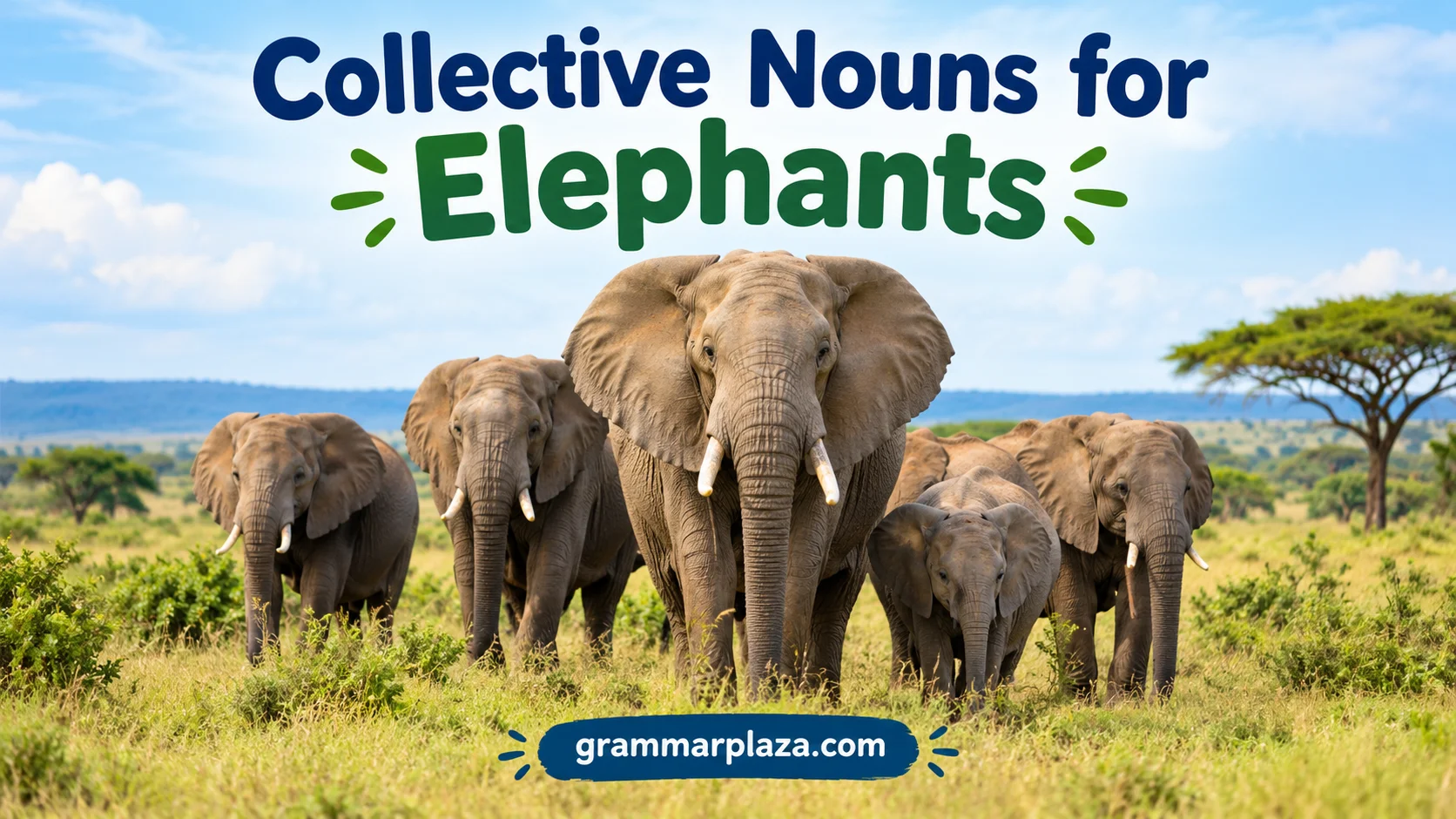
Collective Nouns for Elephants explains how a herd or parade describes these social mammals and helps readers build clear English vocabulary.
Language has many special words that describe animals when they live, travel, or feed together. A collective noun for elephants is a word or expression used to describe a group of these large and intelligent mammals. The most widely recognized term is a herd of elephants, reflecting their family-based social lives and their habit of moving together. Another expression, a parade of elephants, appears in descriptive writing and literary writing. These collective nouns make English more expressive and help us describe groups without naming every individual animal.
Some common terms are used in everyday conversation, while traditional terms and less frequently used terms may appear in books or creative descriptions. Understanding the difference helps English learners choose words naturally and accurately. An article about the main collective nouns for elephants can include sentence examples that show how to use these terms in sentences. For example, “A herd of elephants moved through the grassland” describes an animal group, while “A parade of elephants crossed the open path” creates a vivid picture. These collective expressions support language learning, build English vocabulary, and strengthen grammar and communication.
Learning these terms also offers a way to explore elephant social behavior, physical features, habitat, diet, and fascinating biological traits. Elephants are social mammals whose animal behavior and social lives are important parts of wildlife study. When discussing animal descriptions, natural movement, and feeding behavior, choosing suitable terminology helps readers picture how elephants live in groups. From my perspective as a language educator, connecting collective nouns with real animal groups makes it easier to remember grammar and describe wildlife cle
What Is a Collective Noun?
A collective noun is a word that names a group of people, animals, or things as a unit. Instead of describing every member separately, we use one expression for the entire group.
Collective nouns make sentences shorter, clearer, and more natural. They are an important part of English grammar and everyday communication.
Here are three simple examples:
- A flock of birds flew over the garden.
- A herd of cattle grazed in the field.
- A team of players practiced before the match.
Some collective nouns are widely used, such as a flock of birds. Others are traditional expressions that readers may encounter mainly in books or descriptive writing. Knowing which terms are familiar and which are uncommon helps us use animal vocabulary correctly.
What Is a Group of Elephants Called?
A group of elephants is most commonly called a herd of elephants. This is the clearest and most widely accepted expression for ordinary conversation, schoolwork, and wildlife writing.
A parade of elephants is another recognized expression. It creates a vivid picture of elephants moving together and is especially suitable for descriptive or literary contexts. However, it is less neutral than herd and should not be presented as the standard term in every situation.
The word group is also completely correct. For everyday English, a group of elephants is a useful alternative when you do not need a more specific collective noun.
Quick Reference Table
| Type | Simple Example |
| Herd | A herd of elephants |
| Parade | A parade of elephants |
1. A Herd of Elephants
Meaning
A herd of elephants is a group of elephants that live, travel, or feed together. Herd is the most common and practical collective noun for elephants. It is suitable for everyday English, educational writing, wildlife reports, and conversations about animal behavior.
The word can describe a family group of elephants or a larger gathering, depending on the context. It does not require the animals to remain together at every moment.
Why It Fits Elephants
The word herd fits elephants because these animals have complex social relationships. In African and Asian elephants, females and their young commonly form family groups. Older females can play important roles in guiding and protecting younger members.
A herd may travel between feeding areas and water sources, rest in shaded places, or respond together to potential danger. Its members communicate through sounds, body movements, touch, and other signals. Although adult males may spend much of their time alone or in smaller male groups, they can also join other elephants. Therefore, herd is a useful general term without suggesting that every elephant always lives in a large permanent group.
Examples
- A herd of elephants crossed the open grassland.
- The herd stopped near a waterhole to drink.
- We watched a herd of elephants moving slowly through the reserve.
- A young calf stayed close to the other members of its herd.
- The herd searched for fresh leaves and grasses.
- After resting in the shade, the herd continued its journey.
- Rangers observed a herd of elephants from a safe distance.
- The largest female helped guide the herd toward familiar feeding grounds.
- Dust rose around the herd as the elephants walked across the dry ground.
- The herd gathered beneath the trees during the hottest part of the day.
2. A Parade of Elephants
Meaning
A parade of elephants is a recognized collective expression that describes elephants moving together, often in a way that creates a striking visual impression. It is more descriptive than herd and is particularly suitable for storytelling, creative writing, and vivid wildlife descriptions.
Unlike herd, which is a standard general term, parade is less neutral and less suitable as the default answer in formal biological descriptions. It should be understood as a traditional or literary-style expression rather than a precise scientific classification.
Why It Fits Elephants
The word parade can bring to mind a line of large animals moving steadily across a landscape. Elephants may travel in a loose line, especially when navigating narrow paths or moving through vegetation. Young calves often remain near adults, and family members may adjust their positions as they walk.
The expression is useful when a writer wants readers to picture the movement, size, and presence of the animals. However, elephants do not always move in a neat line, and their natural travel patterns vary with the terrain and circumstances. Calling a gathering a parade describes the scene; it does not establish a special type of elephant society.
Examples
- A parade of elephants moved across the dusty plain.
- From the viewing platform, we saw a parade of elephants approaching the river.
- The parade passed slowly between the scattered trees.
- At sunrise, a parade of elephants appeared along the edge of the grassland.
- The photographer waited quietly as the parade moved into view.
- A parade of elephants followed a narrow path through the woodland.
- The sight of the parade crossing the open ground was unforgettable.
- One calf hurried to keep up with the parade.
- The parade continued toward a shady area after feeding.
- We could see the parade clearly from the wildlife reserve’s observation point.
3. A Group of Elephants
Meaning
A group of elephants is a simple, accurate way to describe two or more elephants considered together. Although group is a general noun rather than a distinctive elephant-specific term, it is entirely natural English.
This expression is useful when the animals’ family relationships, social organization, or movement patterns are unknown. It also works well for English learners because it can describe almost any collection of animals without requiring specialized vocabulary.
Why It Fits Elephants
Elephants do not always travel as one large, tightly connected herd. Their arrangements can change according to food availability, water, reproductive behavior, age, and social relationships. Some elephants may temporarily separate and later reunite with familiar individuals.
The word group allows a writer to describe what is visible without making assumptions about the animals’ relationships. For example, a wildlife observer might see several adult males together or notice elephants gathering around a water source. If their social structure is uncertain, group remains a reliable choice. It is also helpful in scientific explanations when the exact nature of a gathering has not been established.
Examples
- A group of elephants gathered beside the river.
- We spotted a group of elephants from the safari vehicle.
- The group moved toward the trees as the temperature rose.
- A small group of elephants fed near the edge of the woodland.
- The researchers recorded the group’s movements without disturbing the animals.
- Several elephants in the group used their trunks to collect food.
- A group of elephants walked across the reserve’s open grassland.
- The group remained near the water for several minutes.
- Visitors watched the group from a designated viewing area.
- The guide explained how the group might change as the elephants grew older.
4. Using “Herd” for Elephant Family Groups
Meaning
The word herd is particularly useful when describing elephants that live and interact as a social unit. In many cases, an elephant herd consists mainly of related females and their young. The term is not limited to a specific number of animals, and it does not mean that every member must be a close relative.
When writing about elephant families, herd provides a natural connection between English vocabulary and the animals’ social organization.
Why It Fits Elephants
Elephant family groups offer an excellent example of how a collective noun can describe more than the simple presence of several animals. Family members may maintain long-lasting relationships, help protect calves, and learn from experienced adults.
Older females often contribute valuable knowledge about routes, feeding areas, and water sources. When a family group encounters a possible threat, members may bunch together, with adults positioning themselves near younger elephants. These behaviors vary with the situation and species, but they help explain why herd is such a useful term for elephants living in family groups.
At the same time, the word should not be taken to mean that all elephants remain in the same family group throughout their lives. Social relationships and group membership can change.
Examples
- The herd stayed close together while the calves explored their surroundings.
- An older female led the herd toward a familiar water source.
- The herd paused when a young calf fell behind.
- Several adults stood near the calves as the herd rested.
- Researchers observed the herd’s social interactions from a distance.
- The herd moved into the shade during the afternoon heat.
- A mother and her calf remained near the other members of the herd.
- The herd changed direction when the path became difficult to cross.
- Young elephants learn many useful behaviors by observing other members of the herd.
- The herd gradually spread out as the elephants began feeding.
5. Choosing Between “Herd,” “Parade,” and “Group”
Meaning
Herd, parade, and group can all describe multiple elephants, but they are not interchangeable in every writing situation.
- Herd: The best general choice for elephants living or moving together.
- Parade: A more descriptive expression that emphasizes the visual impression of elephants moving together.
- Group: A neutral, flexible word for two or more elephants when their social relationships are not important or are unknown.
Choosing the right expression makes your writing clearer and more natural. It also helps readers distinguish between everyday vocabulary and a more colorful literary description.
Why It Fits Elephants
Elephants are large, social mammals, but not every gathering has the same structure. A family traveling together can naturally be called a herd. Several elephants moving across a landscape might be described as a parade when the writer wants a vivid image. If a researcher sees elephants gathered at a water source but does not know whether they belong to the same family, group may be more appropriate.
The context determines which word works best. In factual wildlife writing, clarity should come before decorative language. In a story, a descriptive term can help readers picture the scene. Understanding these distinctions is useful for students, teachers, and anyone learning English animal vocabulary.
Examples
- A herd of elephants rested beneath the trees.
- A parade of elephants made its way across the open plain.
- A group of elephants gathered near the feeding area.
- The herd stayed together while the young elephants played.
- The parade moved slowly into the distance.
- Researchers counted the group before recording their observations.
- The writer used the word herd to describe a family of elephants.
- The phrase parade of elephants gave the story a more vivid tone.
- The guide chose the word group because the elephants’ relationships were unknown.
- In a wildlife report, herd was the clearest term for the elephants traveling together.
How to Use Collective Nouns for Elephants
Collective nouns follow simple grammar rules. The most useful pattern is:
A + collective noun + of + animal name
For example, a herd of elephants and a parade of elephants.
Use a before herd and parade because both words begin with consonant sounds. The word of connects the collective noun to the animals being described.
Here are five examples:
- A herd of elephants is approaching the river.
- A parade of elephants crossed the plain at sunrise.
- The herd rested under the trees.
- We watched a group of elephants from the observation point.
- Several herds of elephants were recorded in the wider region.
Notice that the collective noun can appear without repeating of elephants when the reader already knows which animals are being discussed.
Should You Use a Singular or Plural Verb?
The verb depends on whether you treat the collective noun as one unit or emphasize the individual animals.
In American English, collective nouns are commonly treated as singular when the group is considered a unit:
- The herd is moving toward the river.
- The herd was resting in the shade.
In British English, a plural verb is also possible when the speaker emphasizes the members acting as individuals:
- The herd are moving in different directions.
- The herd were spreading out across the grassland.
The singular form emphasizes the group as a whole, while the plural form emphasizes the animals within it. Actual usage depends on the variety of English, the sentence, and the intended meaning.
For English learners, a helpful starting point is to use a singular verb when treating a herd as one unit. Then learn to recognize plural agreement in varieties of English where it is natural.
Interesting Facts About Elephants
Longevity
Elephants are long-lived mammals. Their lifespan varies with species, environment, health, and living conditions. African and Asian elephants can live for many decades, and some individuals reach around 60 years or more. However, lifespan is not identical for every elephant, and living in captivity does not automatically guarantee a longer life. Research has found important differences among captive populations and between captive and wild settings.
Their long lives allow elephants to develop lasting social relationships and accumulate valuable knowledge. Experienced adults can help younger animals learn where to find resources and how to respond to challenges. Longevity is therefore relevant not only to elephant biology but also to the structure of elephant families.
Unique Physical and Biological Features
Elephants are the largest living land animals. Their most recognizable feature is the trunk, a long, muscular structure formed by the nose and upper lip. Elephants use their trunks to breathe, smell, touch, collect food, draw up water, and communicate through physical contact. The trunk is highly flexible and capable of delicate movements as well as powerful actions.
Elephants also have large ears that help with hearing and heat regulation. African elephants generally have larger ears than Asian elephants, although ear size varies among individuals. Their thick skin can appear tough, but it is sensitive and needs care. The folds and wrinkles in elephant skin can help retain moisture.
Their tusks, which are elongated incisor teeth, are present in many African elephants and in some Asian elephants. Tusks can be used for digging, stripping bark, moving objects, and other tasks. Not all elephants have visible tusks, and tusk size and presence vary by species, sex, and individual.
Dietary Habits
Elephants are herbivores, meaning they eat plant material rather than hunting other animals for food. Their diet may include grasses, leaves, bark, roots, fruit, and other vegetation, depending on the habitat and what is available.
Because of their large bodies, elephants need to spend considerable time feeding. Their trunks help them reach, grasp, and gather food from different plants and surfaces. They may use their tusks or feet to assist with certain feeding activities, such as removing bark or disturbing soil.
Food choices change with the season and local conditions. In some environments, elephants feed heavily on grasses when these are abundant. At other times, they may consume more leaves, bark, or woody vegetation. Their feeding behavior can influence vegetation patterns and help move seeds through the environment, making elephants important parts of their ecosystems.
Social Behavior
Elephants are known for their complex social lives. Female African and Asian elephants commonly live in family groups that include related females and young. An experienced female often plays a central role in guiding the group. Family members may touch one another with their trunks, remain close to calves, and respond to one another’s calls and movements.
Communication includes audible sounds, body postures, touch, and low-frequency vocalizations. Some low-frequency sounds can travel long distances, helping elephants communicate beyond immediate visual contact.
Adult males often spend more time alone or in smaller male associations than females do, although their social behavior varies with age and circumstances. Elephants may come together at feeding areas or water sources even when they do not belong to the same family.
These patterns show why the word herd is useful but not a complete scientific description of every elephant gathering. Their relationships are flexible and shaped by social bonds, resources, and the environment.
Why Are Animal Collective Nouns So Interesting?
Animal collective nouns make English colorful and memorable. Words such as herd, flock, pack, and colony help us describe animals in a concise way. Some expressions are closely connected with familiar patterns of animal life, while others are traditional terms that have become part of English vocabulary through storytelling, observation, and literary use.
Certain collective nouns are especially vivid. A phrase such as a parade of elephants creates a clear mental picture, while a herd of elephants gives readers a straightforward description of animals moving or living together.
However, it is important not to assume that every collective noun began as a scientific description of animal behavior. Some expressions have uncertain histories, and traditional usage can continue even when it does not correspond to a formal biological category.
Learning these words allows readers to appreciate both language and wildlife. It also encourages curiosity about the ways people describe animals and the differences between everyday speech, creative writing, and scientific communication.
Collective Nouns vs. Ordinary Group Words
A collective noun names a group as a unit, while an ordinary group word can describe a collection without specifying a particular animal relationship.
Here is how several common terms are used:
- Herd: Commonly used for elephants, cattle, and several other large grazing or social mammals.
- Group: A general term that can describe almost any collection of animals.
- Pack: Commonly used for certain social animals, including wolves and wild dogs.
- Flock: Commonly used for birds and some other animals that gather or move together.
- School: Commonly used for fish and some other aquatic animals.
- Colony: Used for animals that live or gather in a shared area or organized settlement, such as certain seabirds or social insects.
These words have overlapping uses in some contexts, but they are not universally interchangeable. The best choice depends on the animal and the meaning you want to communicate.
For elephants, a herd of elephants is usually the most natural specific expression. Nevertheless, a group of elephants is grammatically correct and useful when you want neutral wording. You do not need to memorize a special term for every animal to communicate clearly.
What Collective Nouns Tell Us About Elephants
Collective nouns offer clues about how people have traditionally described animals. The word herd directs attention to animals living or moving together, while parade emphasizes the striking appearance of elephants traveling across a landscape.
These expressions can make wildlife writing more engaging, but they are not scientific definitions. A herd does not always have the same number of members, and a parade is not a formal category of elephant society. The words describe groups from a language perspective rather than defining their biological structure.
Modern wildlife research examines family relationships, communication, movement, feeding patterns, and the ways elephants respond to their environment. Traditional English vocabulary and scientific knowledge can complement one another, provided that their roles remain clear.
For students and language learners, this distinction is valuable. Collective nouns teach vocabulary and grammar, while elephant behavior provides real examples that make those language lessons easier to understand and remember.
Frequently Asked Questions About Elephants
What is a group of elephants called?
A group of elephants is most commonly called a herd of elephants. The word group is also correct, and parade is a more descriptive alternative.
What is the most common collective noun for elephants?
Herd is the most widely recognized general collective noun for elephants. It is suitable for everyday conversation, school assignments, and factual wildlife writing.
Can I say “a group of elephants” in English?
Yes. A group of elephants is grammatically correct and natural. It is particularly useful when the animals’ family relationships or social structure are unknown.
Is “a parade of elephants” correct?
Yes. A parade of elephants is a recognized descriptive expression. It is less neutral than herd and is especially useful in storytelling or vivid descriptions of elephants moving together.
Why does English have special names for groups of animals?
English uses collective nouns to describe groups concisely and expressively. Some terms reflect familiar animal groupings, while others belong to traditional or literary vocabulary. Not every animal has one universally used special term.
Conclusion
The most useful collective noun for elephants is herd. It provides a clear, natural way to describe elephants living, feeding, or traveling together. The expression parade of elephants offers a more vivid alternative, while group of elephants remains a simple and grammatically correct choice.
Learning these terms helps students strengthen their English grammar and expand their animal vocabulary. It also opens a window into elephant biology. These remarkable mammals have muscular trunks, long lifespans, plant-based diets, and complex social relationships. Family groups can depend on experienced females, and elephants use varied signals to communicate and maintain social bonds.
Collective nouns are more than words to memorize. They connect language with the living world, showing how a simple expression can help us describe an animal’s presence, movement, and relationships with others.