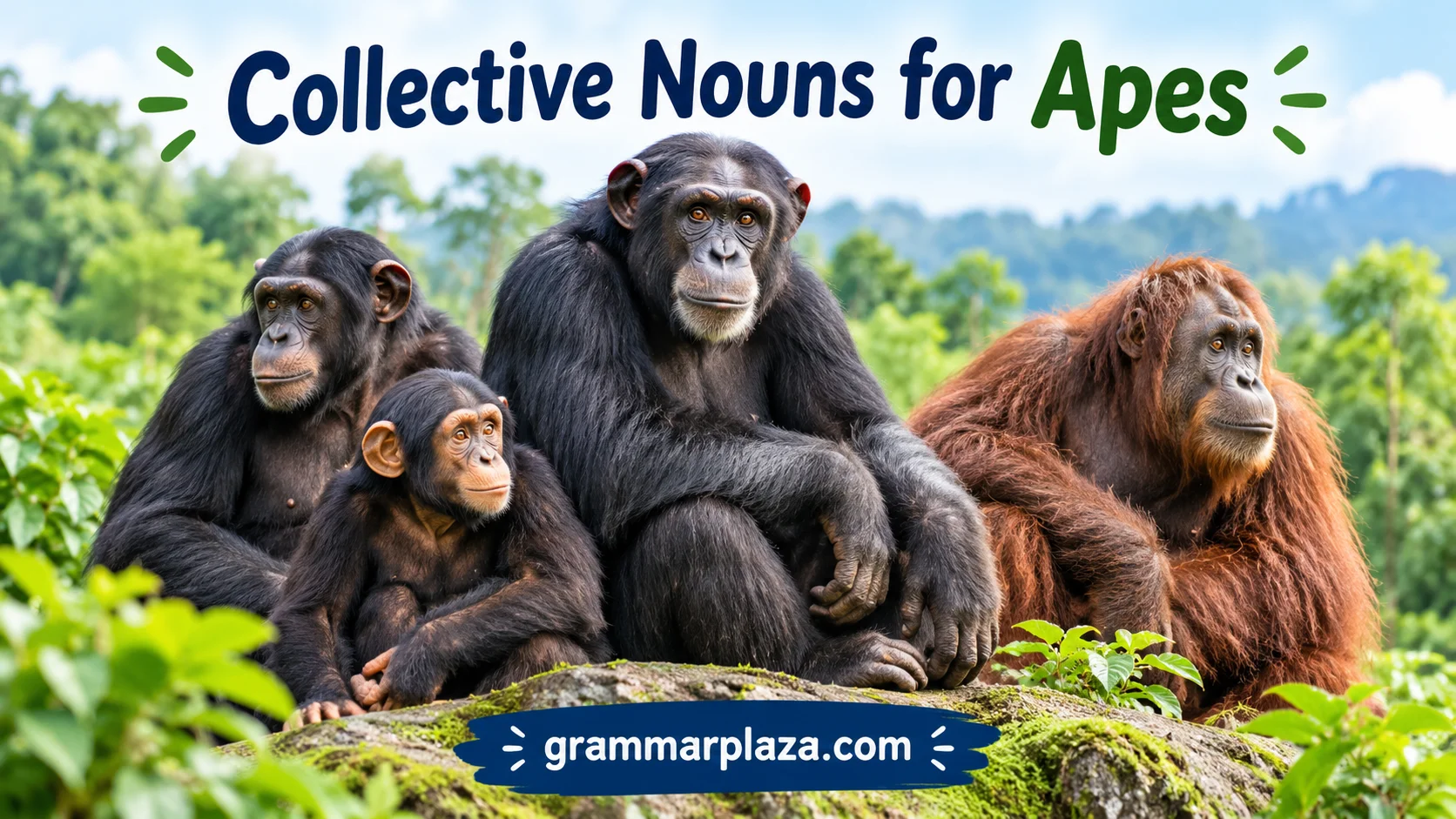
Collective Nouns for Apes explains how a troop and shrewdness describe apes together, helping readers learn animal group names and English grammar naturally.
The collective noun for apes is commonly given as a troop, while shrewdness is another traditional term found in lists of animal collective nouns. These expressions help us describe several apes without naming each animal individually. A collective noun is a word that represents a group of people, animals, or things. In English, words such as herd, flock, and team make descriptions shorter and more expressive. Learning these interesting animal group names shows how collective expressions improve English vocabulary and grammar. Choosing suitable group terminology also makes writing about these fascinating animal species clearer and more accurate.
However, not all apes live in the same social group. Gorillas often live in family groups, while chimpanzees form communities with changing associations between individuals. Orangutans, in contrast, are generally more solitary in the wild. These differences make ape communities an interesting subject for wildlife education. To use correctly the collective nouns associated with apes, readers should understand ape social behavior, animal behavior, social structure, and family relationships. Studying animal vocabulary alongside the animals’ real lives, rather than simply memorizing terms, provides helpful context for understanding these expressions.
Learning about apes also means exploring their physical features, habitat, diet, and lifespan. These details help readers understand wildlife, the natural environment, and the animal characteristics that make different primates unique. Their feeding habits and life expectancy add useful information to an article about apes. Exploring these broader facts helps readers learn about the animals while improving vocabulary and strengthening their understanding of wildlife.
What Is a Collective Noun?
A collective noun is a word used to name a group of people, animals, or things as a unit.
Collective nouns are useful because they allow us to describe several individuals with one expression. They are common in everyday English, educational writing, wildlife descriptions, and storytelling.
Here are three simple examples:
- A flock of birds flew across the sky.
- A herd of cattle grazed in the field.
- A team of players practiced before the match.
Some animal collective nouns, such as herd and flock, are widely used in ordinary conversation. Others are traditional or unusual expressions that readers may encounter mainly in vocabulary lists or literary writing.
What Is a Group of Apes Called?
A group of apes is commonly described as a troop of apes. The word shrewdness is also traditionally associated with apes, although it is much less familiar in everyday conversation.
The choice of group name can depend on the species and the context. For example, community is a useful term for chimpanzees, while party is used to describe temporary associations of orangutans. These words have different levels of specificity: some are general English group expressions, while others are associated with particular patterns of ape social behavior.
For most general English writing, “a troop of apes” or simply “a group of apes” is a clear and natural choice.
Quick Reference Table
| Type | Simple Example |
| Troop | A troop of apes moved through the forest. |
| Shrewdness | A shrewdness of apes appeared in the traditional vocabulary list. |
| Community | A community of chimpanzees searched for food. |
| Party | A party of orangutans gathered where fruit was plentiful. |
| Group | A group of apes rested among the trees. |
The terms in this table are not all interchangeable. Troop and shrewdness are associated with apes as collective nouns, while community and party have particular relevance to chimpanzee and orangutan social organization. Group is an ordinary, universally understandable description rather than an animal-specific term.
1. A Troop of Apes
Meaning
A troop of apes refers to a number of apes considered together. Troop is the most straightforward traditional collective noun for a group of apes and is also used for other primates. It is a useful choice when writing about apes that live or travel in social groups.
The word is especially suitable for descriptions of gorillas, which often live in family groups commonly called troops. However, not every ape species forms a stable troop, so the term should not be treated as a complete description of all ape social systems.
Why It Fits Apes
Many apes develop social relationships that influence how they feed, rest, communicate, and care for their young. Gorillas, for example, commonly live in groups containing a silverback male, females, and their offspring. Chimpanzees also form social communities, although their daily associations can change as individuals separate and reunite.
The word troop offers a convenient way to describe apes observed together in their habitat. It does not mean that all members always move as one unit. Some may forage separately before returning to other members of their social group. Therefore, the term works best as a general description rather than a universal biological rule.
Examples
- A troop of apes rested beneath the tall forest trees.
- We watched a troop of gorillas feeding on plants.
- The troop of apes moved slowly through the woodland.
- Several young apes played while the adults rested nearby.
- A troop of apes searched the forest for food.
- The wildlife guide observed a troop of gorillas from a safe distance.
- A troop of apes gathered around the shaded feeding area.
- The young members of the troop climbed and explored their surroundings.
- Researchers recorded the behavior of a troop of apes in their natural habitat.
- The troop of gorillas remained close together as the rain began.
2. A Shrewdness of Apes
Meaning
A shrewdness of apes is a traditional collective expression associated with apes. The word shrewdness usually means good judgment, cleverness, or the ability to make sensible decisions. In the collective-noun context, it is an unusual vocabulary term rather than a standard phrase used regularly in wildlife research or everyday conversation.
Readers may encounter it in animal collective-noun lists and language-learning materials. It is worth recognizing, but writers should avoid presenting it as the universally accepted scientific name for an ape social group.
Why It Fits Apes
The association between shrewdness and apes is an interesting feature of traditional English vocabulary. Apes are intelligent primates that can learn from experience, solve certain problems, and respond flexibly to their surroundings. Chimpanzees, for example, use tools in some populations and can develop complex social relationships.
Nevertheless, the collective noun does not scientifically measure intelligence or describe a particular type of ape society. The word reflects a traditional way of naming an animal group, while biological research examines intelligence through observed behavior and carefully designed studies. Use shrewdness when discussing traditional vocabulary, but choose troop, community, or group when a clearer description is needed.
Examples
- The traditional expression described a shrewdness of apes in the forest.
- The teacher introduced the phrase shrewdness of apes during an English lesson.
- The students added shrewdness to their list of animal collective nouns.
- A shrewdness of apes appeared in the vocabulary book the class was reading.
- The writer explained that shrewdness is an unusual term for a group of apes.
- During the language activity, the children discussed the meaning of a shrewdness of apes.
- The wildlife article mentioned a shrewdness of apes as a traditional expression.
- Our teacher asked us to use shrewdness in a sentence about apes.
- The student distinguished the traditional word from the scientific study of ape intelligence.
- A shrewdness of apes made an interesting example in the animal vocabulary lesson.
3. A Community of Apes
Meaning
A community of apes is a group of apes connected through social relationships. The word community is particularly useful when describing chimpanzees, whose social systems involve relationships among many individuals and changing patterns of association.
Unlike shrewdness, community is an ordinary English word with a clear meaning. It is also a well-established term in descriptions of chimpanzee social organization. Although it can describe other social groups in a general sense, its precise biological use depends on the species being discussed.
Why It Fits Apes
Chimpanzees are known for their complex social lives. They may travel with particular companions, forage in smaller parties, and reunite with other members of their wider community. Relationships can involve cooperation, competition, grooming, communication, and alliances.
This social structure explains why community can be more informative than a simple word for a gathering when writing about chimpanzees. It suggests a network of relationships rather than a group that must remain together at every moment. Still, not all apes have identical social systems. Orangutans, for example, generally spend more time alone in the wild, while gorillas commonly live in family groups. The word should be used with the species and context in mind.
Examples
- A community of chimpanzees searched the woodland for ripe fruit.
- Researchers studied the relationships within the chimpanzee community.
- Members of the community communicated through calls and gestures.
- The young chimpanzee stayed close to its mother.
- Several chimpanzees groomed one another after feeding.
- The community of chimpanzees occupied part of the African forest.
- Some members of the community traveled together while others foraged separately.
- Scientists recorded changes in the community’s social relationships.
- The chimpanzee community used different calls in different situations.
- Researchers observed how the community responded when food became available.
4. A Party of Apes
Meaning
A party of apes is a description of a group of apes associated together at a particular time. In primate research and wildlife writing, party is especially relevant to temporary associations of chimpanzees and orangutans, although the details differ between species.
For orangutans, the word can describe individuals coming together to feed or interact, rather than a permanent troop. This makes party a useful term when the writer wants to emphasize a temporary gathering. It is not a universal collective noun for every ape species, and its use should reflect the animal’s actual social behavior.
Why It Fits Apes
Orangutans spend much of their lives moving through trees and foraging for food. Unlike gorillas, which commonly live in family groups, orangutans generally have a more solitary social system. However, they are not completely antisocial. Individuals may come together when food is abundant, and mothers maintain close relationships with their dependent offspring.
A party can describe such a temporary association without suggesting that the animals belong to a permanent, tightly organized group. The word is therefore useful in species-specific wildlife descriptions. It is important to remember that a temporary gathering does not necessarily mean that every ape will remain with the others throughout the day.
Examples
- A party of orangutans gathered where ripe fruit was plentiful.
- The wildlife team observed a party of orangutans in the forest canopy.
- Several orangutans fed near one another before moving away.
- A young orangutan remained beside its mother during the gathering.
- The party of orangutans dispersed after the food supply became limited.
- Researchers watched a party of orangutans feeding among the branches.
- The orangutans came together briefly in an area rich in fruit.
- A party of orangutans rested in the trees during the warm afternoon.
- The guide explained why orangutans do not usually form tight groups like gorillas.
- After feeding, the party of orangutans moved through different parts of the forest.
5. A Group of Apes
Meaning
A group of apes is an ordinary English expression for two or more apes considered together. Although group is not a special animal-specific collective noun, it is fully correct and often the clearest choice when the exact social structure is unknown.
This phrase works for general wildlife writing, school assignments, classroom exercises, and conversations. It can also be used when several apes are seen together but there is not enough information to determine whether they belong to the same social community or family group.
Why It Fits Apes
Apes include gorillas, chimpanzees, bonobos, and orangutans. Their social behavior varies considerably, so a general expression can sometimes be more accurate than a more specific collective noun. A few apes seen together may be a family group, a temporary gathering, or members of a larger community.
The word group does not make a claim about how the animals organize their lives. It simply describes the number of individuals being discussed. This is useful in science communication, where accuracy is more important than choosing an unusual word. English learners should remember that a simple phrase such as a group of apes is always a reasonable option when a more specific term is uncertain.
Examples
- A group of apes rested in the shade of the forest canopy.
- We saw a group of gorillas feeding on leaves.
- A group of chimpanzees crossed the forest floor.
- The group of apes became quiet when the rain started.
- Several young apes played while the adults searched for food.
- The guide explained how a group of apes communicates.
- A group of apes moved through the woodland in search of fruit.
- The researchers photographed a group of chimpanzees from a distance.
- A group of apes climbed the trees to reach fresh leaves.
- The group of apes disappeared into the thick vegetation.
How to Use Collective Nouns for Apes
Using collective nouns in English is straightforward once you understand how the words fit into a sentence.
1. Put the collective noun before “of”
The usual structure is:
A collective noun + of + animal name
Examples:
- A troop of apes moved through the forest.
- A community of chimpanzees searched for food.
- A party of orangutans gathered near fruit trees.
The word of connects the group name with the animals that belong to or make up the group.
2. Use “a” or “an” correctly
Use a or an according to the sound at the beginning of the next word.
- A troop of apes rested nearby.
- A shrewdness of apes is a traditional expression.
- An unusual group of apes appeared near the trees.
The choice depends on pronunciation, not simply on the first written letter.
3. Choose the right level of detail
Use a specific expression when it suits the context. For example, community is appropriate when discussing chimpanzee social relationships. Use group when the exact social structure is unknown.
4. Match the verb to the intended meaning
When the group is treated as one unit, a singular verb is natural:
- The troop is resting.
- The community has moved into the woodland.
When the sentence emphasizes the individual members, a plural verb may be appropriate in varieties of English that commonly treat collective nouns this way:
- The troop are spreading out in different directions.
The choice depends on the meaning and the variety of English being used.
Should You Use a Singular or Plural Verb?
A collective noun names several individuals but can be treated grammatically as either a single unit or a collection of individuals, depending on the variety of English and the meaning of the sentence.
In American English, collective nouns are commonly treated as singular when the group is considered one unit.
- The troop is moving through the forest.
- The community has found food.
In British English, plural agreement is more common when the writer wants to emphasize the members as individuals.
- The troop are moving in different directions.
- The community are returning to their separate activities.
These patterns are general tendencies, not absolute rules. Both varieties can use collective nouns in different ways depending on context.
For English learners, the simplest approach is to use a singular verb when the group acts together as one unit. Choose a plural verb when the sentence emphasizes individual members, following the conventions of the English variety you are writing in.
Interesting Facts About Apes
Longevity
Apes are generally long-lived mammals, but their lifespan varies by species, environment, and individual circumstances. Chimpanzees can live for several decades, while orangutans may also live for many decades, particularly under human care. Gorillas can have similarly long lives, although survival in the wild depends on food availability, disease, habitat conditions, and other factors.
It is important not to assign one lifespan to all apes. Wild and captive animals may experience different risks and levels of veterinary care, and estimates vary between species and populations. A careful wildlife description should identify the species before giving a specific lifespan figure.
Unique Physiological Features
Apes belong to the primate family and share several distinctive physical features. Unlike most monkeys, apes have no external tail. Many have long arms, flexible shoulders, and grasping hands that help them climb, reach for food, and manipulate objects. Their bodies are adapted to different ways of moving through their environments.
Chimpanzees and bonobos can climb trees and travel on the ground, while gorillas commonly move on all fours using their knuckles to support their weight. Orangutans have particularly long arms and grasping hands and feet, which are useful for moving through the forest canopy.
Apes also have relatively large brains and show complex learning abilities. Some species use tools in the wild, and individuals can learn from observation and experience. These abilities do not mean that all apes behave in the same way; physical features and behavior vary among species.
Dietary Habits
The diet of an ape depends on its species and habitat. Many apes eat substantial amounts of plant material, including fruit, leaves, stems, seeds, and other vegetation. Some also eat insects or other animal foods.
Chimpanzees are omnivores. Although fruit is an important part of their diet, they may also consume insects, eggs, and meat. Gorillas eat a largely plant-based diet, with the exact foods varying by species, season, and habitat. Orangutans rely heavily on fruit when it is available and also eat leaves, bark, and other foods.
Apes find food through different forms of foraging. Their hands, memory, and ability to learn can help them locate and obtain food. Some chimpanzee populations use tools to access particular foods, demonstrating how behavior can complement physical adaptations.
Social Behavior
Ape social behavior is varied and complex. Gorillas commonly live in family groups, often organized around a silverback male, females, and their offspring. Chimpanzees live in communities with changing associations, and individuals may spend time in smaller parties before reconnecting with other members. Bonobos also live in social communities, with relationships that include cooperation and conflict.
Orangutans are generally more solitary than the other great apes. Adult individuals often forage alone, but they maintain social relationships, and mothers care for their young for an extended period. Individuals may also gather when food is abundant.
Apes communicate through sounds, facial expressions, gestures, and body movements. Grooming can help maintain social bonds, while play allows young animals to practice physical and social skills. These behaviors show why it is important to distinguish traditional group names from the more detailed findings of modern animal research.
Why Are Animal Collective Nouns So Interesting?
Animal collective nouns make English vocabulary more colorful and precise. Words such as herd, flock, and troop allow a writer to describe a group without repeating the name of each animal. Other expressions, including shrewdness of apes, are less familiar and can introduce readers to unusual parts of traditional English vocabulary.
Some collective nouns are closely connected with practical descriptions of animal groups, while others appear mainly in traditional lists and literary language. It is not always possible to establish a clear historical origin for every expression, so unusual terms should not automatically be assigned a particular story or explanation.
The language used for animals can also encourage readers to notice differences in movement, appearance, and social behavior. However, a collective noun does not prove that an animal always lives or behaves in a particular way. Scientific observations are needed to explain how an animal feeds, communicates, raises its young, or interacts with others.
Learning animal collective nouns is therefore both a language exercise and an opportunity to explore the natural world.
Collective Nouns vs. Ordinary Group Words
Collective nouns and ordinary group words can overlap, but not every group expression is a special animal name.
- Herd: Commonly used for animals such as cattle and elephants.
- Group: A general word that can describe almost any collection of individuals.
- Pack: Often used for animals such as wolves and dogs.
- Flock: Commonly used for birds and some other animals.
- School: Used for a group of fish and some other aquatic animals.
- Colony: Used for certain animals that live together in organized or concentrated groups.
- Troop: A traditional group name used for apes and other primates.
- Community: A term that describes a social group, especially a chimpanzee community.
- Party: A term used for temporary associations of some primates, including orangutans.
These words are not interchangeable in every situation. A pack of apes, for example, is not the usual expression for a group of apes. By contrast, “a group of apes” is grammatically correct and easy to understand.
When writing about wildlife, choose a specific collective noun when it is well suited to the context. Otherwise, a simple group word is often the most accurate option.
What Collective Nouns Tell Us About Apes
Collective nouns provide clues about how English speakers have traditionally described animals. The word troop suggests a collection of individuals, while community emphasizes relationships among members. The unusual expression shrewdness of apes also demonstrates how traditional vocabulary can connect animal names with qualities people associate with them.
However, traditional language and modern biological knowledge serve different purposes. A collective noun is a linguistic label, not a scientific classification. It cannot tell us by itself whether a species lives in a family group, forms temporary feeding parties, or spends much of its time alone.
Modern wildlife research examines those questions through observation and evidence. Studies of apes explore their social relationships, communication, food choices, tool use, and care of their young. Such findings help explain the diversity of ape behavior more accurately than any single group name could.
For language learners, the lesson is simple: learn the traditional expression, understand its context, and use scientific information when describing the animal itself. This approach makes animal vocabulary both accurate and interesting.
Frequently Asked Questions About Apes
What is a group of apes called?
A group of apes is commonly called a troop. Shrewdness is another traditional expression associated with apes, but it is much less familiar in everyday English.
What is the most common collective noun for apes?
Troop is a practical and widely recognized choice for general writing about apes. For chimpanzees, community is particularly useful when describing their social organization.
Can I use “a group of apes” in English?
Yes. A group of apes is grammatically correct, natural, and easy to understand. You can use it when you do not know which specific collective noun best fits the situation.
Are animal collective nouns always commonly used?
No. Some collective nouns are common in everyday English, while others are traditional, literary, or unusual. Shrewdness of apes is an example of a less familiar expression that readers may encounter in animal vocabulary lists.
Why does English have special names for groups of animals?
Special group names make descriptions shorter and more expressive. They also reflect traditional vocabulary and the ways people have described animals over time. However, the words do not always represent scientific categories or accurately describe every species’ social behavior.
Conclusion
Collective nouns add variety and meaning to English by allowing us to describe groups of animals with a single word. For apes, troop is a useful traditional expression, while shrewdness is a less familiar collective noun found in traditional vocabulary lists. Terms such as community and party can also be useful when describing the social lives of particular apes.
Understanding these words becomes more interesting when we connect them with wildlife. Gorillas commonly live in family groups, chimpanzees maintain complex social communities, and orangutans are generally more solitary in the wild. Apes also have remarkable physical adaptations, including grasping hands, flexible shoulders, and an absence of external tails.
Learning animal vocabulary helps students develop stronger English skills while discovering the diversity of the natural world. Language gives us names for animal groups, while wildlife science helps us understand the lives behind those names.