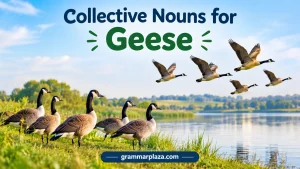
Collective Nouns for Geese explains how language provides different ways to describe animals that are living together, feeding together, or moving together.
A collective noun for geese is a word used to describe a group of geese, which are waterbirds often found near lakes, rivers, and wetlands. In English, flock, gaggle, and skein are useful terms, although their meanings and contexts differ. A flock of birds is a general word for birds together, while a gaggle of geese traditionally describes geese on the ground or geese on water. A skein of geese refers to geese flying across the sky. These expressions make everyday communication more vivid and help English learners expand vocabulary and develop animal vocabulary connected with the natural world.
When geese gather to feed, raise their young, communicate, or migrate, knowing these collective nouns for geese helps readers learn to use the appropriate terms correctly in sentences. Observing birds in the wild can help readers match the term to the group behavior rather than treating every expression as interchangeable. Readers can also explore geese’s physical features, diet, habitat, and lifespan, alongside their fascinating social behavior. These details connect bird groups and animal terminology with flying geese, wildlife, grammar, and English vocabulary. They also help explain bird behavior, feeding habits, migration, social interaction, and the value of protecting natural habitats.
What Is a Collective Noun?
A collective noun is a word that names a group of people, animals, or things as a unit. It helps speakers describe several individuals without naming each one separately.
Collective nouns are useful because they make sentences shorter, clearer, and more expressive. For example:
- A team of players prepared for the match.
- A herd of cattle grazed in the field.
- A flock of birds rested in a tree.
Some collective nouns are common in everyday English, while others are traditional expressions used in particular situations. Learning both kinds helps readers understand different forms of English and choose words that fit their meaning.
What Is a Group of Geese Called?
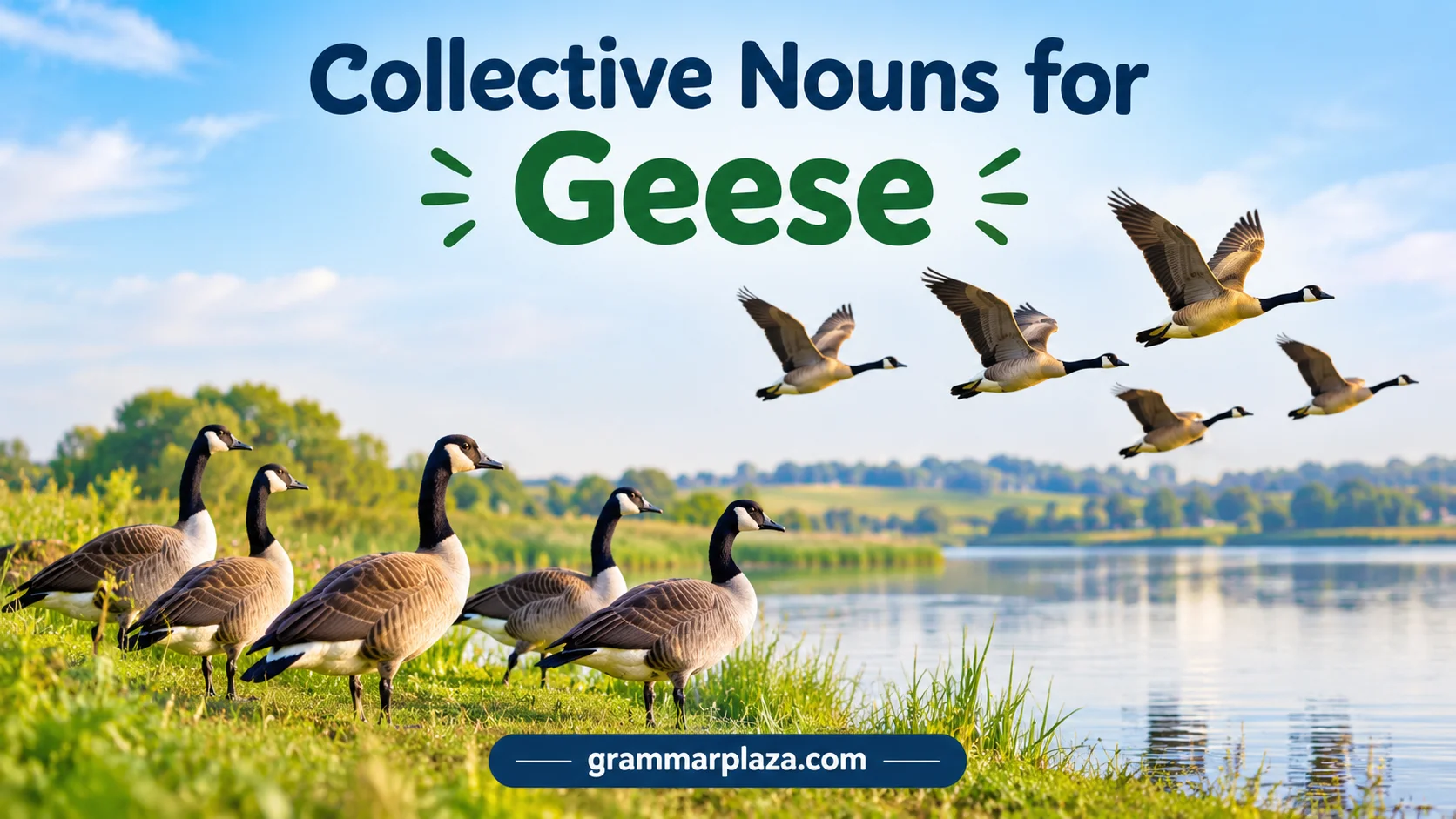
A group of geese is commonly called a flock. Two more specific traditional terms are gaggle, generally used for geese on the ground or water, and skein, used for geese in flight. A wedge can describe geese flying in a V-shaped formation.
The best word depends on the situation. Use flock as a straightforward general term, gaggle for a gathering on land or water, and skein when describing geese flying overhead. These distinctions are useful in descriptive writing, although ordinary biological descriptions do not always require a special collective noun.
Quick Reference Table
| Type | Simple Example |
| Flock | A flock of geese crossed the lake. |
| Gaggle | A gaggle of geese gathered on the grass. |
| Skein | A skein of geese passed overhead. |
| Wedge | A wedge of geese flew in a V formation. |
| Group | A group of geese rested beside the river. |
1. A Flock of Geese
Meaning
A flock of geese is a group of geese gathered or moving together. Flock is a common, general collective noun for birds. It is an excellent choice when the birds’ exact activity or formation is not important.
Why It Fits Geese
Geese frequently gather in flocks to feed, rest, travel, and spend time with other birds. Depending on the species and season, a flock may include family groups, breeding pairs, and unrelated individuals. Canada geese, for example, often associate in large flocks outside the breeding season. Some populations migrate over long distances, while others remain in the same general area throughout the year. A flock may gather on a lake, graze in a field, or rest near a wetland. The word is useful because it describes the group without suggesting that every bird behaves in exactly the same way.
Examples
- A flock of geese crossed the lake at sunrise.
- We watched a flock of geese grazing in the field.
- The flock of geese rested near the riverbank.
- Several geese joined the flock near the pond.
- A flock of geese flew above the wetlands.
- The farmer saw a flock of geese feeding among the crops.
- Children observed a flock of geese from the park bridge.
- The flock moved toward the water when the weather warmed.
- A large flock of geese gathered in the open meadow.
- We heard the flock calling before we saw it.
2. A Gaggle of Geese
Meaning
A gaggle of geese is a traditional collective noun generally used for geese gathered on the ground or water. It is a well-established English expression. The word can also describe a noisy or disorderly gathering of people, usually informally.
Why It Fits Geese
Geese can be noisy birds, particularly when several gather in one place. They use honks and other calls to communicate with mates, family members, and nearby birds. On land, they may graze together, walk across open grass, or gather near a pond. On water, they may swim and rest close to one another. These lively gatherings make gaggle a vivid descriptive choice. However, the word is a traditional language label rather than a scientific classification. A gaggle does not necessarily have a fixed size, and geese can also be described simply as a flock when they are standing or swimming.
Examples
- A gaggle of geese wandered across the village green.
- The gaggle gathered beside the pond to feed.
- We heard a gaggle of geese honking near the water.
- A gaggle of geese blocked the path through the park.
- The children watched the gaggle swim toward the far bank.
- A gaggle of geese grazed peacefully beside the farm.
- The gardener waited for the gaggle to leave the lawn.
- One goose called loudly as the gaggle approached the lake.
- A noisy gaggle of geese crossed the muddy field.
- By late afternoon, the gaggle had settled near the reeds.
3. A Skein of Geese
Meaning
A skein of geese is a traditional collective expression for geese flying together. The word is particularly useful in descriptive and literary writing. It can evoke a line or loose formation of birds stretching across the sky.
Why It Fits Geese
Many geese travel between feeding, resting, and breeding areas, and some species undertake seasonal migrations. During flight, they often form lines or V-shaped arrangements. These formations are striking against the sky and can be seen over fields, lakes, and wetlands. Geese may also call while flying, helping birds maintain contact. In a migrating flock, family groups and individual birds can travel together. The term skein offers writers a more specific and evocative alternative to flock when the birds are airborne. It is not necessary in everyday speech, however, and a flock of geese flew overhead remains perfectly correct.
Examples
- A skein of geese appeared above the distant hills.
- At dusk, a skein of geese crossed the open sky.
- We watched a skein of geese fly toward the wetlands.
- The skein passed silently over the quiet countryside.
- A skein of geese moved south across the autumn sky.
- The children pointed at a skein of geese above the lake.
- A skein of geese disappeared behind the clouds.
- The photographer waited for a skein of geese to enter the frame.
- A distant skein of geese flew beyond the mountain ridge.
- We heard the calls of a skein of geese passing overhead.
4. A Wedge of Geese
Meaning
A wedge of geese is a traditional expression associated with geese flying in a V-shaped formation. The word wedge describes the formation’s shape. It is more specific than the general word flock and is most useful when the birds’ arrangement is visible.
Why It Fits Geese
Geese are strong fliers, and many species travel in recognizable V formations. This arrangement can help birds make use of the moving air around neighboring birds, reducing the effort required for flight under suitable conditions. Birds may change positions during a journey, and the leading bird does not necessarily remain at the front throughout the flight. A V formation is a feature of group movement, not a requirement for every flock of geese. Therefore, wedge is a descriptive option when the formation looks like a V. It should not be used to suggest that all geese always fly in this shape.
Examples
- A wedge of geese crossed the bright morning sky.
- We spotted a wedge of geese above the open fields.
- The wedge turned east as the birds continued their journey.
- A wedge of geese flew over the marsh at sunset.
- The photographer captured a wedge of geese against the clouds.
- A wedge of geese appeared above the distant shoreline.
- The birds maintained their V-shaped formation for several minutes.
- A wedge of geese passed beyond the tree-covered ridge.
- We watched a wedge of geese travel toward the lake.
- The wedge gradually disappeared from view as evening approached.
5. A Group of Geese
Meaning
A group of geese is an ordinary, general phrase rather than a special animal-specific collective noun. It is completely correct English and works in almost any situation. Writers can use it when they do not know which specialized term fits or when the exact arrangement of the birds is unimportant.
Why It Fits Geese
Not every situation requires a traditional collective noun. A group of geese might include birds swimming together, feeding on grass, resting near a river, or moving through a wetland. The phrase does not specify whether the birds are on land or in flight, and it does not imply that they are a family or a tightly organized flock. This flexibility makes it especially useful for students and English learners. Specific words such as gaggle, skein, and wedge can add detail when appropriate, but ordinary group words communicate the basic meaning clearly without creating unnecessary complexity.
Examples
- A group of geese rested beside the river.
- We counted a group of geese swimming across the pond.
- The group of geese moved toward the grassy bank.
- A group of geese gathered near the feeding area.
- Several people photographed a group of geese in the park.
- The group of geese crossed the field together.
- A group of geese flew over the wetland.
- We watched a group of geese searching for food.
- The group of geese remained near the lake until dusk.
- A group of geese rested while their goslings explored the grass.
How to Use Collective Nouns for Geese
Using collective nouns correctly is straightforward once you understand their basic structure.
1. Place the collective noun before “of geese.”
The word naming the group comes first, followed by of and the animal’s plural name.
- A flock of geese crossed the lake.
- A gaggle of geese gathered on the grass.
- A skein of geese flew overhead.
2. Use “a” or “an” according to the sound of the next word.
Use a before a consonant sound. Since flock, gaggle, skein, and wedge begin with consonant sounds, we write a flock, a gaggle, a skein, and a wedge.
3. Remember that “goose” becomes “geese.”
Goose is singular, while geese is plural.
- One goose is swimming.
- Three geese are swimming.
- A flock of geese is swimming nearby.
4. Choose the term that fits the situation.
Use flock for a general group, gaggle for geese gathered on the ground or water, and skein for geese in flight. Use wedge when you want to emphasize their V-shaped formation.
Should You Use a Singular or Plural Verb?
A collective noun names a group, but English speakers can sometimes view that group either as one unit or as several individuals. The choice of verb depends on the sentence and the variety of English being used.
Singular verbs
In American English, collective nouns are commonly treated as singular when the group acts as one unit.
- The flock is moving toward the lake.
- The gaggle has settled near the pond.
- The group is resting in the grass.
Here, the group is being considered as a whole.
Plural verbs
In British English, collective nouns may take plural verbs when the sentence focuses on the individual members.
- The flock are spreading out across the field.
- The gaggle are moving in different directions.
These forms can be natural in British English when the individuals’ actions are emphasized. Other varieties of English may prefer the singular form.
For English learners, the most useful approach is to choose the form that matches the intended meaning and follow the conventions of the English variety used in the surrounding text. In formal writing, consistency is important.
Interesting Facts About Geese
Longevity
Geese can live for many years, although their lifespan depends on the species and the conditions in which they live. Wild birds face challenges such as predators, disease, harsh weather, food shortages, and human-related hazards. Some individuals survive much longer than others. Captive geese may live longer when they receive reliable food, veterinary care, and protection, but a long lifespan is not guaranteed. It is therefore better to avoid giving one exact lifespan for all geese. Different species, populations, and living conditions can produce different results.
Unique Physiological Features
Geese are waterbirds in the family Anatidae, which also includes ducks and swans. Many species have broad bills, webbed feet, strong wings, and bodies suited to swimming and walking. Their webbed feet help them move through water, while their wings support sustained flight. Many geese have relatively long necks that help them reach vegetation on land and in shallow water. Their feathers provide insulation and help keep the body warm. Like other birds, geese maintain their feathers through preening, using their bills to arrange and clean them.
Some geese have distinctive markings that make identification easier. Canada geese, for example, are known for their black necks and heads and their characteristic white chinstrap markings. Other species vary in color, body size, and bill shape. These differences reflect the diversity of the birds commonly called geese.
Dietary Habits
Most geese are primarily plant eaters. Depending on the species and season, their food may include grasses, leaves, seeds, roots, aquatic plants, berries, and agricultural grains. They often graze on grassy land or forage in shallow water. Canada geese, for instance, feed on grasses and sedges during parts of the year and may eat seeds, berries, and farm crops in other seasons.
Feeding habits are closely connected to habitat. Wetlands offer aquatic plants and access to water, while meadows and fields provide grasses and seeds. Some species have specialized diets suited to their local environment. Although geese may occasionally consume small invertebrates or other animal matter, plants make up most of the diet of many familiar species.
Social Behavior
Geese are known for their social behavior and strong family relationships. Many species form long-term pair bonds, and both parents may take part in protecting their young. Baby geese are called goslings. After hatching, goslings can often walk and feed soon afterward, although their precise abilities depend on the species and conditions. They remain close to their parents for protection and guidance.
Geese communicate through calls, body movements, and displays. Honking can help birds maintain contact, signal alarm, or communicate in different social situations. During the breeding season, pairs may defend nesting areas. Outside that period, many geese gather in larger flocks to feed, rest, or migrate. Some populations travel long distances between breeding and wintering grounds, while others move relatively short distances or remain in the same region throughout the year.
These behaviors help explain why words such as flock and gaggle are useful in everyday descriptions. However, the collective noun itself does not scientifically define how the birds behave.
Why Are Animal Collective Nouns So Interesting?
English contains many special words for groups of animals. Some are familiar, such as herd for cattle and flock for birds. Others are more unusual or traditional, including gaggle for geese. These words make animal vocabulary richer and give writers different ways to describe a scene.
Some collective nouns are associated with the sounds, shapes, or movements of animals. The word gaggle, for example, is linked historically to a Middle English verb associated with a goose’s call. Other terms have developed through traditional English usage, including literary and hunting vocabulary. Their histories are not all equally well documented, so it is important not to assume that every collective noun has a clear origin or a scientific explanation.
Collective nouns can make a sentence more vivid. Compare geese flew across the sky with a skein of geese crossed the evening sky. Both sentences are correct, but the second offers a more traditional and descriptive expression.
Learning these terms is therefore useful for grammar, reading, and creative writing. It also reminds us that language can preserve older ways of describing the natural world.
Collective Nouns vs. Ordinary Group Words
Collective nouns and ordinary group words can describe similar situations, but they do not always carry the same meaning.
- Flock: A common collective noun for birds gathered or moving together.
- Gaggle: A traditional term for geese on the ground or water.
- Skein: A traditional term associated with geese flying together.
- Wedge: A descriptive term for geese flying in a V-shaped formation.
- Group: A general word for several individuals or things.
- Herd: Commonly used for certain grazing mammals, such as cattle and deer.
- Pack: Commonly used for animals such as wolves and dogs.
- School: Commonly used for fish swimming together.
- Colony: Used for certain animals living or breeding in a shared area, including some seabirds.
These words are not interchangeable in every context. For example, a pack of geese is not the usual expression, whereas a flock of geese is natural and widely understood.
Importantly, “a group of geese” is always a reasonable general phrase when the context supports it. A specialized collective noun may add color or precision, but it is not necessary for a sentence to be grammatically correct.
What Collective Nouns Tell Us About Geese
Traditional language can offer clues about how people have observed and described animals. The word gaggle brings to mind a lively gathering, while skein can suggest a line of birds in flight. Such terms help writers communicate an impression of movement, sound, or appearance.
However, a collective noun is not a scientific description of animal behavior. A gaggle does not have to be noisy, and a flock does not have to move in a single direction. Geese may feed independently while remaining near other birds, separate into family groups during breeding, or gather in large numbers at migration sites. Their behavior depends on their species, environment, season, and circumstances.
Modern wildlife research helps explain these patterns through observation of feeding, nesting, migration, communication, and family relationships. Traditional vocabulary provides a different kind of value: it makes these observations easier to express in ordinary language.
By learning both animal vocabulary and basic wildlife facts, readers can appreciate how English describes nature without confusing a literary expression with a biological rule.
Frequently Asked Questions About Geese
What is a group of geese called?
A group of geese is commonly called a flock. A gaggle traditionally describes geese on the ground or water, while a skein refers to geese in flight.
What is the most common collective noun for geese?
Flock is a familiar, general-purpose collective noun for geese and other birds. Gaggle is also a well-established traditional term specifically associated with geese gathered on the ground or water.
Can I use “a group of geese” in English?
Yes. “A group of geese” is grammatically correct and suitable for everyday speech, schoolwork, and formal writing. You do not need to use a specialized collective noun.
Are animal collective nouns always commonly used?
No. Some collective nouns, such as flock and herd, are widely used. Others are traditional, literary, or uncommon. When a term is unfamiliar, it is best to explain its meaning and context rather than assume every reader knows it.
Why does English have special names for groups of animals?
English has developed collective nouns through everyday usage, observation, and literary traditions. These expressions provide convenient and sometimes vivid ways to describe animals gathered together, moving, feeding, or resting.
Conclusion
Collective nouns make English more expressive by giving us convenient ways to describe groups of people, animals, and things. For geese, flock is a useful general term, gaggle traditionally describes geese on the ground or water, and skein is associated with geese in flight. Wedge can describe their V-shaped formation, while the ordinary phrase group of geese remains perfectly correct.
Understanding these terms also opens a window into the birds’ lives. Geese have distinctive physical features, often feed on vegetation, communicate through calls, and maintain important family relationships. Some migrate over long distances, while others remain in the same region year-round. Learning animal vocabulary alongside reliable wildlife facts helps students improve their grammar while developing a greater appreciation of nature. In this way, language becomes more than a collection of words: it becomes a meaningful way to describe and understand the living world.