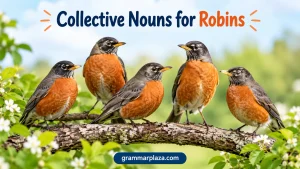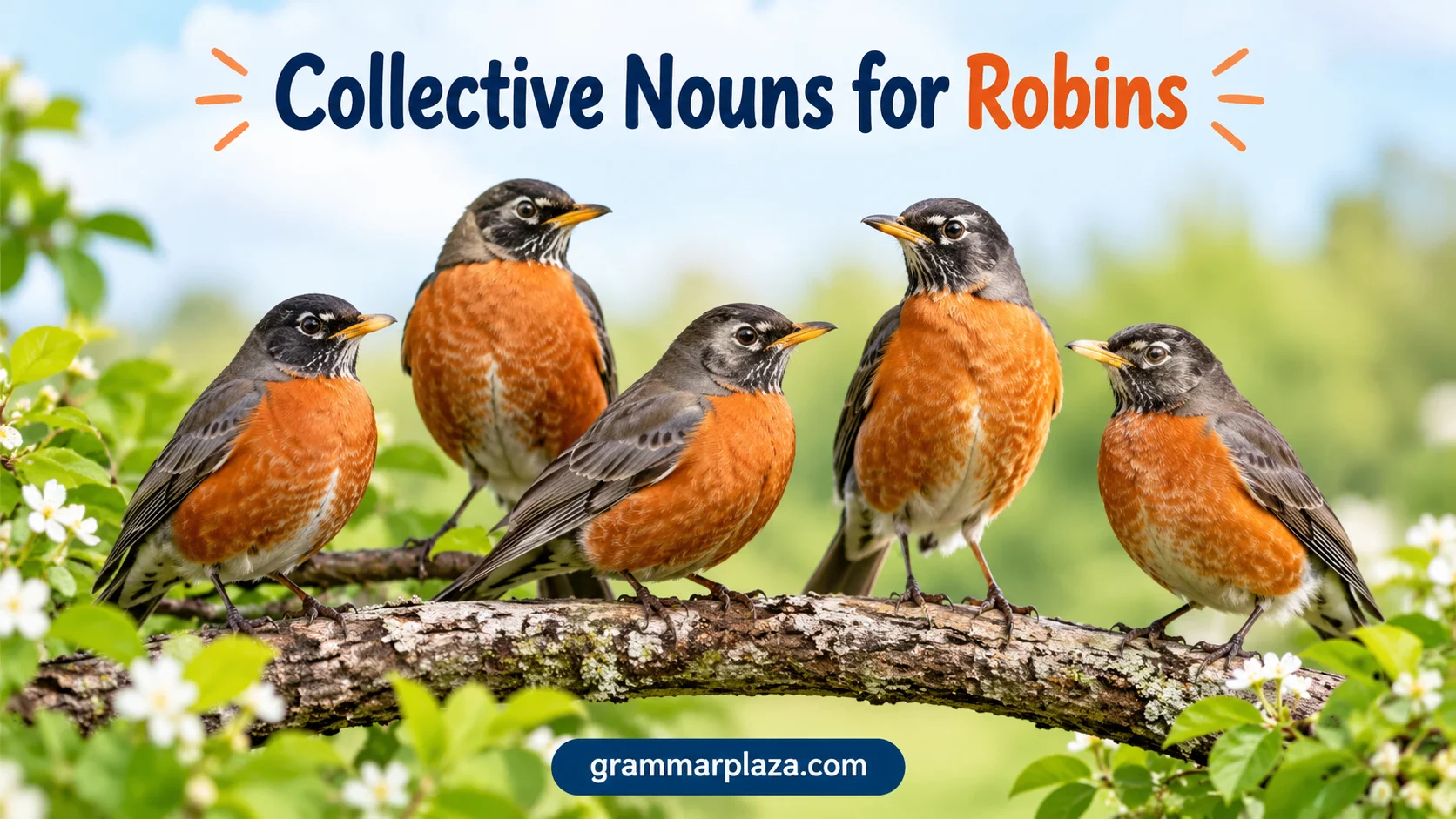
Collective Nouns for Robins explains why a flock is the familiar term for these songbirds when they gather to feed, fly, or rest.
In English, a collective noun for robins is a word that describes several robins gathered together. More broadly, a collective noun names a group of people, animals, or things as one unit. These English expressions make descriptions shorter, clearer, and more interesting. Many animal group names are common terms in everyday conversation, while others belong to traditional vocabulary or literary vocabulary. Robin behavior changes with the season: birds may forage individually in the warmer months but form large flocks during autumn and winter. Understanding robin group names, correct grammatical use, grammar, and vocabulary helps readers describe these birds accurately.
The physical features, habitat, diet, lifespan, and social behavior of robins provide context for understanding bird groups. Knowing a robin’s habitat, diet, and lifespan also supports accurate group terminology. The origins of collective bird nouns are not always straightforward. Some come from peculiar habits or perceived characteristics. Such terms may reflect a supposed personality trait or an observation of bird behavior, rather than a scientific classification.
Some unusual collective nouns reveal more about history than animal science. The number of dastardly-sounding nouns for crows, including murder, mob, and horde, may reflect the fears of medieval peasants, who associated sinister-looking corvids with the Devil or witches in disguise. These bird group names and literary expressions show how animal behavior, bird characteristics, historical beliefs, folklore, and medieval traditions have shaped collective terminology. However, traditional names do not always describe proven behavior. When discussing robins or other birds, distinguish familiar group terms from colorful historical expressions, and describe nesting behavior, parental care, and other bird descriptions carefully.
What Is a Collective Noun?
A collective noun is a word used to describe a group of people, animals, or things. Instead of naming every member separately, we can use one word to refer to the whole group.
Collective nouns make English more concise and expressive. They are especially useful when describing animals in nature.
Examples include:
- A flock of birds.
- A herd of cattle.
- A team of players
What Is a Group of Robins Called?
The ordinary expression a group of robins is called a flock of robins. It is useful whenever the writer wants to describe several birds without emphasizing a particular activity.
A pair of robins refers specifically to two birds, often a male and female during the breeding season. The word pair describes their number and possible relationship rather than a special name for a large gathering.
The word roost is also relevant when describing robins gathering to rest, particularly in winter. It refers to a resting place or gathering of birds rather than being a unique, universally established collective noun for robins.
Quick Reference Table
| Type | Simple Example |
| Flock | A flock of robins |
| Group | A group of robins |
| Pair | A pair of robins |
| Flight | A flight of robins |
| Roost | A winter roost of robins |
Note: “Flock” is the best general-purpose collective noun in this table. The other expressions describe a group, a number of birds, their movement, or their resting behavior; they should not all be treated as equally established robin-specific collective nouns.
1. A Flock of Robins
Meaning
A flock of robins is a group of robins gathered together. Flock is the most useful and widely recognized expression for describing several robins in English. It can refer to birds feeding, flying, or resting together.
Why It Fits Robins
Although robins often search for food individually during the breeding season, they can become more social outside that period. American robins, in particular, frequently form large flocks during autumn and winter. They may gather in trees to eat berries or settle together at nighttime roosts. These gatherings allow birds to use the same food-rich areas and resting locations. A flock may move between feeding sites as local conditions change. The word flock therefore describes a real and familiar aspect of robin behavior without suggesting that the birds always live in permanent groups.
Examples
Example 1: A flock of robins landed on the garden lawn.
Example 2: We watched a flock of robins searching for worms after the rain.
Example 3: Several robins joined the flock near the berry bushes.
Example 4: A flock of robins flew across the open field.
Example 5: The children counted the robins in the flock.
Example 6: In winter, a flock of robins gathered in a fruiting tree.
Example 7: The flock moved from the lawn to the nearby shrubs.
Example 8: A flock of robins rested quietly among the branches.
Example 9: Our morning walk revealed a flock of robins beside the woodland path.
Example 10: The flock scattered when a hawk appeared overhead.
2. A Group of Robins
Meaning
A group of robins is a straightforward phrase for several robins considered together. Unlike more specialized animal group names, group is a general noun that works in almost any situation. It is particularly useful when the birds’ behavior or arrangement is not important to the description.
Why It Fits Robins
Robins may gather temporarily around food sources, trees, open lawns, and other suitable areas. Observers do not always know whether the birds are traveling together, feeding independently, or simply occupying the same space. In such situations, group provides a neutral description. It does not imply that the birds have a fixed social structure or that they cooperate in every activity. For students and English learners, this phrase is also easy to use because it follows the same grammatical pattern as a group of children or a group of animals.
Examples
Example 1: A group of robins appeared beside the walking trail.
Example 2: We noticed a group of robins near the garden fence.
Example 3: The group searched the grass for insects and worms.
Example 4: A group of robins gathered beneath the trees.
Example 5: The photographer waited until the group settled down.
Example 6: A group of robins crossed the open lawn.
Example 7: The children observed a group of robins through binoculars.
Example 8: After the rain, a group of robins explored the damp ground.
Example 9: A group of robins visited the berry bushes in the backyard.
Example 10: We recorded the group’s movements in our birdwatching notebook.
3. A Flight of Robins
Meaning
A flight of robins describes robins in flight or emphasizes their movement through the air. Flight is an ordinary descriptive expression used for birds moving together, not a uniquely established collective noun for robins. It is appropriate when the action of flying is central to the sentence.
Why It Fits Robins
Robins are capable fliers and regularly travel between feeding grounds, trees, nesting areas, and resting places. American robins may fly between lawns and fruit-bearing trees as they search for food. During seasonal movements, some populations also travel to areas with more favorable conditions. Describing birds as a flight emphasizes their movement rather than their social organization. The expression should be used when it accurately describes what the birds are doing. For a general description of several robins, flock remains the more familiar choice.
Examples
Example 1: A flight of robins passed over the garden.
Example 2: We watched a flight of robins cross the field.
Example 3: The flight of robins disappeared behind the tall trees.
Example 4: A flight of robins moved toward the wooded hillside.
Example 5: The children pointed at the flight crossing the morning sky.
Example 6: A flight of robins swept over the rooftops.
Example 7: We saw a flight of robins heading toward the berry trees.
Example 8: The flight changed direction above the open meadow.
Example 9: A flight of robins crossed the woodland clearing.
Example 10: The birdwatcher photographed the flight before it passed from view.
4. A Pair of Robins
Meaning
A pair of robins means two robins considered together. Pair is a standard English word for two associated individuals. It is not a special collective noun exclusive to robins, but it is useful when describing two birds, especially during nesting and breeding.
Why It Fits Robins
During the breeding season, male and female American robins form pairs. The female selects a nest site and builds a nest, often on a tree branch or a suitable human-made structure. Both parents contribute to raising the young, including feeding the nestlings. A pair may defend its nesting area against other robins. However, a pair should not automatically be assumed to remain together for life. The term describes two birds associated with one another in a particular context, and the nature of that association depends on the circumstances.
Examples
Example 1: A pair of robins built a nest in the garden tree.
Example 2: We watched a pair of robins carrying nesting material.
Example 3: The pair visited the lawn early each morning.
Example 4: A pair of robins perched on the garden fence.
Example 5: The female in the pair disappeared into the nest.
Example 6: A pair of robins searched the damp soil for food.
Example 7: The children spotted a pair of robins near the hedge.
Example 8: A pair of robins sang from opposite branches.
Example 9: The pair returned to the nesting area with food for their young.
Example 10: We observed a pair of robins from a respectful distance.
5. A Roost of Robins
Meaning
A roost of robins refers to robins gathered at a place where they rest or sleep. The word roost is most clearly understood as a resting place or the act of settling there. A roosting flock of robins is an especially clear phrase when describing a group of birds resting together.
Why It Fits Robins
American robins often gather in trees and other suitable locations to roost during autumn and winter. These gatherings may include many birds, sometimes numbering in the thousands or more at particularly large sites. The birds can spend the night together and disperse to different feeding areas afterward. Their choice of roosting places depends on suitable shelter and local conditions. Describing a winter gathering as a roost connects the group name with the birds’ actual activity. It is best to use roost as a behavioral or location-based term rather than claim that it is a special robin-only collective noun.
Examples
Example 1: A winter roost of robins formed in the tall trees.
Example 2: The robins returned to their roost before sunset.
Example 3: We watched the roosting flock settle among the branches.
Example 4: The woodland roost became noisier as more birds arrived.
Example 5: A roost of robins occupied the trees beside the field.
Example 6: The birds left the roost at different times the next morning.
Example 7: The birdwatcher observed the roost from a quiet distance.
Example 8: The robins gathered at the roost after feeding on berries.
Example 9: The large roost was hidden among dense branches.
Example 10: At dawn, the robins began leaving their roost to find food.
How to Use Collective Nouns for Robins
Collective nouns follow simple grammatical patterns. The collective noun comes first, and the word of connects it to the animal being described.
The usual pattern is:
Article + collective noun + of + animal name
For example, a flock of robins and a group of robins follow this structure.
Use a before a singular collective noun that begins with a consonant sound. The phrase a flock of robins is correct. Use an when the following word begins with a vowel sound, as in an assembly of birds. The choice depends on sound, not simply on the first written letter.
Examples:
- A flock of robins is feeding on the lawn.
- A group of robins has settled in the tree.
- A pair of robins is building a nest.
- Several flocks of robins are moving between feeding sites.
- Two groups of robins were observed in the park.
Should You Use a Singular or Plural Verb?
The correct verb depends on the English variety and whether the group is being treated as one unit or as individual birds.
Singular verb: Use a singular verb when the group acts as a whole.
- The flock is moving toward the trees.
- The group has settled near the garden.
- The pair is building a nest.
Plural verb: In British English, a plural verb may be used when the members are considered separately.
- The flock are spreading out across the field.
- The group are feeding in different places.
- The pair are taking turns visiting the nest.
For English learners, the safest general approach is to choose a grammatical pattern that matches the variety of English being studied and to remain consistent within the same piece of writing.
Interesting Facts About Robins
Longevity
Robins’ lifespans vary considerably. Many young birds do not survive their first year, while some adults live for several years. The American robin has a documented longevity record of nearly fourteen years, although this is not typical of every bird. Survival depends on factors such as weather, food availability, predators, disease, and habitat quality. Wild birds face many natural challenges, so an individual robin’s life expectancy can differ greatly from that of another bird.
Unique Physiological Features
The American robin is a relatively large member of the thrush family. It has a rounded body, long legs, a fairly long tail, and a strong bill. Adults generally have gray-brown upperparts and warm orange or rusty underparts. Males typically have darker heads, while females are often paler, although individual appearances vary.
Its legs help it move quickly across lawns and other open ground. The robin’s bill is useful for picking up insects, probing soil, and handling fruit. Its eyesight is important when searching for food, and its hearing helps it respond to sounds in its surroundings.
Dietary Habits
Robins are omnivores. Their diet includes earthworms, insects, other small invertebrates, and a wide variety of fruits. During spring and summer, earthworms and insects can be particularly important sources of food. In autumn and winter, berries and other fruits often become more prominent.
When searching for worms, an American robin may pause on the ground, tilt its head, and inspect the soil before pulling out its prey. This behavior is familiar to many people who watch robins on lawns after rainfall. Robins may also visit shrubs and trees that produce berries. Their food choices change with the season and with the resources available in their habitat.
Social Behavior
Robins do not always live in large groups. During the breeding season, they often forage individually or in pairs and may defend nesting territories. Males sing to attract mates and communicate territorial boundaries. Females build nests, lay eggs, and incubate them, while both parents help feed the young.
Outside the breeding season, American robins can gather in flocks. They may feed together where fruit is abundant and roost in trees at night. These seasonal changes show why the collective noun flock is especially useful for describing robins in autumn and winter. However, seeing several robins in one place does not necessarily mean they are cooperating closely. They may simply be using the same food source or resting area.
Habitat and Distribution
Robins They occupy a wide range of environments, including gardens, lawns, parks, fields, pastures, woodlands, forests, and shrublands. They can also live in some mountainous and northern environments.
Their ability to use both natural and human-modified habitats helps explain why they are familiar in residential areas. Many people see them searching lawns for earthworms or visiting fruit-bearing trees. Some northern populations migrate south for winter, while many robins remain in their breeding areas throughout the year. Local weather and food availability influence where birds spend the colder months.
Why Are Animal Collective Nouns So Interesting?
Animal collective nouns make English colorful and memorable. Words such as flock, herd, pack, and school help readers imagine different kinds of animals and the ways they may gather. Some terms are ordinary words that have become closely associated with particular animals, while others belong to traditional or literary vocabulary.
For robins, flock is especially practical because it matches a familiar behavior: these birds often gather outside the breeding season. The term gives a sentence a clear picture without requiring a long explanation. Learning such vocabulary can help students develop their English while encouraging closer observation of wildlife.
Collective Nouns vs. Ordinary Group Words
Collective nouns and ordinary group words both help us describe several animals together, but they differ in how specific or conventional they are.
- Flock: A familiar term for a group of birds, including robins.
- Group: A general word that works for almost any collection of animals.
- Pack: Commonly associated with certain social or hunting animals, such as wolves.
- Herd: Often used for grazing mammals, such as cattle and deer.
- School: A common term for a group of fish.
- Colony: Often describes animals living or breeding together in a shared area.
These words are not interchangeable in every context. A flock of robins sounds natural, whereas a herd of robins would usually sound inappropriate because herd is not the normal term for birds.
The phrase a group of robins remains grammatically correct even when a more specific term is available. It is often the best choice when the writer does not know the birds’ activity or wants to keep the sentence simple.
What Do Collective Nouns Tell Us About Robins?
Collective nouns can offer clues about how people have traditionally observed and described animals. The word flock encourages readers to picture birds gathered together, while pair draws attention to two individuals associated with one another.
However, traditional language is not the same as scientific classification. A collective noun does not prove that animals always live in groups, cooperate, or behave in a particular way. Robins, for example, may feed alone, defend territories, form breeding pairs, or gather in large winter flocks, depending on the season and circumstances.
Modern wildlife research explains these behaviors through observation of feeding patterns, breeding, migration, and habitat use. English group names provide a useful vocabulary for discussing those observations, but they do not replace biological evidence.
Learning the collective noun for robins is therefore more than a grammar exercise. It is an opportunity to explore how language describes nature while keeping traditional expressions separate from scientific facts.
Frequently Asked Questions About Robins
What is a group of robins called?
A group of robins is commonly called a flock of robins. The word flock is particularly suitable when the birds gather to feed, fly, or roost.
What is the most common collective noun for robins?
Flock is the most familiar general-purpose collective noun for robins. It is widely understood and works naturally in everyday English.
Can I say “a group of robins”?
Yes. A group of robins is grammatically correct and natural. It is a general expression that can be used whenever several robins are present.
Do robins always live in flocks?
No. Robins may forage alone or in pairs, especially during the breeding season. American robins often form larger flocks during autumn and winter, when they may feed on fruit or gather at nighttime roosts.
Why does English have special names for groups of animals?
English uses collective nouns to make descriptions shorter and more expressive. Some words, such as flock and herd, are widely used, while others are traditional or literary. These terms help people describe animals without implying that every species always behaves in the same way.
Conclusion
The most useful collective noun for robins is a flock of robins. The ordinary phrase a group of robins is also correct, while pair, flight, and roost describe particular numbers, movements, or resting situations. Understanding these distinctions helps English learners choose words that sound natural without memorizing questionable animal group names.
Robins are fascinating birds because their behavior changes with the seasons. They may search for worms individually, form breeding pairs, and gather in large winter flocks. Their orange breasts, clear songs, and varied diet make them familiar visitors in gardens and parks. Learning about their lifespan, physical features, habitat, and feeding habits also shows how language can lead to a deeper understanding of wildlife.
By combining grammar with careful observation, readers can build their vocabulary and appreciate the natural world. The best animal words are those that describe nature clearly while respecting what science tells us about it.