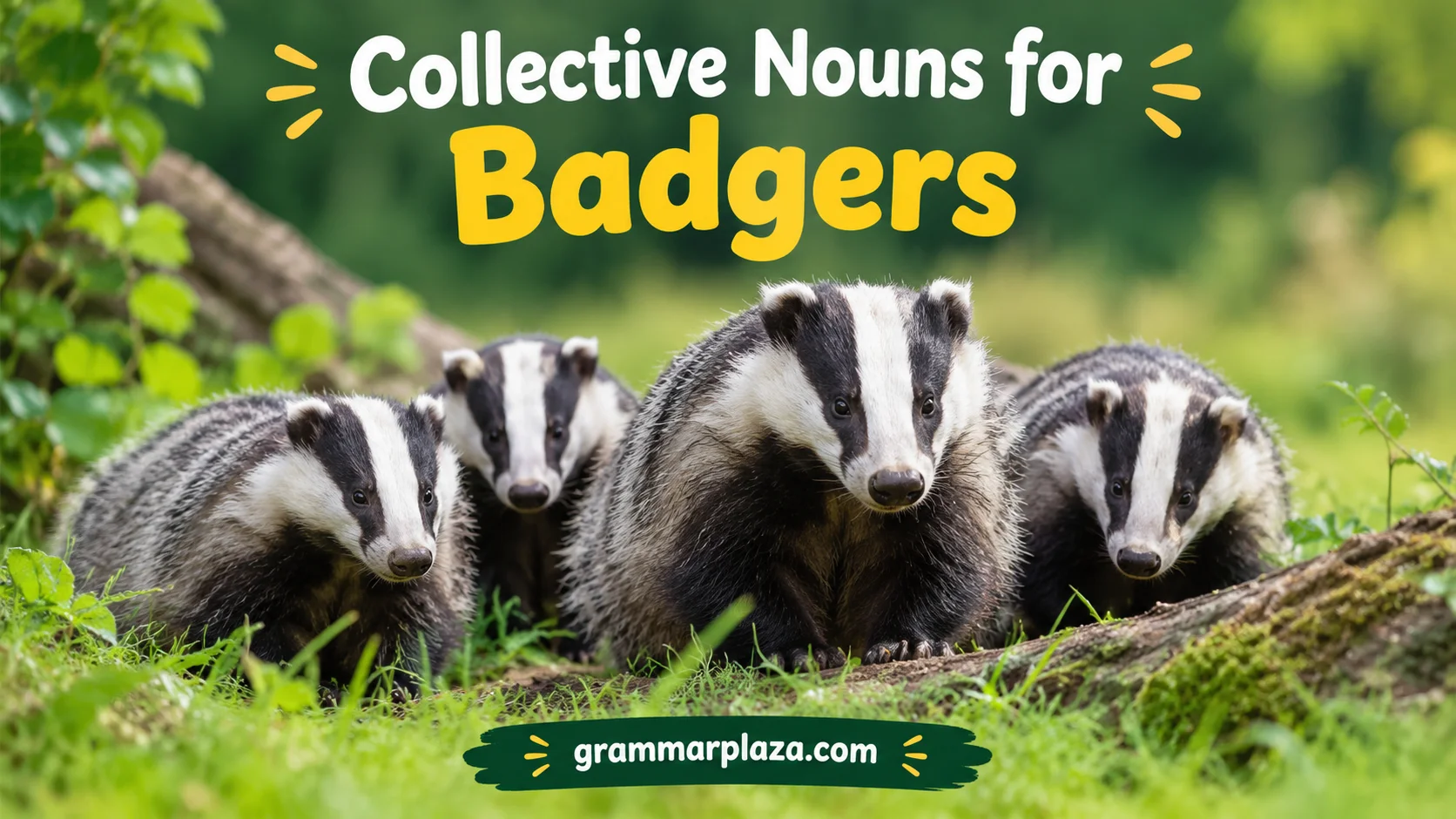
Collective Nouns for Badgers include cete and clan, terms that help describe badger groups and explain how these fascinating mammals live in nature.
The collective noun for badgers is traditionally cete, while clan is another recognized term, particularly for the social groups of European badgers. In English, these special expressions help describe animals that are living together or gathering together. A collective noun is a word that names a group as a single unit, making sentences more precise and interesting. Badgers are fascinating mammals with powerful claws, strong bodies, distinctive facial markings, and impressive digging abilities. These group names make wildlife writing clearer and help readers understand animal groups in nature.
The terms cete and clan have different meanings and uses when discussing badgers. A traditional term, cete refers to a group of badgers, while clan describes the social organization often associated with European badgers. Their behavior depends on their species and environment: some live alone, while others raise young in family groups or share underground homes with other badgers. Their social behavior helps explain collective noun usage, although a group name does not mean every badger always lives with others.
When writing an article about badgers, explore other expressions associated with badgers, including their habitat, diet, lifespan, and physical features. From an editing perspective, choosing terms carefully makes explanations accurate and easy to follow. Simple example sentences help readers improve their vocabulary and learn to use correctly the collective nouns they encounter. These expressions add variety to wildlife descriptions while keeping the focus on how badgers live and interact.
What Is a Collective Noun?
A collective noun is a word used to describe a group of people, animals, or things. Instead of naming every member individually, the word refers to the group as a whole.
Collective nouns make English more concise and expressive. For example, saying “a flock of birds” is more natural in many situations than saying “a group of birds.”
Here are three simple examples:
- A flock of birds flew across the sky.
- A herd of cattle grazed in the field.
- A team of players practiced before the match.
Some collective nouns are widely used in everyday conversation, while others are traditional, specialized, or uncommon. Animal vocabulary includes both kinds. Learning the difference helps readers choose suitable words without assuming that every traditional expression is used frequently in modern English.
What Is a Group of Badgers Called?
A group of badgers is traditionally called a cete. Another recognized term is clan, particularly when describing a social group of European badgers that share a territory and underground sett.
The two words have slightly different practical uses:
- Cete: A traditional English collective noun for badgers. It is correct but relatively uncommon in everyday conversation.
- Clan: A recognized term for a social group of badgers, especially in British wildlife writing.
- Colony: A less specific descriptive term that may be used for a population or group living in the same area, although it is not as distinctive as cete or clan.
- Group of badgers: A simple, natural expression that is always useful when a specialized term is unnecessary.
A sett is different: it is the underground network of tunnels and chambers used by badgers as a home, not the name of the animals themselves.
Quick Reference Table
| Type | Simple Example |
| Cete | A cete of badgers |
| Clan | A clan of badgers |
| Colony | A colony of badgers |
The first two expressions are the most useful specialized terms to learn. Colony is a broader descriptive word and should not be treated as a uniquely established badger collective noun.
1. A Cete of Badgers
Meaning
A cete is a traditional English collective noun for a group of badgers. It is pronounced like “seat.” The term appears in English dictionaries, but it is uncommon in ordinary conversation. It is most useful in wildlife writing, educational articles, and discussions of traditional animal vocabulary.
For example, “A cete of badgers emerged after sunset” describes several badgers together. Although the word has a long history in English, its exact origin is uncertain. It should therefore be understood as a traditional language term rather than a scientific classification.
Why It Fits Badgers
The word cete provides a concise way to refer to multiple badgers. It can be useful when describing European badgers that occupy the same social territory or share an underground sett. These animals may use common resting places and feeding areas, even when they search for food individually.
However, not all badger species have the same social habits. American badgers, for example, are generally solitary outside the breeding season and the period when mothers raise their young. The word cete simply identifies a group; it does not mean that the animals always hunt, travel, or cooperate together.
Example Sentences
Example 1: A cete of badgers emerged from the sett after sunset.
Example 2: The wildlife photographer waited quietly for a cete to appear.
Example 3: A cete of badgers moved through the woodland near dusk.
Example 4: The researcher recorded signs of a cete living in the area.
Example 5: A cete of badgers shared the same underground home.
Example 6: The nature guide explained the meaning of the word cete.
Example 7: We spotted several badgers near the entrance to their sett, forming a small cete.
Example 8: A cete of badgers appeared in the wildlife documentary.
Example 9: The children learned that cete is a traditional collective noun for badgers.
Example 10: In her story, the writer described a cete exploring the countryside at night.
2. A Clan of Badgers
Meaning
A clan of badgers is a social group of badgers, especially European badgers that share a territory and may use the same sett. The word clan is an established term in British badger ecology and wildlife education.
Unlike cete, which is mainly notable as a traditional collective noun, clan is particularly helpful when the writer wants to discuss the social organization of European badgers. It suggests a group with an ongoing association rather than merely several animals seen together.
A clan is not necessarily a family made up only of close relatives. Its membership and behavior depend on local conditions and the population being studied.
Why It Fits Badgers
European badgers can live in social groups that share a territory containing feeding grounds and one or more setts. Members may rest in the same underground system, communicate through scent marking, and use overlapping paths as they search for food.
Despite living in a social group, individual badgers often forage alone rather than hunting cooperatively. A clan therefore illustrates an important distinction: sharing a home or territory does not mean that every activity is performed together.
The term is particularly useful when discussing European badger behavior. It should not be assumed that every badger species forms similar social groups.
Example Sentences
Example 1: A clan of badgers occupied the old sett beside the woodland.
Example 2: The wildlife team studied how the clan used its territory.
Example 3: Several members of the badger clan emerged after dark.
Example 4: The clan shared a network of underground tunnels.
Example 5: A clan of badgers searched for food in nearby fields.
Example 6: The researcher observed scent-marking behavior among members of the clan.
Example 7: The young badger remained near its mother while the clan rested underground.
Example 8: A well-established clan may use several setts within its territory.
Example 9: The nature book explained how a badger clan could share a home without always feeding together.
Example 10: The conservationist monitored the clan to learn more about its movements.
3. A Colony of Badgers
Meaning
A colony of badgers is a descriptive expression for badgers living in the same general area. The word colony is used for various animal populations, but it is not as specifically associated with badgers as cete or clan.
In wildlife writing, colony may help describe a local population or a concentration of animals in a particular habitat. Nevertheless, it can be less precise than clan when the subject is the social organization of European badgers.
For learners of English, the important point is that a grammatically correct group expression does not always have to be a specialized collective noun.
Why It Fits Badgers
Badgers may occupy areas with suitable soil, underground shelters, and enough food to support their needs. European badgers can share a sett and use a common territory, while other badger species are often more solitary.
The word colony can describe a local population when several badgers live in the same area, but it does not necessarily tell the reader whether they share a sett, belong to one social group, or interact regularly.
When describing a known social group of European badgers, clan is usually more informative. When the relationship between animals is unknown, a group of badgers is often the clearest choice.
Example Sentences
Example 1: A colony of badgers lived in the surrounding countryside.
Example 2: The conservation team surveyed the area where the local badger colony was found.
Example 3: Suitable soil and abundant prey helped support the local population of badgers.
Example 4: The report described a colony of badgers occupying a patch of suitable habitat.
Example 5: Researchers investigated the movements of badgers across the study area.
Example 6: The woodland provided shelter and feeding opportunities for the local badger population.
Example 7: The wildlife officer recorded signs of several badgers near the fields.
Example 8: A colony of badgers may occupy a wider area than one underground sett.
Example 9: The report used the word colony descriptively rather than as a precise scientific classification.
Example 10: The students discussed how habitat quality can influence where badgers live.
4. A Group of Badgers
Meaning
A group of badgers is an ordinary, widely understood expression for two or more badgers. Unlike cete, it is not a specialized animal collective noun. However, it is often the best choice in everyday English because it is simple, accurate, and easy to understand.
You can use group when the animals are seen together, when their social relationship is unknown, or when a more traditional expression would sound unnecessarily formal.
For English learners, this is an important lesson: knowing an unusual collective noun is useful, but using ordinary group words correctly is equally valuable.
Why It Fits Badgers
Badgers may be observed together during breeding, while mothers care for their young, or in social groups of European badgers. At other times, individual badgers may be seen alone while searching for food or moving through their habitat.
The word group avoids making assumptions about these relationships. It can describe a few young badgers, several animals near a sett, or individuals observed together by a researcher.
If you do not know whether the animals belong to a clan, a group of badgers is a safe and natural expression. Scientific accuracy often depends on describing what was observed rather than assuming a social connection.
Example Sentences
Example 1: A group of badgers crossed the path after dark.
Example 2: The children watched a group of badgers in a wildlife documentary.
Example 3: A group of young badgers explored the area near their sett.
Example 4: The ranger noticed a group of badgers beside the field.
Example 5: The researcher photographed a group of badgers emerging at dusk.
Example 6: A group of badgers appeared on the camera footage during the night.
Example 7: The family learned about badgers during their visit to the wildlife centre.
Example 8: The group of badgers disappeared into the undergrowth.
Example 9: The report described a group of badgers without assigning them to a particular clan.
Example 10: A group of badgers was visible near the sett entrance.
5. Choosing Between Cete, Clan, and Other Group Names
Meaning
Choosing the correct collective noun means selecting a word that fits both the context and the meaning you want to communicate. Cete is a traditional collective noun, clan is especially useful for the social groups of European badgers, and group is a general-purpose expression.
The broader word colony may be suitable when discussing a local population, but it should be used carefully if the social relationships between the animals are unknown.
There is no need to force an uncommon term into every sentence. Good English depends on clarity, grammar, and context, not simply on choosing the rarest word.
Why It Fits Badgers
Badger species differ in their social habits, and even animals of the same species do not always behave identically. European badgers often form social groups, whereas American badgers are generally solitary except during particular periods, such as breeding and the raising of young.
A writer describing a known European badger social group may prefer clan. A writer using traditional animal vocabulary may choose cete. A person describing a brief wildlife sighting may find group of badgers more suitable.
The best expression communicates what is known without suggesting that every badger population has the same structure.
Example Sentences
Example 1: The writer chose cete to introduce a traditional animal collective noun.
Example 2: The wildlife report referred to a European badger clan.
Example 3: The guide used the phrase a group of badgers because their social relationship was unknown.
Example 4: The teacher explained that sett means the badgers’ underground home, not the animals themselves.
Example 5: The student used clan when discussing the social behavior of European badgers.
Example 6: The article mentioned a cete of badgers before explaining the term’s traditional use.
Example 7: The researcher avoided calling the animals a clan because their relationship had not been established.
Example 8: The class compared cete with the more familiar expression group of badgers.
Example 9: The wildlife writer used colony as a broad description of the local population.
Example 10: The editor selected the clearest group name for the intended audience.
How to Use Collective Nouns for Badgers
Collective nouns follow a straightforward pattern in English. Place the group name first, followed by of and the plural animal name.
The basic structure is:
A + collective noun + of + plural animal name
For example:
- A cete of badgers emerged from the sett.
- A clan of badgers occupied the woodland.
- A group of badgers crossed the field.
When Should You Use “A” or “An”?
Use a or an before a singular countable collective noun.
- A cete of badgers.
- A clan of badgers.
- A group of badgers.
The choice between a and an depends on the initial sound of the next word. Since cete, clan, and group begin with consonant sounds, a is correct for all three.
How Does “Of” Work?
The word of connects the group name to the animals being described.
In “a clan of badgers,” clan identifies the group, while badgers tells us which animals belong to it.
The word badgers remains plural even though the collective noun is singular.
Three More Examples
- A cete of badgers was mentioned in the book.
- The clan of badgers was resting underground.
- Several groups of badgers were recorded in the survey.
Notice that the verb changes according to the grammatical subject. In the third example, groups is plural, so the verb were is appropriate.
Should You Use a Singular or Plural Verb?
The correct verb depends on whether the collective noun is treated as one unit or as several individual animals. Usage also varies between English varieties, especially British and American English.
Singular Verbs
Use a singular verb when the group is viewed as a single unit.
- The clan is occupying the same territory.
- The cete was mentioned in the wildlife guide.
- A group of badgers has entered the field.
This approach is common in American English and is also used in British English when the group is treated collectively.
Plural Verbs
In British English, a collective noun may take a plural verb when the writer emphasizes the individual members.
- The clan are moving in different directions.
- The group are searching separate areas for food.
This construction highlights the members’ individual actions rather than the group as a single unit.
Which Form Should English Learners Choose?
If you are unsure, a singular verb is a practical choice when the group is presented as one unit. If you are writing in British English and want to emphasize individual members, a plural verb may also be natural.
The key is to maintain consistency and follow the conventions of the English variety you are using.
Interesting Facts About Badgers
Longevity
Badgers’ lifespans vary according to species, habitat, food availability, disease, and other environmental conditions. American badgers can live for several years in the wild, and some individuals may reach approximately 14 years under favorable circumstances. Many wild animals do not live that long because they face predators, injuries, food shortages, and human-related hazards.
Captive animals may live longer when they receive appropriate food, shelter, and veterinary care, although lifespan depends on the individual and the conditions in which it lives. Lifespan figures should not be treated as guarantees for every badger.
It is also important to distinguish between badger species. The American badger and the European badger differ in aspects of their behavior and ecology, so a figure reported for one species should not automatically be applied to all badgers.
Unique Physiological Features
Badgers have compact, powerful bodies and strong forelimbs adapted for digging. Their long, sturdy claws help them excavate underground shelters and dig into soil in pursuit of prey. These features are particularly important because underground burrows provide places to rest, shelter, and raise young.
The European badger is recognizable by its greyish body and distinctive black-and-white facial markings. The American badger typically has a pale body, dark feet, and a dark stripe along its back. These differences help distinguish the species.
Badgers also have a well-developed sense of smell, which plays an important role in finding food and communicating with other badgers. Scent glands allow them to leave chemical signals in their environment. Such signals can provide information about territory and reproductive status.
Their eyes are relatively small, and vision is not their strongest sense compared with smell and hearing. Some species also have protective eye structures that help reduce the risk of injury from soil while digging.
Dietary Habits
Badgers have diets that reflect their species and local environment. European badgers are omnivores, eating a variety of foods, including earthworms, insects, small animals, and fruits. Earthworms can form a substantial part of their diet where they are readily available. When food conditions change, badgers can turn to other suitable sources.
American badgers eat many small animals, particularly ground-dwelling rodents such as ground squirrels and pocket gophers. They may also consume other small mammals, reptiles, amphibians, insects, birds, and eggs. Their powerful digging limbs help them reach prey that hides underground.
Badgers are generally foragers rather than cooperative pack hunters. An individual may search for food on its own even when it belongs to a social group. Their flexible feeding habits allow them to make use of available food, although the precise diet depends on the species, season, and habitat.
Social Behavior
Badgers do not all have the same social structure. European badgers can live in social groups commonly called clans. Members may share a territory and use one or more setts, but they often forage individually rather than working together to catch food.
American badgers, in contrast, are generally solitary outside the breeding season and the period when females care for their young. Their underground dens provide shelter and a safe place to raise offspring. Young badgers gradually become independent as they grow.
Badgers communicate in several ways, including scent marking and vocal sounds. Scent is particularly important for conveying information about territory and reproductive condition. Individuals may mark familiar locations or other animals with scents produced by specialized glands.
Badgers are also largely nocturnal, meaning they are most active at night. They often rest in underground shelters during the day and emerge to search for food after sunset. In cold weather, some badgers reduce their activity, but they should not generally be described as true hibernators.
These differences explain why clan is especially useful for European badgers, while group remains appropriate for badgers whose social relationships are unknown.
Why Are Animal Collective Nouns So Interesting?
Animal collective nouns make English vocabulary more varied and memorable. Words such as flock, herd, and school are familiar to many speakers, while cete is a more specialized term associated with badgers.
Some animal group names developed through traditional vocabulary, literature, hunting language, or people’s observations of wildlife. However, the history of an individual term may be uncertain. It is better to acknowledge that uncertainty than to invent an appealing origin story.
The word cete, for example, has been recorded in English for centuries, but its precise origin is not firmly established. It is a recognized traditional word, not a scientific term describing a particular behavior.
Collective nouns can also make descriptions more vivid. A writer may choose clan to discuss European badgers sharing a territory or cete to introduce a traditional expression. Both choices can make a wildlife article more engaging, provided the meaning is explained accurately.
Learning these terms combines English grammar, vocabulary, and wildlife knowledge. It also teaches an important language skill: words have different levels of formality, familiarity, and precision.
Collective Nouns vs. Ordinary Group Words
Collective nouns and ordinary group words help us describe several individuals together, but they do not always carry the same meaning.
- Herd: Commonly used for animals such as cattle and deer.
- Pack: Often used for social hunting animals such as wolves.
- Flock: Commonly used for birds and some other animals.
- School: Used for groups of fish and certain aquatic animals.
- Colony: Used for some animal populations that live in the same area or form a breeding group.
- Cete: A traditional collective noun for badgers.
- Clan: Used for social groups of European badgers.
- Group: A general word for several individuals or objects.
These terms are not interchangeable in every context. For example, flock of birds is more conventional than pack of birds, while clan of badgers is useful when discussing European badger social organization.
Nevertheless, saying “a group of badgers” is grammatically correct. It remains a sensible choice when the reader needs a clear description rather than a traditional animal name.
The most suitable expression depends on your purpose. In everyday conversation, a general word may be best. In a wildlife article, a more specific term may communicate additional information.
What Do Collective Nouns Tell Us About Badgers?
Collective nouns offer a small window into the relationship between language and wildlife. A word such as clan can direct attention to the social organization of European badgers, while cete introduces readers to a traditional part of English animal vocabulary.
However, traditional language and modern biological knowledge are not the same thing. A collective noun does not prove that an animal always lives in a group or behaves cooperatively. Wildlife research is needed to understand the actual behavior of a species.
For example, European badgers may live in social groups and share a territory, but they often forage individually. American badgers are generally more solitary. The word cete can still describe a group of badgers in English, but it does not mean every badger species forms permanent groups.
This distinction is useful for both students and wildlife enthusiasts. It encourages readers to enjoy traditional vocabulary while checking animal facts carefully. Language helps us describe the natural world, while biology helps us understand it.
Frequently Asked Questions About Badgers
What is a group of badgers called?
A group of badgers is traditionally called a cete. A clan is another recognized term, particularly for a social group of European badgers.
What is the most common collective noun for badgers?
Cete is the traditional collective noun most specifically associated with badgers. However, it is uncommon in everyday conversation. Clan is useful in British wildlife writing, while group of badgers is a straightforward general expression.
Can I use “a group of badgers” in English?
Yes. A group of badgers is grammatically correct and widely understandable. You do not need to use a specialized collective noun in every sentence.
Are animal collective nouns always commonly used?
No. Some, such as flock and herd, are common in everyday English. Others, including cete, are traditional or relatively uncommon. Knowing the difference helps you choose vocabulary that suits your audience.
Why does English have special names for groups of animals?
English has developed collective nouns through traditional usage, literature, and people’s descriptions of the natural world. These words make language more varied, but their existence does not necessarily mean that an animal always lives or behaves in a particular way.
Conclusion
Collective nouns make English more expressive by giving us concise ways to describe groups of people, animals, and things. For badgers, the traditional term cete and the recognized term clan are particularly useful, although their everyday usage differs. The simple phrase group of badgers is also correct and often the clearest choice.
Understanding these expressions becomes more interesting when we connect them with wildlife. Badgers have powerful claws for digging, a strong sense of smell, and diets adapted to the food available in their habitats. Their social behavior also varies: European badgers may share territories in clans, while American badgers are generally more solitary.
Learning animal vocabulary therefore teaches more than grammar. It encourages us to notice how words describe the natural world while reminding us that traditional language and scientific evidence serve different purposes. By studying both, we can become better writers, more confident English learners, and more informed observers of wildlife.