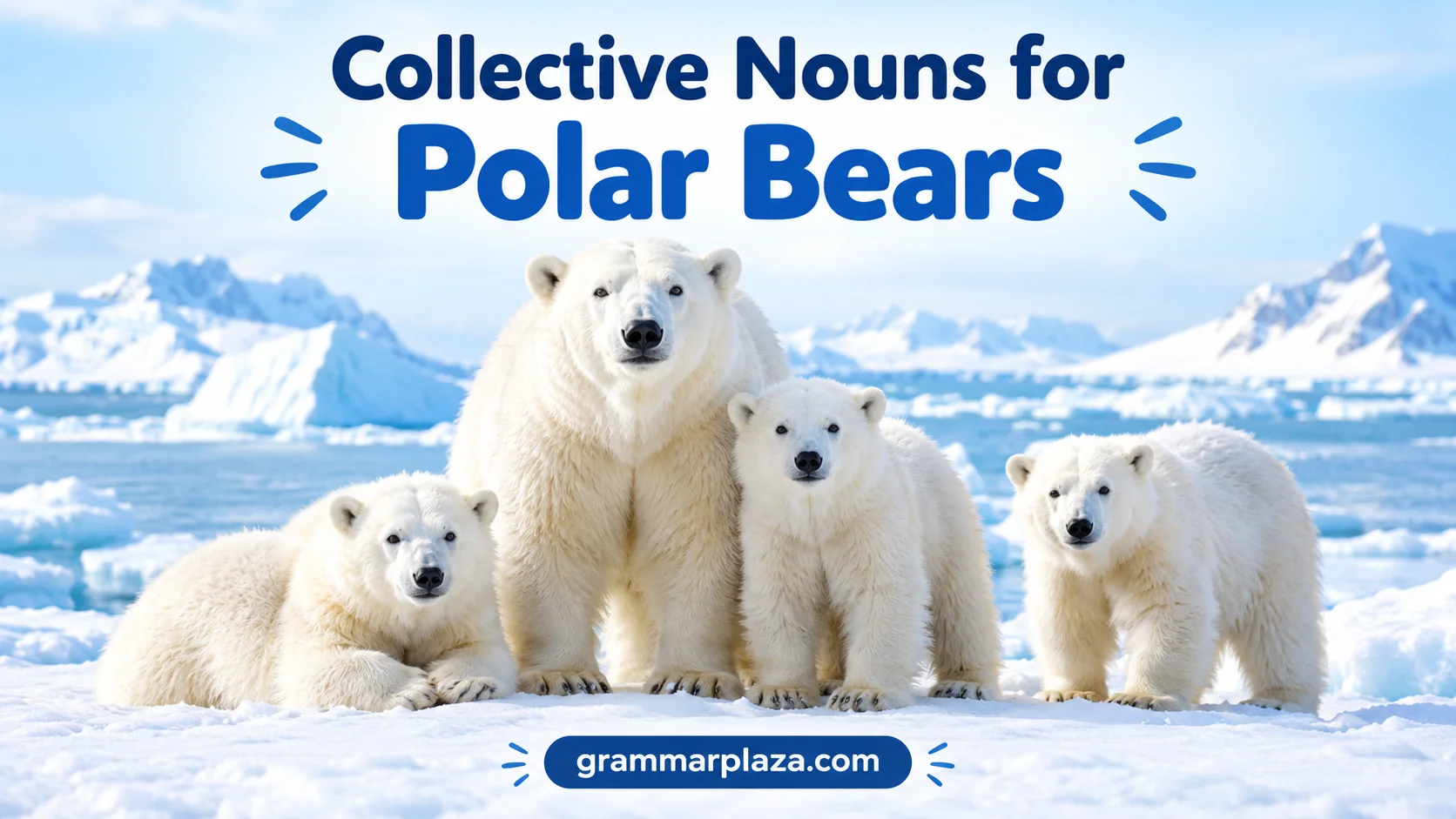
Collective Nouns for Polar Bears help readers describe these powerful Arctic animals clearly while learning how groups are named in English grammar.
Collective nouns are special words that describe a group of people, animals, or things as one unit. When discussing a group of polar bears, a specific collective noun can make a sentence more interesting and meaningful. These terms help writers and speakers describe animals in a vivid way, highlighting their behavior, movement, and environment. Polar bears are powerful Arctic animals that usually live alone, although they may interact and gather in certain situations.
Polar bears are usually solitary animals, but they may come together during feeding, breeding, or when they find a rich food source. Learning the right terms adds depth to our understanding of their social patterns and the beauty of the English language. From my experience with English grammar and wildlife writing, it is important to choose words that describe real polar bear behavior rather than suggest that bears always live in groups. These details help explain animal groups, animal interactions, and the conditions that influence when polar bears gather.
Exploring collective noun examples builds animal vocabulary and supports accurate writing. The right group names strengthen descriptive language about Arctic wildlife, including feeding behavior, breeding behavior, food sources, and solitary behavior. Understanding the wildlife environment helps explain why polar bears may gather temporarily instead of forming permanent social groups. These distinctions encourage accurate descriptions and help readers better understand animal social patterns.
Collective Nouns Used for Polar Bears
Polar bears do not have many widely recognized collective nouns because they generally prefer living alone. However, some terms are used to describe groups of polar bears based on their appearance, behavior, or location.
| Collective Noun Type | Simple Example |
| Celebration | A celebration of polar bears rested near the ice. |
| Pack | A pack of polar bears moved across the frozen land. |
| Family | A family of polar bears stayed together near the den. |
| Huddle | A huddle of polar bears gathered during harsh weather. |
| Group | A group of polar bears searched for food. |
1. A Celebration of Polar Bears
A celebration of polar bears is a creative collective term sometimes used to describe a group of polar bears gathered together. It creates an image of these magnificent animals peacefully sharing the Arctic landscape.
Example
- A celebration of polar bears rested on the snowy shore.
- The researchers observed a celebration of polar bears near the coastline.
- A celebration of polar bears appeared during the feeding season.
- The photographer captured a celebration of polar bears on the ice.
- A celebration of polar bears moved slowly across the frozen field.
- The tourists admired a celebration of polar bears from a safe distance.
- A celebration of polar bears gathered near a seal hunting area.
- The documentary showed a celebration of polar bears in the Arctic.
- A celebration of polar bears created a beautiful scene on the ice.
- Scientists studied a celebration of polar bears during their research.
2. A Pack of Polar Bears
A pack of polar bears describes a group moving or traveling together. Although polar bears usually live alone, small groups may form temporarily.
Example
- A pack of polar bears walked across the snowy landscape.
- The explorers saw a pack of polar bears near the frozen ocean.
- A pack of polar bears traveled together in search of food.
- The camera recorded a pack of polar bears crossing the ice.
- A pack of polar bears rested after a long journey.
- The scientists followed a pack of polar bears for observation.
- A pack of polar bears moved carefully over thin ice.
- The Arctic region was home to a pack of polar bears.
- A pack of polar bears appeared near the frozen coastline.
- The wildlife team photographed a pack of polar bears.
3. A Family of Polar Bears
A family of polar bears is one of the most natural ways to describe polar bears living together. A mother polar bear and her cubs often stay together for several years while the cubs learn survival skills.
Example
- A family of polar bears lived near the Arctic den.
- The mother protected her family of polar bears from danger.
- A family of polar bears walked across the snow together.
- The researchers studied a family of polar bears in the wild.
- A family of polar bears rested beside the icy water.
- The photographer found a family of polar bears during winter.
- A family of polar bears searched for food on the sea ice.
- The documentary showed a family of polar bears raising cubs.
- A family of polar bears moved through the Arctic wilderness.
- The mother guided her family of polar bears across the ice.
4. A Huddle of Polar Bears
A huddle of polar bears describes bears gathered close together. While uncommon, polar bears may come close together in certain conditions.
Example
- A huddle of polar bears gathered near the snowy hills.
- The researchers observed a huddle of polar bears during the cold season.
- A huddle of polar bears rested on the frozen ground.
- The wildlife photographer captured a huddle of polar bears.
- A huddle of polar bears stayed close during harsh weather.
- The Arctic landscape showed a huddle of polar bears near the ice.
- A huddle of polar bears attracted attention from scientists.
- The visitors watched a huddle of polar bears from far away.
- A huddle of polar bears remained together for warmth.
- The documentary featured a huddle of polar bears in nature.
5. A Group of Polar Bears
A group of polar bears is the simplest and most commonly understood way to describe several polar bears together.
Example
- A group of polar bears was spotted near the ocean.
- The researchers studied a group of polar bears in the Arctic.
- A group of polar bears traveled across the ice.
- The wildlife team observed a group of polar bears from a distance.
- A group of polar bears gathered near a food source.
- The photographer captured a group of polar bears on camera.
- A group of polar bears moved through the snowy valley.
- The scientists recorded information about a group of polar bears.
- A group of polar bears explored the frozen environment.
- A group of polar bears rested after hunting.
Interesting Facts About Polar Bears
Polar bears are among the most fascinating animals on Earth and are specially adapted to survive in the freezing Arctic environment. They can live for around 20 to 30 years in the wild, depending on their health and living conditions. Their thick layer of body fat and dense fur help them stay warm in extremely cold temperatures.
Polar bears have unique physical features that make them excellent Arctic hunters. Their large paws act like snowshoes, helping them walk on ice, while their strong swimming abilities allow them to travel long distances through cold waters. Their white fur provides camouflage in snowy surroundings, helping them approach prey more effectively.
Polar bears are mainly carnivores, and their favorite food is seals, especially ringed and bearded seals. They rely heavily on sea ice because it allows them to hunt. Their powerful sense of smell helps them locate seals from great distances. Despite their reputation as fierce predators, polar bears are also caring mothers that spend years teaching their cubs how to survive.
Frequently Asked Questions (FAQs)
1. What is the most common collective noun for polar bears?
The most common and simple collective noun for polar bears is a group of polar bears because it clearly describes several bears together.
2. Do polar bears usually live in groups?
No, polar bears are mostly solitary animals. They usually live alone except when mothers are raising cubs or when bears gather around food sources.
3. What is a group of baby polar bears called?
Baby polar bears are called cubs. A mother polar bear with her cubs can be described as a family of polar bears.
4. Why are collective nouns used for animals?
Collective nouns make language more interesting and help people describe animal groups in a creative and memorable way.
5. How do collective nouns help us understand polar bears?
Collective nouns allow us to describe situations where polar bears interact, while also encouraging interest in their behavior and natural lifestyle.
Conclusion
Understanding collective nouns for polar bears helps us appreciate both the richness of the English language and the fascinating lives of these Arctic giants. Words like family, group, and huddle give us different ways to imagine polar bears when they come together. Beyond language, learning about polar bears reveals their impressive adaptations, hunting skills, and ability to survive in one of the harshest environments on Earth. By exploring their collective nouns and biological traits, we gain a deeper respect for these remarkable animals and the importance of protecting their Arctic habitat.