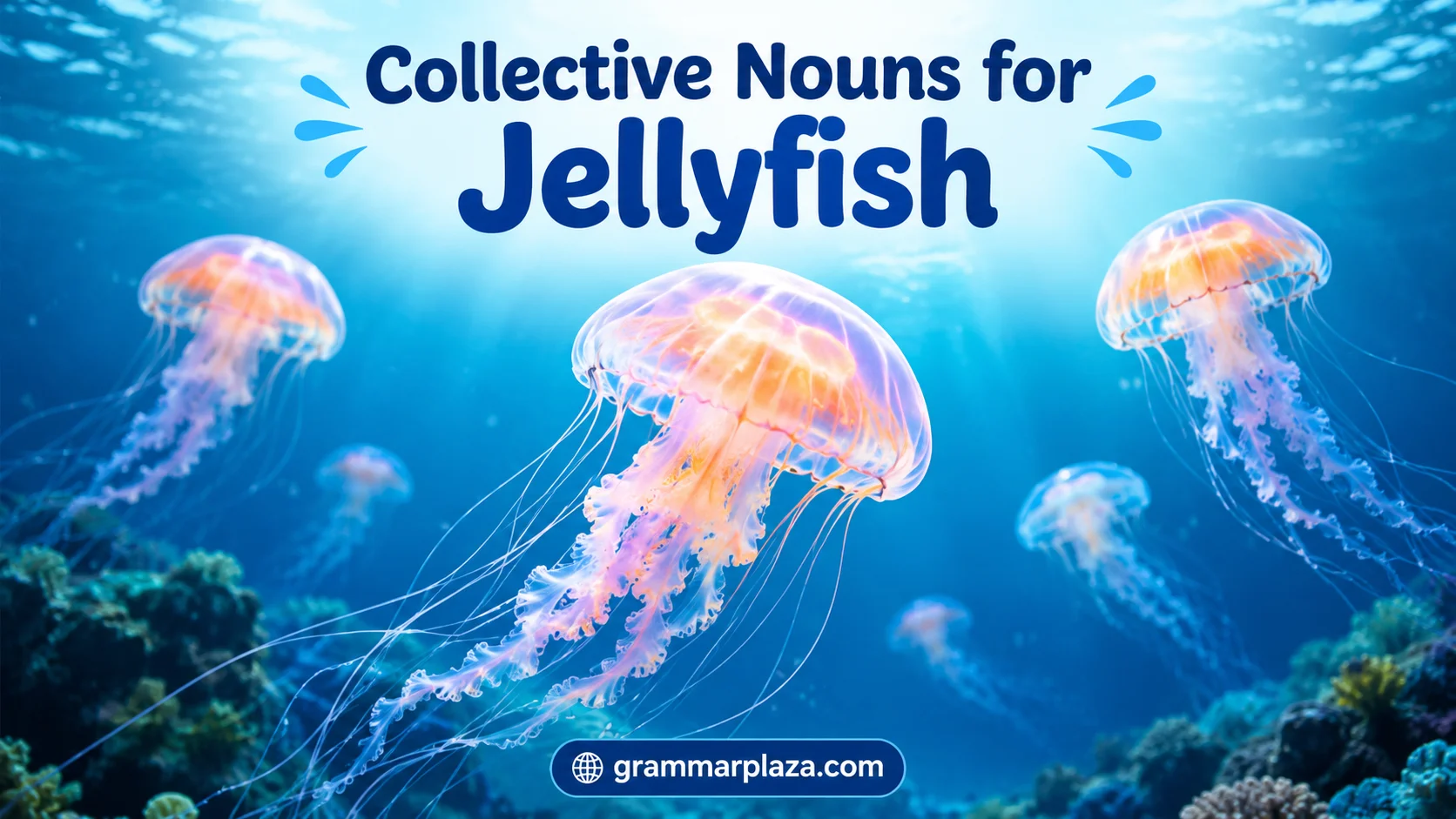
Collective Nouns for Jellyfish help learners describe groups of these fascinating sea animals in clear, natural English.
Collective nouns are special words that describe a group of people, animals, or things as a single unit. In the English language, they make writing more colorful and descriptive. Instead of saying “a group of jellyfish,” a writer may use a unique collective noun to create a clearer picture for readers. The right term depends on the context and describes how these fascinating marine creatures gather in large numbers, drifting together with ocean currents. Learning these terms builds vocabulary and helps readers appreciate the remarkable sea animals and their behavior.
When studying marine life, it is useful to learn the group names for different sea creatures and animal groups. Jellyfish move through the ocean in a marine environment shaped by water currents. Their gathering, movement, and jellyfish behavior provide interesting examples for language learning. From my personal experience with English vocabulary and descriptive language, explaining collective terms alongside real animal behavior makes new words easier to understand. These collective noun examples show how word usage connects grammar with the natural world.
English grammar becomes easier when learners connect a group description with familiar aquatic animals and ocean life. The term used for a gathering of jellyfish may vary with context, so choose a phrase that sounds natural and describes the scene clearly. Studying these expressions builds vocabulary, while encouraging readers to notice how jellyfish move, gather, and live in their environment.
| Collective Noun | Used For | Simple Example |
| Bloom | A large group of jellyfish | A bloom of jellyfish floated near the beach. |
| Smack | A group of jellyfish | We spotted a smack of jellyfish in the bay. |
| Swarm | A moving group of jellyfish | A swarm of jellyfish drifted with the tide. |
| School | A group swimming together (less common) | A school of jellyfish moved slowly through the water. |
| Colony | A large gathering in one area | A colony of jellyfish covered the shallow water. |
Bloom of Jellyfish
A bloom is the most common collective noun for jellyfish. It usually refers to a large number of jellyfish gathering in one area, often because of warm water, favorable currents, or abundant food.
Examples
- A bloom of jellyfish floated close to the shore.
- We watched a bloom of jellyfish from the boat.
- Divers avoided the bloom of jellyfish.
- A bloom of jellyfish appeared after the storm.
- The bloom of jellyfish stretched across the bay.
- Scientists studied the bloom of jellyfish.
- The beach was closed because of a bloom of jellyfish.
- A colorful bloom of jellyfish drifted slowly.
- Fish swam around the bloom of jellyfish.
- Tourists photographed the bloom of jellyfish.
Smack of Jellyfish
The term smack is one of the oldest and most traditional collective nouns for jellyfish. Although it is less commonly used in everyday conversation, it remains a favorite among wildlife writers and nature enthusiasts.
Examples
- A smack of jellyfish floated across the ocean.
- We saw a smack of jellyfish near the pier.
- The fisherman avoided the smack of jellyfish.
- A large smack of jellyfish filled the bay.
- Children watched the smack of jellyfish from the dock.
- The smack of jellyfish moved with the current.
- A photographer captured the beautiful smack of jellyfish.
- The boat sailed around the smack of jellyfish.
- A glowing smack of jellyfish appeared at night.
- Marine biologists counted the smack of jellyfish.
Swarm of Jellyfish
The collective noun swarm emphasizes movement. It is often used when jellyfish drift together in large numbers with ocean currents.
Examples
- A swarm of jellyfish floated toward the beach.
- We spotted a swarm of jellyfish underwater.
- The swarm of jellyfish moved slowly.
- Divers stayed away from the swarm of jellyfish.
- A swarm of jellyfish surrounded the rocks.
- Fish swam beside the swarm of jellyfish.
- The current carried the swarm of jellyfish.
- A swarm of jellyfish appeared after sunset.
- The swimmers noticed the swarm of jellyfish.
- Scientists tracked the swarm of jellyfish.
School of Jellyfish
Although school is usually associated with fish, it is occasionally used for jellyfish when they appear to move together in a coordinated manner.
Examples
- A school of jellyfish drifted through the water.
- We observed a school of jellyfish near the reef.
- The school of jellyfish looked beautiful.
- A school of jellyfish moved with the waves.
- Divers photographed the school of jellyfish.
- The current guided the school of jellyfish.
- A school of jellyfish filled the lagoon.
- The school of jellyfish shimmered in the sunlight.
- Marine researchers studied the school of jellyfish.
- The boat passed a school of jellyfish.
Colony of Jellyfish
The word colony is sometimes used when a large number of jellyfish remain concentrated in the same area for an extended period.
Examples
- A colony of jellyfish covered the shallow bay.
- The colony of jellyfish attracted researchers.
- We saw a colony of jellyfish near the coast.
- A colony of jellyfish drifted close together.
- The colony of jellyfish filled the harbor.
- Fish avoided the colony of jellyfish.
- The colony of jellyfish glowed at night.
- Scientists monitored the colony of jellyfish.
- A colony of jellyfish remained in warm waters.
- Tourists admired the colony of jellyfish.
Interesting Facts About Jellyfish
Jellyfish Have Existed for Hundreds of Millions of Years
Jellyfish are among the oldest animals on Earth. They have existed for more than 500 million years, making them older than dinosaurs. Their simple body structure has allowed them to survive dramatic environmental changes throughout Earth’s history.
Some Jellyfish Can Live Remarkably Long Lives
Most jellyfish live for only a few months to a couple of years. However, the immortal jellyfish (Turritopsis dohrnii) has the extraordinary ability to reverse its life cycle. When injured or stressed, it can transform back into an earlier developmental stage, allowing it to potentially repeat its life cycle many times under favorable conditions.
Their Bodies Are Mostly Water
A jellyfish’s body is made of approximately 95% water. They have no brain, heart, lungs, or bones. Instead, they rely on a simple nerve net to sense their surroundings and coordinate movement.
Jellyfish Use Specialized Cells to Catch Food
Jellyfish have tentacles covered with tiny stinging cells called nematocysts. These microscopic structures release venom that helps capture prey and defend against predators. Different species have varying levels of sting intensity.
Jellyfish Have a Diverse Diet
Jellyfish mainly feed on plankton, tiny fish, fish eggs, shrimp, crustaceans, and other small marine organisms. Larger species may also consume smaller jellyfish. Their tentacles capture prey, which is then transported to the mouth located beneath the bell-shaped body.
Why Learning Collective Nouns for Jellyfish Is Useful
Understanding collective nouns makes communication more vivid and precise. Instead of repeatedly saying “a group of jellyfish,” words like bloom, smack, or swarm provide richer descriptions. These terms are especially useful in wildlife writing, education, and storytelling, helping readers better visualize the behavior of jellyfish in their natural marine environments.
FAQs
1. What is the most common collective noun for jellyfish?
The most common collective noun is bloom, especially when referring to a large gathering of jellyfish in the ocean.
2. Is “smack of jellyfish” a real term?
Yes. Smack is a traditional and widely recognized collective noun for jellyfish, although it is less commonly used than bloom.
3. Why do jellyfish form blooms?
Jellyfish blooms often occur because of warm water temperatures, plentiful food, favorable ocean currents, and suitable breeding conditions.
4. Do jellyfish swim together intentionally?
Not usually. Most jellyfish drift with ocean currents rather than actively forming organized groups, although they often appear together in large numbers.
5. Are all jellyfish dangerous to humans?
No. While some species have painful or even dangerous stings, many jellyfish have mild stings that pose little threat to people.
Conclusion
Collective nouns add richness and precision to the English language, making it easier to describe the natural world. For jellyfish, terms such as bloom, smack, swarm, school, and colony help portray the different ways these graceful marine animals gather in the ocean. Beyond their unique group names, jellyfish are extraordinary creatures with ancient origins, water-filled bodies, remarkable survival abilities, and specialized hunting techniques. By learning both their collective nouns and their fascinating biological characteristics, we gain a deeper appreciation for these mysterious inhabitants of the sea and the diversity of life they represent.