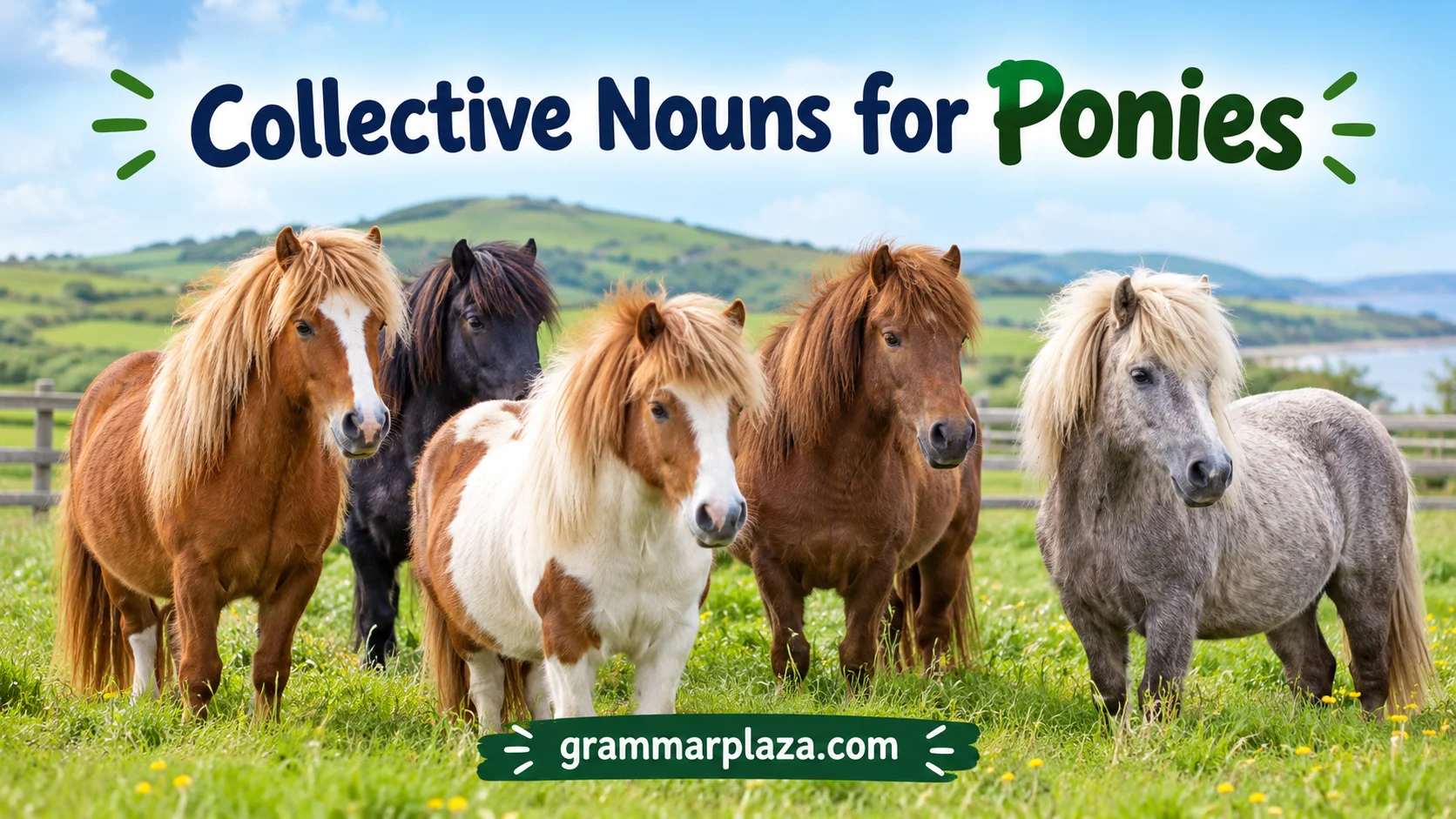
Collective Nouns for Ponies help describe pony groups clearly, making English more interesting and showing how these animals live and behave together.
Collective nouns are special words that describe a group of people, animals, or things as a single unit. Instead of saying group of ponies, a specific collective noun gives a clearer picture of their behavior. These terms make language more interesting and help writers and speakers describe groups in a creative way. Ponies are small animals, yet they are also strong and intelligent animals that move, live, and interact with each other in different ways.
Ponies are social animals that often stay together in herds, forming close relationships that support their safety and companionship. The common collective noun is a herd of ponies, a natural expression for ponies living together or moving together. When explaining these terms, connecting each word with ponies’ everyday lives can make learning easier and help readers understand their natural social habits. Learning collective nouns for ponies also improves vocabulary and helps people describe groups of animals accurately.
Other words may be suitable depending on the situation, especially when a group of ponies gathers for work, travel, or competition. The best expression depends on what the ponies are doing and how the group is organized. Using collective nouns thoughtfully helps people describe pony groups clearly without making every situation sound the same.
| Collective Noun Type | Simple Example |
| Herd | A herd of ponies grazed in the meadow. |
| Group | A group of ponies walked across the field. |
| Team | A team of ponies pulled the small cart. |
| String | A string of ponies was led along the trail. |
| Stable | A stable of ponies rested after training. |
Common Collective Nouns for Ponies with Examples
1. A Herd of Ponies
A herd of ponies is the most widely used collective noun. Ponies naturally live in herds because staying together provides protection from danger and allows them to socialize. A herd usually includes ponies of different ages, including young foals and adult ponies.
Example
- A herd of ponies grazed peacefully in the green valley.
- The farmer watched a herd of ponies running across the open land.
- A herd of ponies gathered near the water source during the afternoon.
- The children enjoyed seeing a herd of ponies at the countryside farm.
- A herd of ponies moved together through the mountain path.
- The wildlife photographer captured a beautiful picture of a herd of ponies.
- A herd of ponies rested under the shade of trees.
- The shepherd guided a herd of ponies toward the grassy fields.
- A herd of ponies played together in the pasture.
- The young foals followed the herd of ponies closely.
2. A Group of Ponies
A group of ponies is a general collective term used when several ponies are together. It can be used for ponies gathered at farms, shows, or riding events.
Example
- A group of ponies stood near the stable entrance.
- The visitors admired a group of ponies at the animal park.
- A group of ponies walked slowly along the village road.
- The trainer worked with a group of ponies every morning.
- A group of ponies enjoyed fresh grass in the field.
- The children fed a group of ponies during their farm visit.
- A group of ponies waited for their riders.
- The farmer bought a group of ponies for his farm.
- A group of ponies gathered around the fence.
- The owner cared for a group of ponies with great attention.
3. A Team of Ponies
A team of ponies refers to ponies working together, especially when pulling carts, participating in competitions, or helping people with tasks.
Example
- A team of ponies pulled the small carriage through the park.
- The farmer trained a team of ponies for farm activities.
- A team of ponies competed in the local event.
- The children enjoyed watching a team of ponies perform tricks.
- A team of ponies carried supplies across the countryside.
- The trainer prepared a team of ponies for the show.
- A team of ponies moved the wagon smoothly along the road.
- The villagers depended on a team of ponies for transportation.
- A team of ponies worked together during the festival.
- The strong team of ponies completed the journey easily.
4. A String of Ponies
A string of ponies is used when several ponies are connected or led together in a line, often during travel or guided tours.
Example
- A string of ponies followed the guide along the mountain trail.
- The rider led a string of ponies through the forest.
- A string of ponies crossed the open field in the morning.
- The tourists followed a string of ponies during their adventure.
- A string of ponies walked quietly along the narrow path.
- The guide controlled a string of ponies during the trip.
- A string of ponies carried equipment for the travelers.
- The farmer moved a string of ponies to another pasture.
- A string of ponies traveled toward the village.
- The children watched a string of ponies passing by.
5. A Stable of Ponies
A stable of ponies describes ponies kept together in a stable or managed by an owner, trainer, or riding center.
Example
- A stable of ponies was cared for by experienced handlers.
- The riding school owned a stable of ponies for students.
- A stable of ponies rested after a long day of training.
- The owner cleaned the area where a stable of ponies lived.
- A stable of ponies received regular medical care.
- The children learned about grooming a stable of ponies.
- A stable of ponies waited for their morning exercise.
- The trainer looked after a stable of ponies carefully.
- A stable of ponies lived comfortably on the farm.
- The visitors toured the stable of ponies during their trip.
Interesting Facts About Ponies
Ponies are fascinating animals known for their strength, intelligence, and adaptability. Although they are smaller than horses, many ponies are extremely strong and can carry heavy loads compared with their body size. Ponies often have a longer lifespan than many larger horse breeds and can live for 25 to 30 years or even longer when properly cared for.
One unique feature of ponies is their sturdy body structure. They usually have shorter legs, thick manes, strong bones, and compact bodies that help them survive in harsh environments. Many pony breeds developed in cold and mountainous regions, where their thick coats protected them from difficult weather conditions.
Ponies are herbivores and mainly eat grass, hay, and other plant materials. Their digestive systems are designed to process small amounts of food over long periods, so they naturally prefer grazing throughout the day. Their social behavior, intelligence, and friendly nature have made them popular animals for riding, farming, therapy programs, and companionship.
Frequently Asked Questions About Collective Nouns for Ponies
1. What is the most common collective noun for ponies?
The most common collective noun for ponies is a herd of ponies. It describes ponies living or moving together as a social group.
2. Can we use “group” for ponies?
Yes, “group of ponies” is a general collective noun that can be used whenever several ponies are together.
3. Why do ponies live in herds?
Ponies live in herds for protection, companionship, and better chances of finding food and water.
4. Is “team of ponies” a correct collective noun?
Yes, “team of ponies” is correct when ponies are working together, such as pulling a cart or participating in activities.
5. Are ponies different from horses?
Ponies are closely related to horses but are generally shorter, stronger for their size, and often have thicker coats and manes.
Conclusion
Understanding collective nouns for ponies helps us appreciate both the beauty of language and the social nature of these remarkable animals. Words like herd, group, team, string, and stable describe different situations in which ponies interact with humans and each other.
Beyond vocabulary, learning about ponies reveals their impressive strength, long lifespan, unique physical features, and interesting feeding habits. Whether they are roaming freely in a herd or working together as a team, ponies continue to capture human interest with their intelligence, loyalty, and fascinating biological traits.