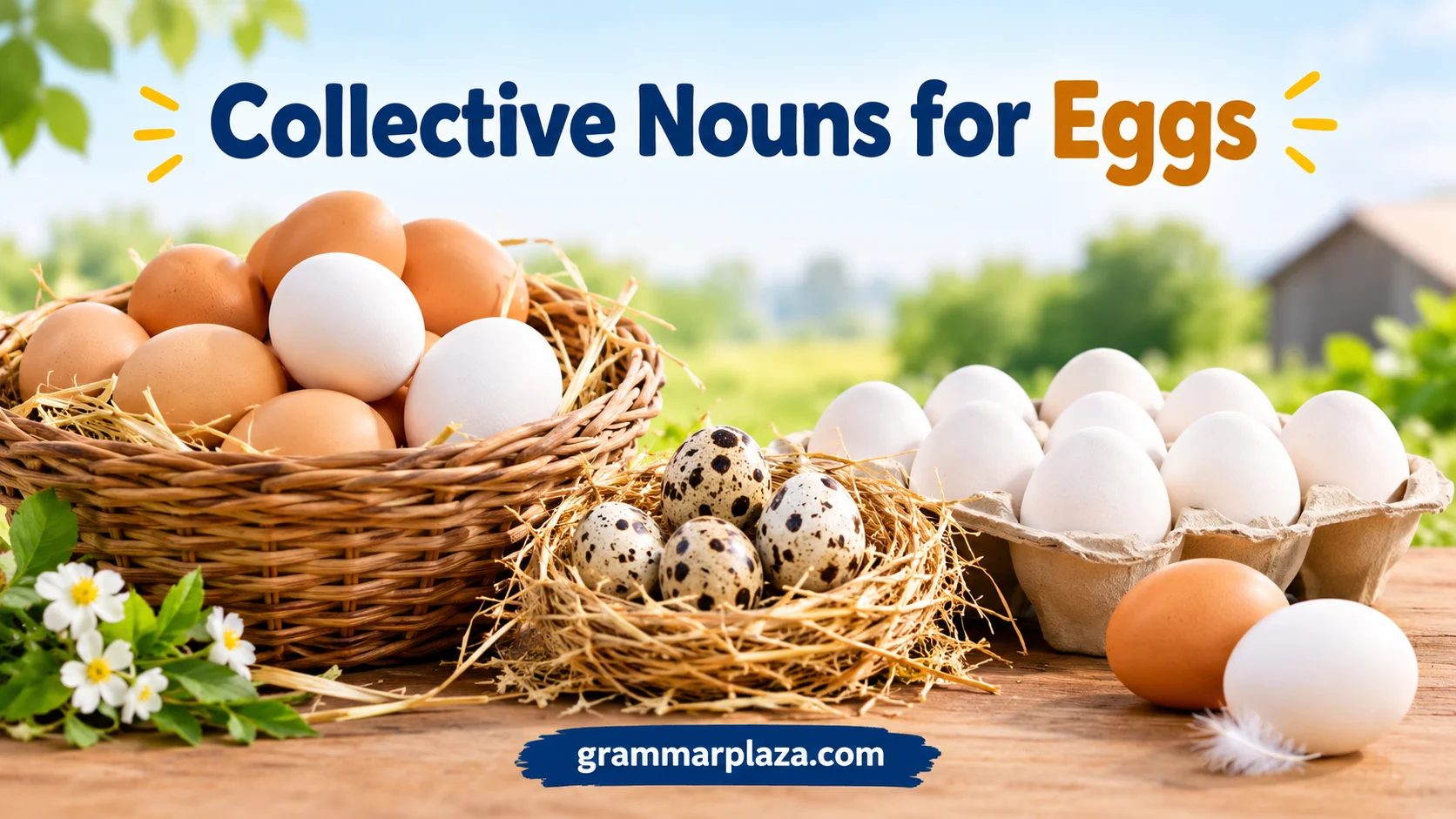
Collective Nouns for Eggs describe how eggs are grouped in nests, baskets, and cartons, making everyday English clearer and more precise today.
Collective nouns are special words that describe a group of people, animals, objects, or things as a single unit. Instead of saying many eggs, we can use expressions that make sentences more interesting and help readers understand how items are arranged and connected. In my experience with English writing, clear group descriptions help readers picture how eggs are gathered, stored, and presented.
Unlike animals that move and behave socially, eggs do not form social groups. Therefore, words used for groups of eggs usually focus on their arrangement, storage, and natural setting rather than behavior. Expressions such as egg groups, egg collections, egg baskets, egg cartons, and bird nests describe how eggs are kept together. Understanding these terms improves English vocabulary and gives readers a better appreciation of the role of eggs in nature, farming, and human diets. The right expression depends on whether eggs are found in nests, collected, or prepared for storage.
Learning about egg-related collective terms also connects language and grammar with everyday life. Simple examples involving egg storage, egg arrangement, and food items support vocabulary development while showing how eggs fit into the natural environment, agriculture, and nutrition. Eggs are important in human food and many farming practices, so describing them accurately makes educational writing more useful. Although some phrases are ordinary descriptive expressions rather than established collective nouns, they still help explain how eggs are gathered and grouped in different contexts.
Collective Nouns for Eggs: A Quick Overview
| Type of Collective Noun | Simple Example |
| Clutch | A clutch of eggs was found in the bird’s nest. |
| Nest | A nest of eggs was protected by the mother bird. |
| Batch | A batch of eggs was prepared for the bakery. |
| Carton | A carton of eggs was placed in the refrigerator. |
| Collection | A collection of eggs was displayed at the museum. |
Common Collective Nouns Used for Eggs
1. Clutch of Eggs
A clutch is one of the most common collective nouns used for eggs, especially eggs laid by birds, reptiles, or amphibians at the same time. It refers to a group of eggs produced during one laying period.
Example
- The bird carefully sat on a clutch of eggs in the tree.
- The farmer discovered a clutch of eggs near the field.
- The mother hen protected her clutch of eggs from danger.
- A clutch of eggs was hidden under the leaves.
- The turtle buried a clutch of eggs in the sand.
- Scientists studied the clutch of eggs to learn about reproduction.
- The nest contained a small clutch of eggs.
- The bird returned every day to guard its clutch of eggs.
- The wildlife team recorded a clutch of eggs during their research.
- The young birds hatched from a clutch of eggs.
2. Nest of Eggs
A nest of eggs describes eggs placed together in a bird’s nest. This phrase is commonly used when talking about wild birds and their natural breeding areas.
Example
- The robin built a nest of eggs in the garden.
- The tree contained a nest of eggs protected by the bird.
- The children observed a nest of eggs from a safe distance.
- The mother bird warmed the nest of eggs with her feathers.
- A nest of eggs was found near the forest path.
- The bird returned to care for its nest of eggs.
- The nest of eggs was carefully monitored by researchers.
- The eggshells from the nest of eggs were tiny and colorful.
- The eagle guarded its nest of eggs from predators.
- The nest of eggs showed signs of new life beginning.
3. Batch of Eggs
A batch of eggs refers to a group of eggs collected, cooked, or prepared together. This term is more commonly used in kitchens, farms, and food production.
Example
- The chef bought a fresh batch of eggs for baking.
- A batch of eggs was delivered to the restaurant.
- The farmer collected a batch of eggs in the morning.
- The bakery used a large batch of eggs for cakes.
- The store received a new batch of eggs today.
- The cook checked every egg in the batch.
- A batch of eggs was packed carefully for customers.
- The family purchased a batch of eggs from the market.
- The baker mixed a batch of eggs with flour and sugar.
- The quality of the batch of eggs was excellent.
4. Carton of Eggs
A carton of eggs refers to eggs stored together in a container, usually for transportation and sale. It is one of the most familiar terms used in everyday life.
Example
- I bought a carton of eggs from the grocery store.
- The carton of eggs was kept safely in the refrigerator.
- She opened a carton of eggs to prepare breakfast.
- The farmer packed each carton of eggs carefully.
- A carton of eggs usually contains several individual eggs.
- The child carried a carton of eggs gently.
- The supermarket displayed a fresh carton of eggs.
- The carton of eggs was checked for broken shells.
- He placed the carton of eggs on the kitchen shelf.
- The family finished the carton of eggs within a week.
5. Collection of Eggs
A collection of eggs describes a group of eggs gathered together for study, display, research, or storage. It can refer to unusual or valuable eggs as well as ordinary groups.
Example
- The museum displayed a collection of eggs from different birds.
- Scientists studied a collection of eggs to understand species differences.
- The farmer kept a collection of eggs ready for sale.
- The collection of eggs included many different sizes.
- The researcher photographed a collection of eggs in the laboratory.
- The children learned about a collection of eggs during the visit.
- The collection of eggs showed different patterns and colors.
- The wildlife center protected a collection of eggs.
- The artist created a display using a collection of eggs.
- The collection of eggs helped students learn about birds.
Interesting Facts About Eggs
Eggs are one of nature’s most remarkable creations because they provide protection and nourishment for developing life. Many birds, reptiles, fish, and insects reproduce by laying eggs, and each species produces eggs with different sizes, shapes, and shell designs. Some eggs can survive in harsh environments because their outer coverings protect the developing embryo from damage and moisture loss.
Eggs have existed for millions of years and have played an important role in the survival of many species. Bird eggs have unique features, such as strong shells with tiny pores that allow oxygen to enter while keeping harmful substances out. The shape and color of eggs can also help protect them from predators by allowing them to blend into their surroundings.
For humans, eggs are an important dietary food because they contain high-quality protein, vitamins, minerals, and healthy fats. People around the world use eggs in many dishes, including breakfast meals, baked goods, and traditional recipes. Different cultures have developed unique ways of cooking and preserving eggs, showing their importance in global diets.
Frequently Asked Questions (FAQs)
1. What is the most common collective noun for eggs?
The most common collective noun for eggs is clutch, especially when referring to eggs laid by birds, reptiles, or other animals.
2. Can we use “flock” as a collective noun for eggs?
No. Flock is used for groups of birds, not eggs. Eggs are usually described using words like clutch, nest, or collection.
3. What collective noun is used for eggs in a store?
A carton of eggs is the most common term used for eggs that are packaged and sold in shops.
4. Are collective nouns for eggs used in everyday English?
Yes. Terms like carton of eggs and batch of eggs are commonly used in daily conversations, while terms like clutch of eggs are more common in nature-related discussions.
5. Why are collective nouns important in English?
Collective nouns make language more accurate and descriptive. They help people explain groups of things in a simple and meaningful way.
Conclusion
Understanding collective nouns for eggs helps us use the English language more effectively while appreciating the importance of eggs in nature and human life. Words such as clutch, nest, batch, carton, and collection describe different ways eggs are grouped, whether they are found in the wild, collected on farms, or used in kitchens.
Although eggs do not display social behavior like animals, learning these terms allows us to better describe their biological importance and natural role. From protecting future generations of animals to providing valuable nutrition for humans, eggs remain fascinating examples of nature’s creativity and diversity.