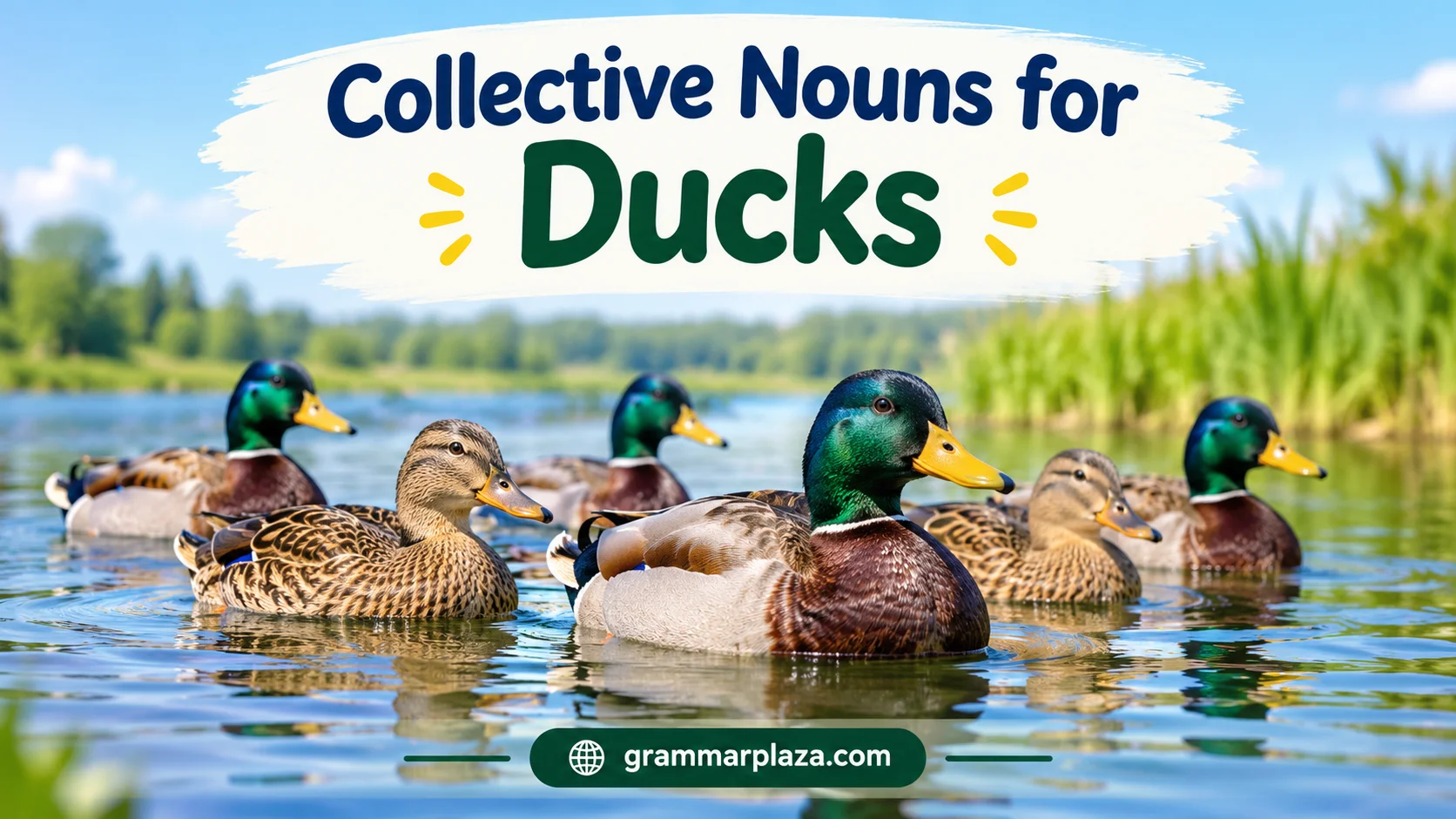
Collective Nouns for Ducks describe groups of familiar water birds in simple, colorful English, whether they swim on ponds, fly across the sky, or search for food.
Ducks are widely recognized water birds found throughout the world. Whether they are swimming peacefully on a pond, flying together across the sky, or searching for food along the shoreline, they are often seen in groups. In the English language, collective nouns are special words that refer to a group of people, animals, birds, or objects as a single unit. Choosing an appropriate collective noun instead of saying group of ducks makes writing more engaging and helps describe these gatherings in a descriptive and colorful way.
Learning these terms improves vocabulary and helps readers understand the social behavior of ducks and other wildlife. A useful guide explains common collective nouns for ducks, their meanings, and easy examples in everyday sentences. For instance, a flock of ducks is a familiar expression for ducks gathered together, whether they are resting on a pond or moving across a field near the water. These examples connect grammar with the natural world and make animal vocabulary easier to remember.
This guide also explores interesting facts about ducks and answers frequently asked questions about their group names. From my experience with language editing, clear explanations, simple definitions, and realistic examples help readers understand a topic more easily. Describing ducks as they swim, fly, or feed together connects each term with an actual situation. Because collective nouns can vary with context, choosing a natural expression is often more helpful than trying to memorize every possible group name.
Collective Nouns for Ducks
The table below introduces the most common collective nouns used for ducks.
| Collective Noun | Used For | Simple Example |
| Flock | Ducks flying or gathered together | A flock of ducks flew over the lake. |
| Raft | Ducks floating on water | A raft of ducks rested on the pond. |
| Team | Ducks moving together | A team of ducks crossed the marsh. |
| Brace | Two ducks, especially in hunting | A brace of ducks landed nearby. |
| Paddling | Ducks swimming together | A paddling of ducks glided across the river. |
A Flock of Ducks
A flock is the most common collective noun for ducks. It is generally used when ducks are flying or gathered together on land.
Examples
- A flock of ducks flew across the sky.
- We watched a flock of ducks land on the lake.
- The flock of ducks searched for food together.
- A large flock of ducks rested near the river.
- The farmer counted every duck in the flock.
- A flock of ducks crossed the grassy field.
- Children enjoyed feeding the flock of ducks.
- The flock of ducks made loud quacking sounds.
- A flock of ducks flew south for the winter.
- We photographed a beautiful flock of ducks.
A Raft of Ducks
A raft refers to ducks floating closely together on the surface of the water. This is one of the most descriptive collective nouns for ducks.
Examples
- A raft of ducks floated peacefully on the pond.
- We spotted a raft of ducks near the shore.
- The raft of ducks drifted with the current.
- A colorful raft of ducks gathered at sunrise.
- The raft of ducks stayed close together.
- Tourists admired the raft of ducks.
- A raft of ducks swam around the small island.
- The raft of ducks searched for insects.
- We counted twenty ducks in the raft.
- A quiet raft of ducks floated across the lake.
A Team of Ducks
The word team is occasionally used to describe ducks moving together, especially while walking or swimming.
Examples
- A team of ducks crossed the marsh.
- The team of ducks followed the leader.
- We watched a team of ducks swim together.
- A team of ducks searched for food.
- The team of ducks moved through the reeds.
- A small team of ducks entered the pond.
- The team of ducks stayed close together.
- Farmers noticed a team of ducks in the field.
- The team of ducks made their way to the water.
- A team of ducks disappeared into the tall grass.
A Brace of Ducks
A brace refers to two ducks together. This term is traditionally used in hunting and wildlife contexts.
Examples
- A brace of ducks landed on the lake.
- We saw a brace of ducks near the reeds.
- The brace of ducks swam quietly.
- A brace of ducks rested by the shore.
- The brace of ducks flew away together.
- A hunter noticed a brace of ducks.
- The brace of ducks searched for food.
- A brace of ducks stayed near the riverbank.
- Children watched a brace of ducks swim.
- The brace of ducks disappeared into the mist.
A Paddling of Ducks
A paddling is a charming and traditional collective noun used for ducks swimming together on water.
Examples
- A paddling of ducks crossed the pond.
- The paddling of ducks swam toward the shore.
- We admired a paddling of ducks at sunset.
- A paddling of ducks floated quietly.
- The paddling of ducks searched for fish.
- A paddling of ducks moved through the reeds.
- The paddling of ducks followed the mother duck.
- A paddling of ducks enjoyed the calm water.
- The paddling of ducks stayed together all morning.
- We photographed a paddling of ducks.
Interesting Facts About Ducks
Ducks are remarkable birds that have adapted to life on both land and water. Depending on the species, ducks can live anywhere from 5 to 20 years, with well-cared-for domestic ducks often reaching longer lifespans than their wild relatives. One of their most impressive features is their waterproof feathers, which are coated with oil from a special gland near the tail. Their webbed feet make them excellent swimmers, while their broad bills are specially designed to filter food from water and mud. Ducks also have lightweight bones that help them fly efficiently.
When it comes to diet, ducks are omnivores with varied eating habits. They commonly feed on aquatic plants, grasses, seeds, insects, worms, snails, small fish, and crustaceans. Their flexible diet allows them to thrive in lakes, rivers, wetlands, ponds, and coastal habitats around the world. Ducks play an important role in ecosystems by helping control insect populations, dispersing plant seeds, and contributing to healthy aquatic environments.
FAQs About Collective Nouns for Ducks
1. What is the most common collective noun for ducks?
The most common collective noun is a flock of ducks, especially when ducks are flying or gathered together.
2. What is a raft of ducks?
A raft of ducks refers to ducks floating together on the surface of the water.
3. Why is a group of ducks called a paddling?
The term paddling comes from the way ducks paddle through the water using their webbed feet.
4. What does a brace of ducks mean?
A brace of ducks means two ducks together and is commonly used in hunting and traditional English.
5. Why should I learn collective nouns for ducks?
Learning collective nouns improves your English vocabulary and helps you describe groups of animals more accurately and creatively.
Conclusion
Collective nouns make the English language more vivid and expressive, especially when describing animals like ducks. Terms such as flock, raft, team, brace, and paddling each highlight a different way ducks gather or move together. Understanding these words not only enriches your vocabulary but also provides insight into the natural behavior of these fascinating birds. Combined with their impressive lifespan, waterproof feathers, webbed feet, and diverse diet, ducks remain one of nature’s most adaptable and interesting waterfowl. By learning their collective nouns and biological characteristics, you gain a deeper appreciation for both the richness of the English language and the remarkable lives of ducks.