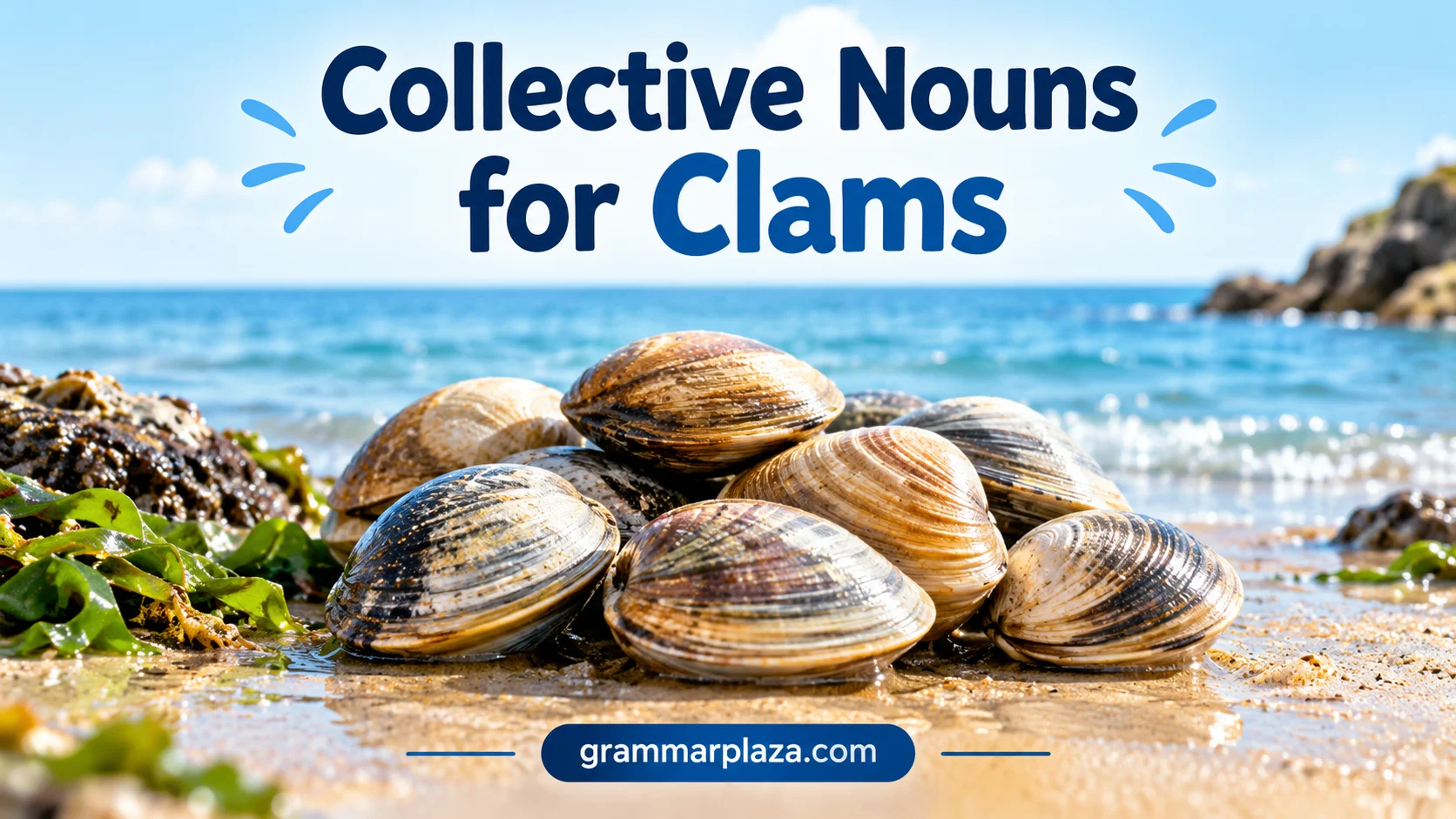
Collective Nouns for Clams help describe groups of clams clearly, adding variety to English and making descriptions more interesting and precise.
Collective nouns are special words that describe a group of people, animals, objects, or things as a single unit. Instead of repeating group of clams, writers, speakers, and readers can use specific terms to make sentences more interesting and descriptive. In the English language, these words help people understand groups more clearly and add variety to everyday communication. Although collective nouns for clams are not as commonly used as terms for birds or fish, suitable expressions can describe clams found together in their natural habitats.
Clams often live close together in sandy areas and muddy areas across oceans, rivers, and coastal regions. Describing their arrangement and presence helps readers understand how these small marine creatures live in their natural environment. From a writing and editing perspective, clear group descriptions make information easier to follow, while avoiding the claim that every gathering has an officially established collective term. Learning about clam groups, their habitat, and their distribution helps readers appreciate the fascinating lives of these animals.
A better understanding of collective terms improves language skills and encourages readers to appreciate marine life. Learning animal group names strengthens English grammar, expands vocabulary, and develops more precise descriptive language and word usage. Clams are marine animals, shellfish, and aquatic creatures that live in different environments. Exploring clam populations in coastal habitats, river habitats, and wider coastal ecosystems connects language learning with ocean life and the habitats where these creatures survive.
Collective Nouns for Clams
The following table shows some collective nouns that can be used for clams along with simple examples:
| Collective Noun Type | Simple Example |
| Bed | A bed of clams covered the ocean floor. |
| Colony | A colony of clams lived near the shore. |
| Cluster | A cluster of clams was found in the sand. |
| Group | A group of clams was collected by fishermen. |
| Gathering | A gathering of clams appeared during low tide. |
Collective Nouns for Clams with Examples
1. A Bed of Clams
A bed is one of the most common collective nouns used for clams. It refers to a large area where many clams live together, usually buried beneath sand, mud, or gravel in shallow waters.
Examples:
- A bed of clams was discovered near the coastline.
- The fishermen searched the bay for a large bed of clams.
- A bed of clams provided food for many sea animals.
- The researchers studied a bed of clams in the shallow waters.
- A large bed of clams covered the sandy ocean floor.
- The beach was famous for its natural bed of clams.
- A bed of clams grew safely under the muddy surface.
- The divers found a healthy bed of clams underwater.
- A bed of clams can support a balanced marine ecosystem.
- The conservation team protected the clam bed from damage.
2. A Colony of Clams
A colony describes a group of clams living together in the same area. This term highlights their shared environment and close population.
Examples:
- A colony of clams lived along the ocean shore.
- Scientists observed a colony of clams in the coastal waters.
- A colony of clams developed in the protected area.
- The marine reserve helped preserve a colony of clams.
- A colony of clams survived despite changing tides.
- The divers photographed a colony of clams beneath the sea.
- A colony of clams can contain thousands of individual animals.
- The beach was home to a thriving colony of clams.
- A colony of clams helped maintain the health of the seabed.
- Researchers studied how the colony of clams adapted to its surroundings.
3. A Cluster of Clams
A cluster is used when several clams are found close together. It describes a small or noticeable collection of clams in one place.
Examples:
- A cluster of clams was found near the rocks.
- The child discovered a cluster of clams on the beach.
- A cluster of clams rested beneath the wet sand.
- The diver spotted a cluster of clams underwater.
- A cluster of clams was carefully moved during research.
- The shoreline contained many clusters of clams.
- A cluster of clams formed in a quiet part of the bay.
- The fisherman collected a cluster of clams during low tide.
- A cluster of clams showed how these creatures live together.
- The researchers examined a cluster of clams for study.
4. A Group of Clams
A group is a simple and general collective noun that can describe any number of clams found together.
Examples:
- A group of clams was found in the shallow water.
- The fishermen collected a group of clams from the beach.
- A group of clams lived beneath the sand.
- The scientist studied a group of clams in the laboratory.
- A group of clams can filter large amounts of water.
- The children saw a group of clams near the shore.
- A group of clams moved slightly with the ocean currents.
- The aquarium displayed a group of clams in a tank.
- A group of clams helped create a healthy marine environment.
- The researchers protected a group of clams from pollution.
5. A Gathering of Clams
A gathering describes clams collected together in a particular area. It is a descriptive term often used when many clams appear in one location.
Examples:
- A gathering of clams appeared after the tide went out.
- The beach showed a gathering of clams along the shore.
- A gathering of clams attracted the attention of researchers.
- The fishermen found a gathering of clams in the bay.
- A gathering of clams was hidden beneath the sand.
- The coastal area was known for its gathering of clams.
- A gathering of clams provided information about marine life.
- The students observed a gathering of clams during their field trip.
- A gathering of clams created a small underwater community.
- The environmental team monitored the gathering of clams carefully.
Interesting Facts About Clams
Clams are fascinating marine animals that have existed for millions of years. Some clam species can live for many decades, and certain types are known for exceptional longevity. One famous species, the ocean quahog clam, can live for more than 400 years, making it one of the longest-living animals on Earth.
Clams have unique physiological features that help them survive underwater. They have two shells connected by a strong hinge, and they use a muscular foot to move through sand and mud. Unlike fish, clams do not have a backbone. They breathe by using gills that also help them collect food from the water.
Clams are filter feeders, meaning they take in seawater and remove tiny food particles such as plankton and organic matter. This feeding habit helps keep coastal waters cleaner. They also play an important role in marine ecosystems by providing food for other animals and helping maintain the balance of ocean environments.
Frequently Asked Questions About Collective Nouns for Clams
1. What is the most common collective noun for clams?
The most common collective noun for clams is “bed.” A bed of clams describes a large group of clams living together in one area of the seabed.
2. Can we use the word “group” for clams?
Yes, “group” is a simple and acceptable collective noun for clams. It can describe any number of clams found together.
3. Where do clams usually live in groups?
Clams usually live together in sandy, muddy, or gravel areas of oceans, rivers, and coastal regions.
4. Why are collective nouns important in English?
Collective nouns make language more interesting and help describe groups of animals, people, or objects in a clearer way.
5. Are clams social animals?
Clams do not communicate socially like mammals, but many species live close together in large communities called beds or colonies.
Conclusion
Understanding collective nouns for clams adds beauty and variety to the English language while helping us describe these remarkable marine creatures. Words like bed, colony, cluster, group, and gathering allow us to talk about clams in a more detailed and meaningful way.
Beyond language, learning about clams reveals their important role in nature. Their long lifespans, special body features, and filter-feeding habits show how valuable they are to marine ecosystems. By appreciating both their vocabulary and biology, we gain a deeper understanding of the quiet but fascinating world of clams.