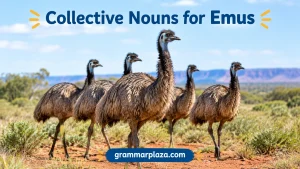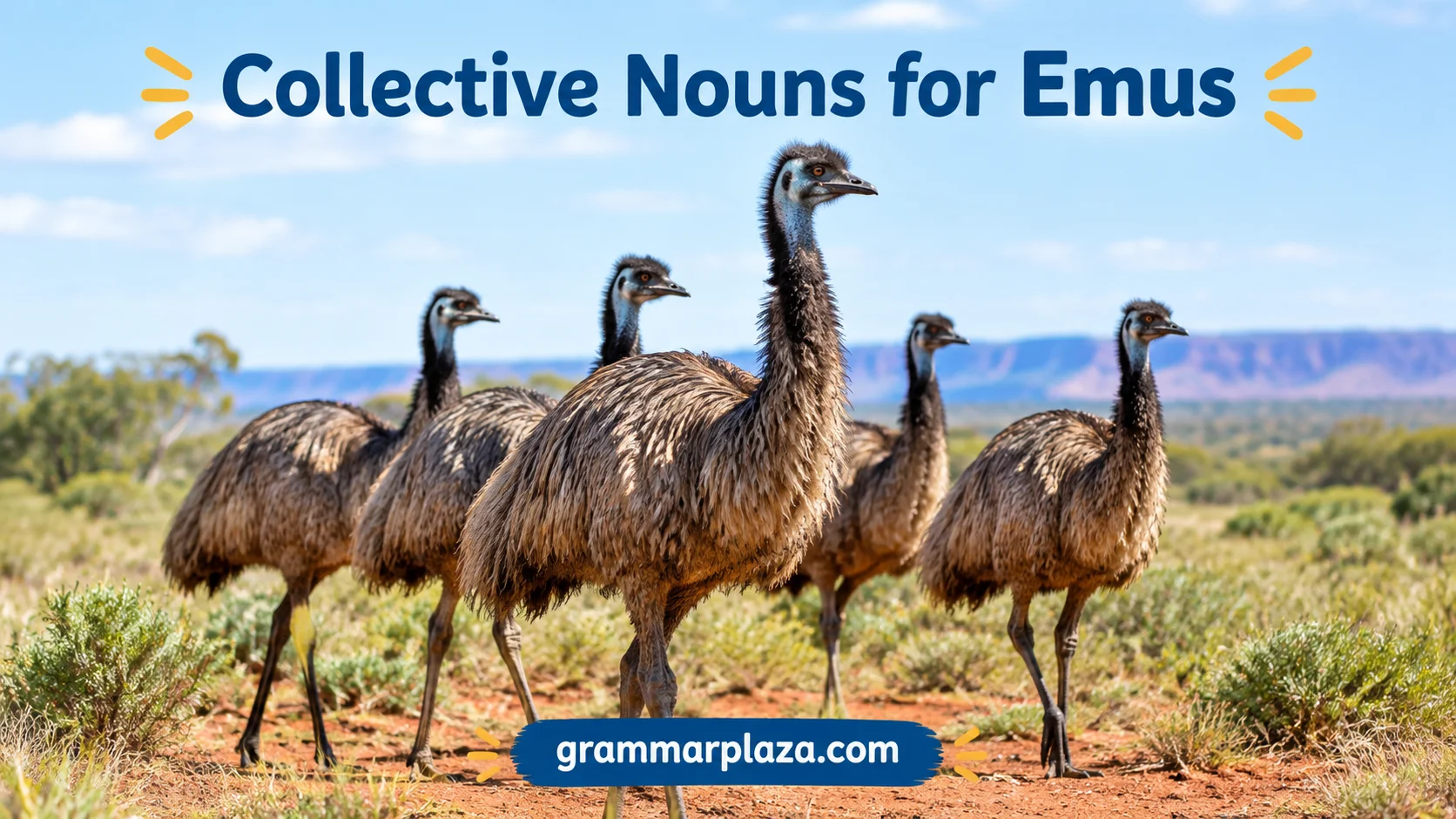
Collective Nouns for Emus explain how English speakers describe these large, flightless Australian birds when they appear together in the wild.
The most commonly used collective noun for emus is mob, as in a mob of emus. Other expressions, including flock of emus and group of emus, are also understandable, although their meaning and level of specificity may differ. In the English language, a collective noun is a word that refers to several people, animals, or things as a single group. Words such as herd, flock, and team make sentences shorter and more expressive, adding variety to animal group names and everyday grammar.
Understanding traditional language and observations of wildlife helps explain why some expressions are preferred, but a collective noun does not always describe an animal’s actual social structure. When writing an article about emus, readers can learn to use suitable expressions while exploring their physical features, habitat, diet, lifespan, and fascinating family behavior. From an editing perspective, the right phrase depends on what the sentence describes rather than simply choosing a colorful term. This approach also improves emu behavior descriptions and develops animal vocabulary about Australian wildlife and different bird groups.
The wider study of collective nouns for animals shows how the English language and group terminology describe animals in different ways. Although emus are flightless birds, their group name is a matter of language, while their animal social structure is a biological subject. Careful wildlife observations help writers distinguish traditional expressions from scientific descriptions. Using mob of emus where appropriate, while understanding alternatives such as flock of emus, makes writing clearer and helps readers separate common vocabulary from claims about how these birds live together.
What Is a Collective Noun?
A collective noun is a word used to name a collection of people, animals, or things. Instead of naming every member individually, we use one word to describe the group.
For example:
- A flock of birds flew over the field.
- A herd of cattle grazed in the pasture.
- A team of players entered the stadium.
Collective nouns are useful because they make communication clearer and more concise. They also add variety to English writing, particularly when describing animals in their natural habitats.
Some collective nouns are widely used in everyday English. Others are traditional, unusual, or mainly found in literary descriptions. It is important to distinguish between a recognized collective noun and an ordinary phrase that simply describes several animals together.
What Is a Group of Emus Called?
A group of emus is commonly called a mob of emus. The word mob is the most distinctive collective noun associated with these birds.
The term can describe several emus gathering or moving together. However, emus are not always found in large groups. They may live alone, travel in loose groups, or gather where food and water are available.
Two other useful expressions are:
- A flock of emus: A general bird-group expression that can be used when several emus are together.
- A group of emus: A straightforward, grammatically correct phrase suitable for almost any context.
The term mob is particularly useful when you want a more specific animal group name. The word flock is more general, while group is the most neutral choice.
Quick Reference Table
| Type | Simple Example |
| Mob | A mob of emus crossed the plain. |
| Flock | A flock of emus moved across the grassland. |
| Group | A group of emus gathered near the trees. |
1. A Mob of Emus
Meaning
A mob of emus is a phrase used to describe a group of emus. In this expression, mob is the collective noun, and emus identifies the birds in the group.
The term is commonly associated with emus in animal vocabulary. It should not, however, be interpreted as a scientific classification or proof that emus always live in large social groups.
Why It Fits Emus
Emus sometimes gather in loose groups, particularly when food and water are available. They may also travel across large areas in response to changing environmental conditions. In parts of Australia, the availability of food and water influences where these birds move.
The word mob provides a concise way to describe several emus seen together in the wild. It works well in wildlife articles, educational writing, and descriptions of birds moving across open country. Nevertheless, emus are not consistently social in the way some flocking birds are. Their grouping behavior varies with circumstances, and individuals may also spend time alone.
Examples
Example 1: A mob of emus crossed the dusty track.
Example 2: We watched a mob of emus walking across the open grassland.
Example 3: A mob of emus appeared near the roadside at sunrise.
Example 4: The wildlife photographer waited patiently for the mob to come closer.
Example 5: A mob of emus searched the ground for seeds and insects.
Example 6: The mob moved toward a water source during the dry weather.
Example 7: Rangers observed a mob of emus in the reserve.
Example 8: A mob of emus disappeared behind a patch of woodland.
Example 9: The children spotted a mob of emus during their visit to Australia.
Example 10: From a safe distance, we photographed the mob as it crossed the plain.
2. A Flock of Emus
Meaning
A flock is a collective noun commonly used for birds gathered together. Although mob is the more distinctive expression associated with emus, flock of emus is an understandable and grammatically acceptable phrase.
Unlike a specialized animal group name, flock is used for many kinds of birds. It is particularly familiar in general descriptions of bird movement and gatherings.
Why It Fits Emus
Emus are birds, so the general word flock can be used when describing several of them together. The expression may suit an informal account, a school assignment, or a general wildlife description.
However, the word should not suggest that emus always travel in closely organized flocks. These birds may form loose aggregations, and their social behavior differs from that of species that routinely gather in coordinated flocks. In careful writing, mob is a good choice when you want the distinctive term associated with emus, while flock is useful when emphasizing that the animals are birds.
Examples
Example 1: A flock of emus walked slowly across the open country.
Example 2: We noticed a flock of emus near the edge of the woodland.
Example 3: The flock moved through the grass in search of food.
Example 4: Several children watched the flock from the visitor area.
Example 5: A flock of emus appeared on the distant plain.
Example 6: The guide pointed out a flock of emus during the wildlife tour.
Example 7: A flock of emus wandered past the fence.
Example 8: The flock gradually moved out of sight behind the trees.
Example 9: A nature writer described a flock of emus crossing the landscape.
Example 10: We saw a flock of emus while exploring the Australian countryside.
3. A Group of Emus
Meaning
A group of emus is an ordinary descriptive phrase rather than a specialized collective noun. It is nevertheless completely correct English and is often the easiest expression for learners to use.
The word group simply means several individuals considered together. It does not specify how the animals behave, why they have gathered, or how long they remain together.
Why It Fits Emus
The phrase works particularly well because emus do not always gather in the same way. Some may be seen together while others move independently. A general expression allows a writer to describe what has been observed without making assumptions about the birds’ social relationships.
For students, teachers, and English learners, a group of emus is an excellent starting point. Once the basic sentence structure is understood, learners can use mob to introduce more specific animal vocabulary. The choice depends on the purpose of the sentence and the amount of detail the writer wants to convey.
Examples
Example 1: A group of emus stood near the roadside.
Example 2: We observed a group of emus in the wildlife reserve.
Example 3: The group searched for food among the plants.
Example 4: A group of emus crossed the open field.
Example 5: The guide explained why the group had gathered near the water.
Example 6: A group of emus moved through the woodland.
Example 7: The visitors watched the group from behind the viewing barrier.
Example 8: A group of emus appeared after the rain.
Example 9: The group walked away when people approached too closely.
Example 10: Researchers recorded the location of a group of emus during their survey.
4. Mob or Flock: Which Expression Should You Choose?
Meaning
Both mob and flock can describe several emus together, but they are not equally specific.
- Mob: The distinctive collective noun associated with emus.
- Flock: A general collective noun for birds.
- Group: A neutral, everyday word for several individuals.
The best expression depends on the context. None of these words automatically tells the reader how the emus are related to one another.
Why It Fits Emus
Choosing an appropriate collective noun helps a writer communicate naturally without overstating an animal’s behavior. For example, a mob of emus crossed the plain uses a distinctive animal group name. A flock of emus crossed the plain uses a familiar bird-related expression. A group of emus crossed the plain simply reports that several birds were together.
These differences are especially useful in educational writing. A teacher might introduce mob as the main vocabulary term, then explain that ordinary alternatives remain grammatically correct. In scientific writing, the most important consideration is accurate observation rather than selecting an unusual collective noun.
Examples
Example 1: A mob of emus crossed the road, while a second group remained farther away.
Example 2: The writer used flock as a general term for the birds.
Example 3: A group of emus stood near the water.
Example 4: The wildlife guide introduced the expression mob of emus to the visitors.
Example 5: In her school report, Maya described a mob of emus walking across the plain.
Example 6: The teacher explained that flock is a general bird-group word.
Example 7: A group of emus appeared on the horizon.
Example 8: The article used mob to introduce the distinctive collective noun.
Example 9: The student chose group because the sentence needed a simple description.
Example 10: Both writers described the same birds, but one used mob and the other used group.
5. Using Collective Nouns for Emus Correctly
Meaning
Using a collective noun correctly means choosing a suitable group word and placing it naturally in a sentence. For emus, the most useful expressions are a mob of emus, a flock of emus, and a group of emus.
The first expression contains the distinctive collective noun, the second uses a general bird-related term, and the third uses an ordinary group word.
Why It Fits Emus
Correct usage involves more than memorizing animal vocabulary. Learners also need to understand articles, prepositions, verb agreement, and sentence structure. For example, a mob of emus is moving treats the mob as a single unit. A sentence focusing on individual birds may use a plural verb in varieties of English that commonly treat collective nouns this way.
These grammar choices allow students to write about wildlife clearly and naturally. They also show that learning animal group names can strengthen broader English skills, from basic sentence construction to more detailed descriptions of animal behavior.
Examples
Example 1: A mob of emus is moving toward the water.
Example 2: We saw a group of emus near the road.
Example 3: A flock of emus appeared in the distance.
Example 4: The mob was searching for food.
Example 5: A group of emus crossed the open plain.
Example 6: The flock moved away from the visitors.
Example 7: Researchers observed a mob of emus during the morning survey.
Example 8: The guide described a group of emus to the students.
Example 9: A mob of emus was visible beyond the fence.
Example 10: The students wrote sentences about a flock of emus in their English notebooks.
How to Use Collective Nouns for Emus
Collective nouns follow a simple sentence pattern:
Article + collective noun + of + animal name
For example, a mob of emus contains the article a, the collective noun mob, the preposition of, and the animal name emus.
When to Use “A” or “An”
Use a or an according to the sound at the beginning of the next word.
- A mob of emus crossed the field.
- A flock of emus moved across the plain.
- A group of emus gathered near the trees.
The word mob begins with a consonant sound, so a mob is correct. The same rule gives us a flock and a group.
Why Is “Of” Important?
The preposition of connects the collective noun with the animals being described.
- A mob of emus.
- A flock of birds.
- A herd of cattle.
Without of, these expressions would not follow their usual grammatical pattern.
More Example Sentences
- A mob of emus walked across the plain.
- The group of emus was visible from the road.
- We watched a flock of emus feeding.
- A mob of emus moved toward the trees.
- The group gathered near a water source.
Should You Use a Singular or Plural Verb?
Collective nouns can take either singular or plural verbs, depending on the variety of English and whether the group is treated as one unit or as individual members.
Singular Verb
Use a singular verb when the group is considered a single unit.
Example: The mob is moving across the plain.
The sentence presents the mob as one group performing an action.
Plural Verb
In varieties of English that allow collective nouns to take plural agreement, a plural verb can emphasize the individual members of the group.
Example: The mob are moving in different directions.
Here, attention is given to the individual birds rather than the group as a single unit.
In American English, singular agreement is generally more common for collective nouns. British English more readily allows plural agreement when the members are considered individually. Usage varies, so writers should follow the conventions of their chosen variety of English and remain consistent.
For English learners, the singular form is a useful default when the group acts together:
- The mob is approaching the water.
- The flock is moving across the field.
- The group is searching for food.
Interesting Facts About Emus
Longevity
Emus are large, flightless birds native to Australia. Their lifespan varies according to their environment, health, and living conditions. The Smithsonian’s National Zoo reports that emus may live around five to ten years and longer in human care, while other wildlife institutions report longer lifespans under particular conditions. Therefore, a single exact lifespan should not be treated as universal. Wild and captive birds may experience different risks, food availability, veterinary care, and environmental pressures.
Unique Physiological Features
The emu is Australia’s tallest native bird and can reach approximately 1.6 to 1.9 metres in height. Its body is covered in shaggy grey-brown feathers, while its head and much of its neck have comparatively little feathering. The neck and face can appear bluish-black.
Emus have greatly reduced wings, which means they cannot fly. However, they have long, powerful legs adapted for running across open terrain. Each foot has three forward-facing toes. These features help them travel over a range of landscapes in search of food and water.
Another fascinating feature is their unusual call. Emus can produce booming, drumming, and grunting sounds. Some calls are created with the help of an inflatable neck sac and can carry over considerable distances.
Dietary Habits
Emus are omnivores, meaning they eat both plant and animal matter. Their diet can include seeds, fruits, leaves, flowers, growing shoots, insects, and other small animals. They may also consume other available food sources, including animal droppings.
Their diet changes with food availability and seasonal conditions. In some areas, emus move across the landscape in response to rainfall and the availability of nutritious plants. When food or water becomes scarce, they may travel considerable distances to find suitable resources.
Their flexible diet helps them survive in a variety of Australian habitats. Rather than relying on one specific food source, emus take advantage of what is available in their environment.
Social Behavior
Emus may be solitary or occur in loose groups. They can gather where food and water are plentiful, but they are not consistently social in the way some birds are. Their movements often reflect environmental conditions, including rainfall and the availability of resources.
Their breeding behavior is especially interesting. After the female lays her eggs, she generally leaves the nest area, and the male takes responsibility for incubation. He also cares for the chicks after they hatch. The striped plumage of young emus helps them blend into their surroundings while they develop.
Young emus remain close to their father for an extended period as they grow and learn to find food. This parental arrangement is one of the species’ most distinctive biological traits. It also reminds us that animal behavior can be much more complex than a collective noun alone suggests.
Why Are Animal Collective Nouns So Interesting?
Animal collective nouns add variety and character to English. Words such as flock, herd, pack, and mob allow writers to describe animals without repeatedly using the phrase a group of animals.
Some expressions have become familiar through everyday speech, while others are associated with traditional vocabulary, literature, or particular cultural settings. The history of an individual term may be difficult to establish, so it is best not to assume that every collective noun originated from a specific animal behavior or historical event.
The word mob, for example, is associated with groups of emus in English animal vocabulary. It is a concise way to describe several birds together, but it does not mean that every group of emus behaves in the same way.
Collective nouns are useful for language learners because they combine vocabulary, grammar, and observation. They also encourage readers to explore how people describe wildlife and how those descriptions relate to what scientists know about animals today.
Collective Nouns vs. Ordinary Group Words
A collective noun names a group, while an ordinary group word can describe several individuals without using a specialized animal term.
Here are some common examples:
- Herd: Often used for animals such as cattle and deer.
- Group: A general word that can describe almost any collection of individuals.
- Pack: Commonly used for certain animals, including wolves and dogs.
- Flock: A familiar word for a group of birds or sheep.
- School: A collective noun for a group of fish.
- Colony: Used for groups of certain animals that live or breed together, such as some seabirds and penguins.
For emus, mob is the distinctive collective noun, while flock is a general bird-related expression. The phrase a group of emus is also entirely correct.
Writers should choose the term that communicates their meaning clearly. A specialized word can make writing more vivid, but a simple group word is often preferable when the context does not call for a particular animal term.
What Do Collective Nouns Tell Us About Emus?
Collective nouns can reveal something about the way people traditionally describe animals. They provide useful vocabulary for discussing wildlife and help writers create clear, engaging descriptions.
The expression mob of emus offers a familiar name for several of these birds together. However, the word does not establish that emus always form permanent groups, travel together, or depend on one another for survival.
Modern biological knowledge shows that emus can be solitary or occur in loose groups, and their movements are influenced by environmental conditions. Their breeding behavior also demonstrates that social relationships vary according to the stage of life. For example, the male’s role in incubating eggs and caring for chicks differs from the responsibilities seen in many other bird species.
It is helpful to distinguish between traditional language and scientific evidence. A collective noun makes a sentence more expressive, while wildlife research helps us understand the animal’s actual behavior. Learning both gives readers a richer understanding of English and the natural world.
Frequently Asked Questions About Emus
What is a group of emus called?
A group of emus is commonly called a mob of emus. The word mob is the distinctive collective noun associated with these birds.
What is the most common collective noun for emus?
Mob is the main collective noun commonly associated with emus. The word flock is also understandable as a general bird-group term.
Can I use “a group of emus” in English?
Yes. A group of emus is grammatically correct and suitable for everyday conversation, school assignments, and wildlife writing.
Are animal collective nouns always commonly used?
No. Some collective nouns are widely recognized, while others are traditional, unusual, or mainly literary. A writer should distinguish familiar terms from obscure or unsupported expressions.
Why does English have special names for groups of animals?
Special group names make English more concise and expressive. They also provide traditional vocabulary for describing animals, although a collective noun does not necessarily reflect a scientifically defined social structure.
Conclusion
The collective noun for emus most commonly identified in English is mob, as in a mob of emus. Writers can also use a flock of emus as a general bird-related expression or a group of emus when a simple, neutral description is more appropriate.
Learning these expressions helps students improve their English grammar, expand their animal vocabulary, and write more naturally about wildlife. Correct usage also involves understanding articles, the preposition of, and the difference between singular and plural verb agreement.
Emus themselves are remarkable birds. Their powerful running legs, reduced wings, varied omnivorous diet, and unusual pattern of male parental care make them especially interesting to study. Their behavior also reminds us that traditional group names cannot explain every aspect of animal life.
By combining language learning with accurate wildlife information, readers can discover how a few words connect English grammar, cultural vocabulary, and the fascinating diversity of nature.