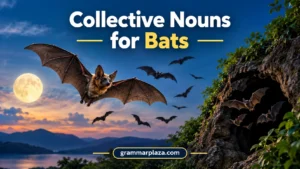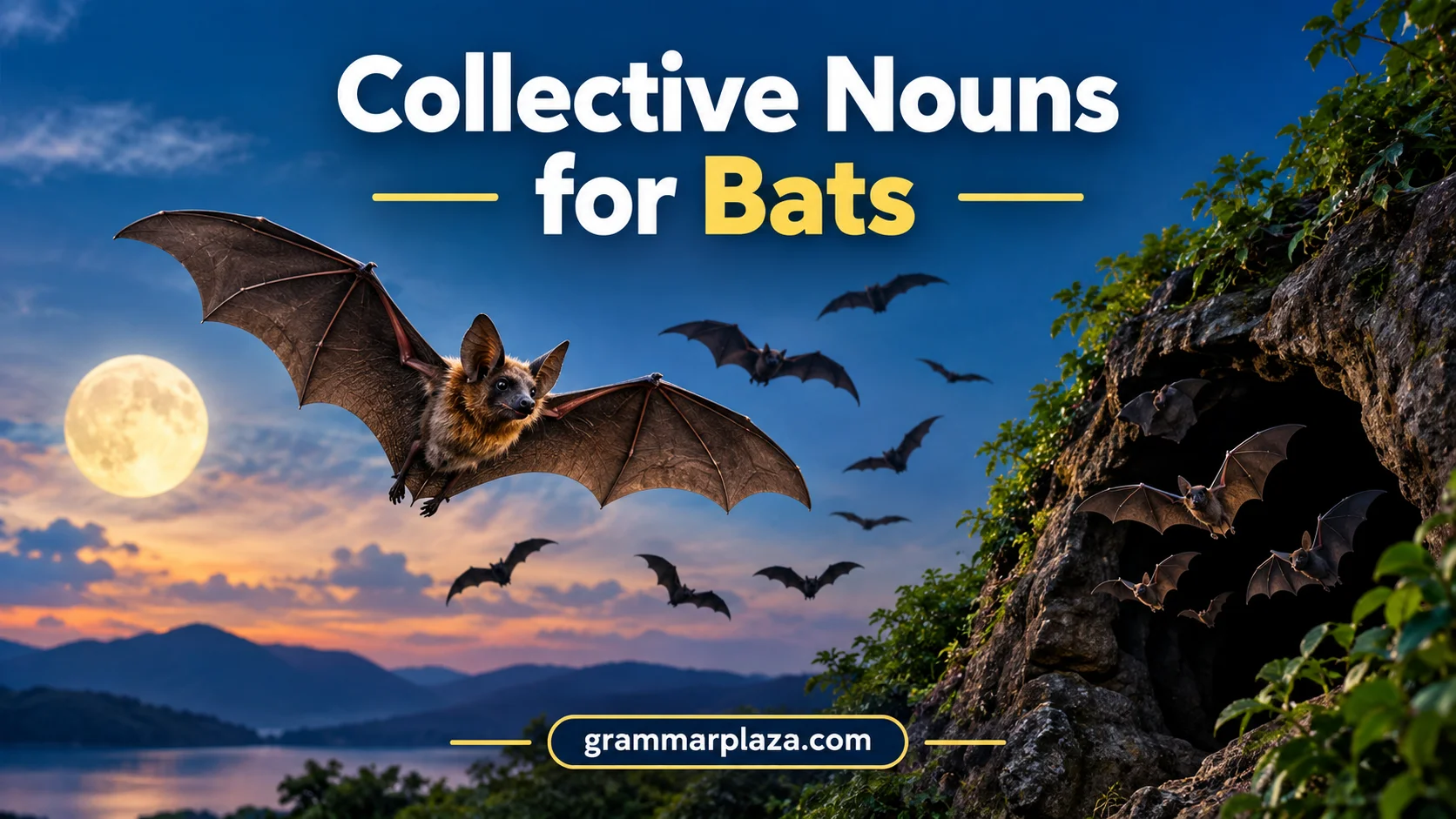
Collective Nouns for Bats help describe several bats as one group. The most common term is colony, especially when bats live together in caves, trees, buildings, or other roosting places. Learning these terms makes wildlife descriptions more accurate, natural, and interesting. For English learners, colony of bats is an easy phrase to remember because it clearly shows that bats share the same living space.
Bats can also be described with colorful expressions such as a cloud of bats or a cauldron of bats. A cloud can refer to bats flying together, while a cauldron gives a more vivid description of a large gathering. These collective nouns can improve your vocabulary and help you create clear, engaging sentences when writing about bats, wildlife, or animal groups.
Collective Nouns for Bats
Here is a simple overview of commonly used collective nouns for bats:
| Type | Simple Example |
| Colony | A colony of bats |
| Cloud | A cloud of bats |
| Cauldron | A cauldron of bats |
| Camp | A camp of bats |
| Swarm | A swarm of bats |
1. Colony of Bats
A colony of bats is one of the most familiar expressions for a group of bats. Many bat species are highly social and live together in caves, hollow trees, buildings, or other suitable roosting locations. A colony can contain anything from a small number of bats to thousands or even millions, depending on the species and habitat.
Example
- A colony of bats lived inside the dark cave.
- We saw a large colony of bats hanging from the ceiling.
- The researchers studied a colony of bats during the summer.
- A colony of bats returned to the cave at sunset.
- The old tunnel became home to a colony of bats.
- A colony of bats rested quietly during the daytime.
- The conservation team protected the colony of bats.
- Thousands of bats formed a huge colony in the cave.
- The colony of bats became active after dusk.
- The children learned about a colony of bats during their nature lesson.
2. Cloud of Bats
A cloud of bats is an expressive term used when many bats fly together, particularly when they emerge from a roost or move through the evening sky. The word “cloud” creates a vivid picture because a large number of flying bats can appear to fill the air like a moving, dark cloud.
Example
- A cloud of bats flew out of the cave at sunset.
- We watched a cloud of bats cross the evening sky.
- A large cloud of bats appeared above the forest.
- The cloud of bats moved quickly toward the trees.
- A cloud of bats emerged when darkness fell.
- The photographer captured a cloud of bats in flight.
- We stood quietly as a cloud of bats passed overhead.
- A cloud of bats filled the sky near the cave entrance.
- The sudden appearance of a cloud of bats surprised the visitors.
- At dusk, a cloud of bats began searching for food.
3. Cauldron of Bats
A cauldron of bats is a colorful and imaginative collective expression. It is especially suitable for describing a large, active group of bats moving together. The unusual word “cauldron” makes the expression memorable and can add a dramatic quality to wildlife writing.
Example
- A cauldron of bats flew from the cave at night.
- We noticed a cauldron of bats above the forest.
- The cauldron of bats became active after sunset.
- A huge cauldron of bats circled the cave entrance.
- The guide pointed toward a cauldron of bats in the distance.
- A cauldron of bats moved across the dark sky.
- The cave was surrounded by a cauldron of bats.
- The explorers watched a cauldron of bats leave its roost.
- A cauldron of bats appeared above the trees.
- The evening sky seemed busy with a cauldron of bats.
4. Camp of Bats
A camp of bats can describe a group of bats living or resting together in a particular roosting area. The term fits especially well when discussing bats that gather in a sheltered location for rest. Since many bats return to the same roost repeatedly, their shared resting place can resemble a small animal “camp.”
Example
- A camp of bats rested inside the old cave.
- The researchers discovered a camp of bats near the forest.
- A large camp of bats occupied the abandoned building.
- We carefully observed the camp of bats from a distance.
- The camp of bats became quiet during the day.
- A camp of bats formed beneath the bridge.
- The cave provided shelter for a camp of bats.
- The wildlife team monitored the camp of bats throughout the year.
- At sunset, the camp of bats began to stir.
- The protected area became an important home for a camp of bats.
5. Swarm of Bats
A swarm of bats is commonly used informally to describe a large number of bats flying together. Although “swarm” is more strongly associated with insects such as bees, it can create a clear visual image when many bats suddenly take flight at the same time.
Example
- A swarm of bats flew over the lake at dusk.
- We saw a swarm of bats leave the cave.
- A large swarm of bats moved across the night sky.
- The swarm of bats quickly disappeared into the forest.
- A swarm of bats emerged from the old tunnel.
- The tourists watched a swarm of bats from a safe distance.
- A swarm of bats gathered near the cave entrance.
- The swarm of bats began hunting after sunset.
- A swarm of bats flew above the trees.
- The sudden swarm of bats made the evening scene unforgettable.
Also Read This: Collective Nouns for Deer
Interesting Facts About Bats
Bats are remarkable mammals with many unusual biological features. They are the only mammals capable of true sustained flight, using elongated fingers connected by a thin membrane of skin. Many bats use echolocation to navigate and locate prey in darkness by producing sounds and listening for returning echoes. Their diets are also surprisingly diverse: depending on the species, bats may eat insects, fruit, nectar, pollen, fish, small vertebrates, and, in a few species, blood. Bats can also be remarkably long-lived for their size, with some species surviving for several decades under suitable conditions. Their social behavior is equally fascinating, as many species gather in large colonies where they roost, reproduce, communicate, and sometimes cooperate in caring for young.
FAQs :
1. What is the collective noun for bats?
The most common collective noun for bats is colony. You can say, “A colony of bats lives in the cave.” It is especially suitable when bats are living together in a shared roosting place.
2. Can I use “cloud” for a group of bats?
Yes. Cloud of bats is a colorful expression used when bats are flying together. It creates a vivid picture of many bats moving through the air at the same time.
3. What does “cauldron of bats” mean?
A cauldron of bats is a creative collective expression for a group of bats. It can describe a large gathering or movement of bats and gives the sentence a more imaginative feel.
4. Where do colonies of bats usually live?
Bats may form colonies in caves, trees, mines, attics, buildings, and other suitable roosting places. The exact location depends on the bat species and its habitat.
5. Why are collective nouns for bats useful?
Collective nouns make your writing clearer, more descriptive, and interesting. Words such as colony, cloud, and cauldron help you describe bats naturally while also improving your English vocabulary.
Conclusion :
Knowing the different collective nouns for bats can make your English more expressive and precise. Colony is the easiest and most common choice for bats living together, while cloud and cauldron offer more colorful descriptions. Using these terms correctly can strengthen your vocabulary and make sentences about wildlife more engaging.