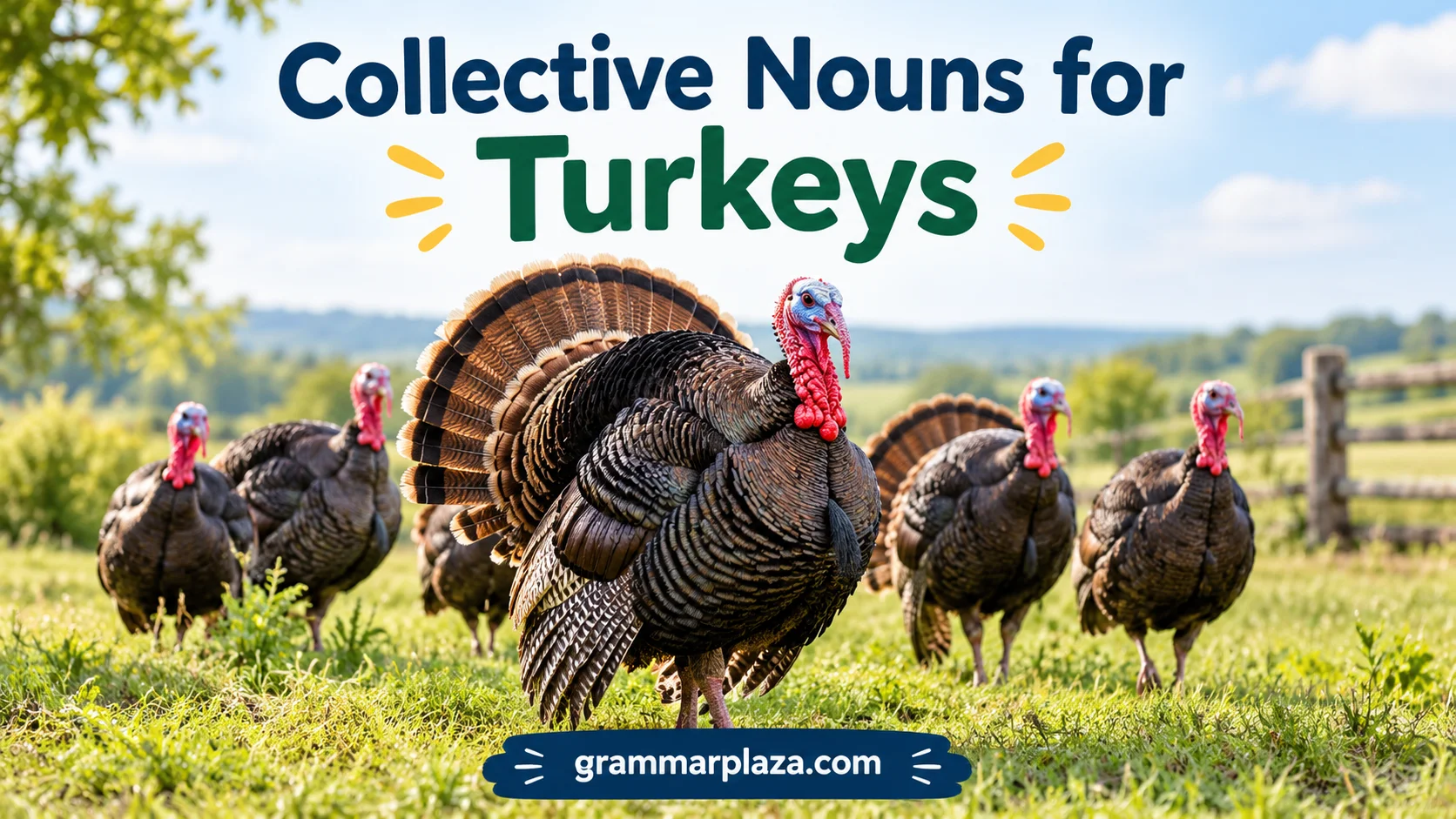
Collective Nouns for Turkeys help describe groups of social birds in clear English, with flock being the familiar term for turkeys moving, feeding, or resting together.
These special words make writing more descriptive, interesting, and meaningful. In the English language, collective nouns describe a group of people, animals, or things as a single unit. Learning these animal group names supports learning English, studying birds, and understanding everyday English. Turkeys are fascinating birds whose social nature, movement, and feeding behavior can be explored by observing bird groups in their natural environment.
Another useful term is rafter, a traditional term associated with turkeys. Depending on the context, this word offers an alternative to flock when describing turkeys gathering together. Both terms add variety to colorful expressions, although flock remains a familiar choice for general use. From an editing perspective, choosing the right expression depends on the sentence structure, the meaning intended, and what the writer wants to communicate. Understanding these expressions can enrich your vocabulary, strengthen English vocabulary, and help writers and speakers use group names and collective terms more clearly and precisely.
These collective nouns for turkeys also connect language with animal behavior, appearance, and social behavior. Turkeys may travel, live together, feed, and interact with one another in nature. Learning how groups of turkeys are described gives curious readers a clearer picture of wildlife and makes wildlife writing more engaging. By understanding terms such as flock and rafter, readers can develop language learning, grammar, and communication skills while keeping their English natural and easy to understand. These descriptions help explain turkey groups, group descriptions, and bird movement in a precise and natural way.
Common Collective Nouns for Turkeys
| Collective Noun Type | Simple Example |
| Rafter | A rafter of turkeys walked through the forest. |
| Flock | A flock of turkeys searched for food. |
| Group | A group of turkeys rested under the trees. |
| Brood | A brood of young turkeys followed their mother. |
| Gang | A gang of turkeys moved across the field. |
Collective Nouns for Turkeys with Examples
1. A Rafter of Turkeys
A rafter is the most commonly recognized collective noun for wild turkeys. It is often used when describing a large group of turkeys moving or gathering together. The word is especially common in North America, where wild turkeys are widely found.
Example
- A rafter of turkeys crossed the open field early in the morning.
- We saw a rafter of turkeys walking near the woodland area.
- A rafter of turkeys searched for seeds on the ground.
- The rafter of turkeys disappeared into the forest quickly.
- A photographer captured a rafter of turkeys during sunrise.
- The farmers noticed a rafter of turkeys near their crops.
- A rafter of turkeys gathered beside the stream.
- The rafter of turkeys moved together through the grassland.
- A rafter of turkeys rested beneath the shade of trees.
- The children watched a rafter of turkeys from a distance.
2. A Flock of Turkeys
A flock is a general collective noun used for many types of birds, including turkeys. It describes a group of turkeys that stay together while feeding, traveling, or resting.
Example
- A flock of turkeys walked across the farmyard.
- The flock of turkeys looked for insects and seeds.
- A flock of turkeys gathered near the bushes.
- The farmer counted the flock of turkeys in the field.
- A flock of turkeys moved slowly through the forest.
- The flock of turkeys flew short distances to reach safety.
- A flock of turkeys rested after searching for food.
- The children enjoyed watching a flock of turkeys outside.
- A flock of turkeys followed the leader through the valley.
- The flock of turkeys made sounds while walking together.
3. A Brood of Turkeys
A brood refers to a group of young turkeys, especially chicks that are cared for by their mother. This collective noun highlights the family behavior of turkeys.
Example
- A brood of turkey chicks followed their mother closely.
- The mother turkey protected her brood from danger.
- A brood of young turkeys searched for tiny insects.
- The farmer watched a brood of turkeys near the barn.
- A brood of turkey chicks rested under their mother’s wings.
- The brood of turkeys learned how to find food.
- A brood of young turkeys moved through the grass.
- The mother turkey guided her brood across the field.
- A brood of turkeys stayed together for safety.
- The wildlife expert photographed a brood of turkey chicks.
4. A Gang of Turkeys
A gang is an informal collective noun sometimes used for a group of turkeys. It describes a group that travels together, especially when they appear active or energetic.
Example
- A gang of turkeys walked beside the road.
- The gang of turkeys explored the garden area.
- A gang of turkeys searched for fallen fruits.
- The farmer saw a gang of turkeys near the trees.
- A gang of turkeys moved across the open land.
- The gang of turkeys gathered before sunset.
- A gang of turkeys crossed the backyard quietly.
- The wildlife researcher followed a gang of turkeys.
- A gang of turkeys stayed together during the day.
- The gang of turkeys returned to the same feeding area.
5. A Group of Turkeys
A group is a simple and commonly understood collective noun for turkeys. It can be used in everyday conversations when the specific term is unknown.
Example
- A group of turkeys gathered near the trees.
- The group of turkeys searched for food in the field.
- A group of turkeys walked through the forest.
- The group of turkeys rested beside the farm.
- A group of turkeys moved together across the grass.
- The group of turkeys made loud calls in the morning.
- A group of turkeys stayed close to protect each other.
- The group of turkeys enjoyed eating seeds and plants.
- A group of turkeys was spotted near the river.
- The group of turkeys returned to their nesting area.
Interesting Facts About Turkeys
Turkeys are fascinating birds with unique behaviors and physical features. Wild turkeys can live for several years in natural environments, depending on their habitat and safety from predators. One of their most interesting features is the colorful skin on their heads and necks, which can change shades based on their emotions and social interactions. Male turkeys, known as toms, have a special feather display called strutting, where they spread their tail feathers and puff up their bodies to attract females. Turkeys have excellent eyesight and can see a wide range of colors, helping them detect danger and locate food. They are also omnivores, meaning they eat both plant and animal materials, including seeds, fruits, nuts, insects, and small creatures. Their strong legs allow them to run quickly, and although they are not long-distance flyers, wild turkeys can fly short distances at impressive speeds.
Frequently Asked Questions About Collective Nouns for Turkeys
1. What is the most common collective noun for turkeys?
The most common collective noun for turkeys is rafter. A rafter of turkeys usually describes a group of wild turkeys traveling or gathering together.
2. Can we use “flock” for turkeys?
Yes, flock is a general collective noun that can be used for turkeys because they are birds. It is commonly understood and acceptable in everyday language.
3. What is a group of baby turkeys called?
A group of baby turkeys is called a brood. This term refers to young turkeys that are raised together by their mother.
4. Why do turkeys stay in groups?
Turkeys stay in groups for protection, finding food, and social interaction. Being together helps them notice predators more easily.
5. Are collective nouns for turkeys important in English?
Yes, collective nouns make language more descriptive and interesting. They allow people to describe groups of animals in a more specific and creative way.
Conclusion
Understanding collective nouns for turkeys helps us appreciate both the beauty of the English language and the social behavior of these remarkable birds. Words like rafter, flock, brood, and gang describe different ways turkeys gather and interact. Beyond language, learning about turkeys reveals their unique features, intelligent behavior, feeding habits, and importance in nature. By exploring these terms and facts, we gain a greater appreciation for the fascinating world of turkeys and the role they play in wildlife.